Search This Blog

Monday, July 31, 2006

Another great bookcase idea, a portrait, and a quiz

I love this bookcase...a real "library ladder."

And how about this portrait of a librarian by Giuseppe Arcimboldo ?
Giuseppe had an unusual and humorous outlook, don't you think?

And a quiz: Am I Geeky Enough to be a Librarian? Posted by Librarian Avengers.

Sunday, July 30, 2006

July 28 update

Clark, Clare. The Great Stink. Difficult book to read. Set in the sewers of London in 1855, the novel follows William May who has been invalided out of the army after having been wounded in Crimea. May suffers from what would today be called post-traumatic stress as a result of both the horrors of the war and the concomitant horrors of "hospitalization." On returning home, he recovers slowly, but begins improving thanks to his position as an engineer involved in the overhaul of the sewer system, responsible for so much disease in mid-century London. Then the corruption of one individual threatens May's hard-won sanity...

I did not enjoy the book. The stress, the dread that Clark creates is palpable and forced me to put it down again and again. In that regard alone, Clark is a powerful writer. I did like Long Arm Tom and Lady--although their situation was every bit as full of trepidation for me as that of William May. Historically fascinating, but ultimately unpleasant.

Robinson, Peter. In a Dry Season. Well, what can I say, I'm a fan. Another Jackson read...in between the hospital and Mila play and when everyone else was sleeping.

Khoury, Raymond. The Last Templar. O.K. read...took it with me to Jackson and read it pretty quickly.

Montgomery, L.M. Anne of Green Gables. Excellent fun. A relaxing and comforting re-read.

Bernhardt, William. Dark Eye. The first I've read by this author, and probably the last. This is one belongs in the category of "the more fantastic and terrible the crime, the better." Story line and character are secondary to graphic, despicable crimes (and the more that can be packed in, the better). Poor Poe, writers of much less imagination and aptitude twist his plots into commercial perversions, playing on the fact that his name alone is enough to draw an audience. I've heard some positive things about this author, but not inclined to try again.

Lackey, Mercedes. The Wizard of London. Another fun read, this one is about a school for psychic children in Victorian England. This is the 4th in Lackey's series The Elemental Masters. I have to go back and pick up the previous novels. Again, light reading, but fun.

Quick, Amanda. Second Sight. A fast and fun read about an Arcane Society in Victorian England, the discovery of a notebook by an alchemist who had died 200 years before, murder, mayhem, photography, and love. Entertaining, light, amusing.

Montgomery, L.M. Anne of Windy Poplars. A delightful re-read after many years. Wrote about in progress here. I must order a set and read them all again.

Shreve, Susan Richards. A Student of Living Things. Initially merely annoying, the novel eventually intrigued me enough to finish (and it is a small book). I liked Uncle Milo and the musical correspondence, but overall was not convinced by any of the other characters.

Harris, Joanne. Gentlemen & Players. From the beginning, this novel lived up to its designation "suspense." The suspense and dread are maintained throughout the novel. There were plenty of clues, but even when you picked up on them, they didn't always turn out the way anticipated. There is a good deal of dark humor, some excellent characterization, and a narrative that pulls you on even when sometimes you don't really want to know. St. Oswald's is a school for privileged boys, but as the fall term gets underway, things that have run relatively smoothly for generations begin to fall apart. I picked up on the names right away and was puzzled by several other things, but failed to quite work it out. I've enjoyed most, but not all, of the novels I read by Harris; this may be her best.

Pickard, Nancy. The Virgin of Small Plains. Completely implausible, first to last. Annoyingly so.

Davis, Lindsey. See Delphi and Die. Marcus Didius Falco sets out to solve the mysterious deaths of two young women who died in Greece while traveling with a group of fellow tourists. Davis uses humor and historical details to bring alive the adventures of Falco and his wife Helena Justina. Falco the family man -- husband, father, brother-in-law, uncle -- provide the most amusing and endearing parts of all of the novels. I thought the twist at the end was too clearly announced throughout and was the least appetizing aspect of the latest in the Falco novels.

Russell, Mary Doria. A Thread of Grace. The novel begins with a Preludio--a terrible portrait dated 1907, then moves to Porto Sant'Andrea on the Northwestern Coast of Italy in 1943 and introduces the first of the novels characters. The highest praise I can think of for this novel is that it is populated with believable characters. Not just one or two or three; Russell has several stories that merge into one and all of her characters ring true. I couldn't put this one down so quickly was I drawn into the lives of these people, Jews and Italians, trying to survive the Nazi occupation. The heroic attempt of Italian citizens to save 43,000 native and refugee Jews makes a fascinating, inspiring, and remarkable tale. Russell spent five years researching this period of Italian history and produced a novel that avoids sentimentality, but fully recognizes the heroism and horror of the time. Excellent.

Dunning. John. The Bookwoman's Last Fling. Asked to assess a remarkable collection of juvenalia (flawless copies worth tens of thousands of dollars) that needed evaluation before an estate can be settled, Cliff Janeway discovers there is more involved than just missing titles. The original owner of the collection had died 20 years ago, and Janeway needs to discover more about the circumstances of her death. Not only the interesting information about books that is always part of the Janeway series, but the details about horse racing played an interesting part in the mystery.

Turow, Scott. Ordinary Heroes. Not the usual Turow novel, although lawyers play a role. This is a novel about WWII and family secrets and judgments and misjudgments. After his father's death, Stewart Dubin sets out to learn more about the man who maintained a distance from him in life. Through letters, a surprising memoir, and military archives, Dubin learns more than he could have imagined. Dubin, a character in Presumed Innocent, unravels a past that surprises him, but ultimately brings him to a clearer understanding of his father's strengths and weaknesses. Slow at times, it is still a worthwhile read.

Thursday, July 27, 2006

Back from Jackson, MS

Have a new grandson. The new baby Max and his sister Mila are on Bayou Quilts. Have read 3 books in between The Great Stink that continues slowly.

Thursday, July 20, 2006

Current reading

I'm currently reading The Great Stink by Clare Clark-- a particularly stressful novel; the subject matter is uncomfortable, and Clark really knows how to inspire a sense of dread and anxiety. Can only manage very short sessions with it. As a result of my difficulties, I turned back to L.M. Montgomery yesterday, and began re-reading Anne of Avonlea.

Abandoned the Last Witch Hunter...just didn't like it.

Update on July reading list is here.

Wednesday, July 19, 2006

the book man


I love this...sculpture and bookshelf in one. Isn't he fun?

Tuesday, July 18, 2006

Literary mapping

Just found this interesting link that I'm posting here on my quilting blog as well. The site produces a map of authors. For example: If you read a particular author and enjoy his/her work, you can get a map of what other people read who also read that author. Not only can it introduce you to new authors, but it can remind you of authors that have slipped your mind.

For example, people who read Amy Tan may also read Anna Quindlan, Gregory Maguire, Minette Walters, etc.

People who enjoy Barbara Kingsolver may also be reading Joyce Carol Oates, Jane Smiley, Margaret Atwood, Annie Proulx.

What you realize is that your own reading patterns are repeated by so many others. And it's fun to see the connections between authors

.Goethe: Heinrich Boll, Charlotte Bronte, Descartes, Nietzsche, Bertold Brecht.

I must leave this alone!!! But there are so many other authors that I've enjoyed that demand attention...

Sunday, July 16, 2006

On misery and memoirs

An essay on memoirists by Benjamin Kunkel published in The New York Times Sunday Book Review resonated with me. I even love the title Misery Loves a Memoir.

Kunkel sees a marked contrast between many contemporary memoirs (including recent "invented" memoirs) and earlier ones. He says Wordsworth's heroic argument was "that the theme of an individual's growth could claim all the dignity and moment traditionally accorded battles in heaven or on earth." Growth, not just recounting loss, abuse, mistreatment, failure (or making them up)...but learning from them.

He goes on to say that "The best and most Romantic memoir an American has produced is "Walden -- though nobody calls it one. But it is: Here is what I did with a few years of my life and how I feel about it now."

I've always loved this account of Thoreau's sojourn in the woods and for many of the reasons Kunkel mentions in his essay.

Kunkel's main problem with many modern memoirs is their tendency to dwell on bad experiences (real or fake) without even imagining the possibility of self-improvement. Of growth...

Saturday, July 08, 2006

Interesting Book Blog Posts

Book World has written about the different reading habits of her two daughters. I always find the differences among readers fascinating, and her post interested and amused me as I remembered some of the differences between my own two girls. What really caught my attention, however, is her decision to begin a family reading club. WHAT IF more families did this? What impact might this have on future readers?

Danielle's post about required reading and what does "well read" mean has also set me to pondering the question.

Monday, July 03, 2006

Children's Books - (Banned, Censored, Challenged)

I just discovered this and found it very interesting.

Judy Blume: "It takes only one parent to challenge a book. It often takes a community to defend it."

M.E. Kerr: "Book banning has a mystique of its own, often one person in a community is the catalyst, often a troubled person displacing her/his own misery."

There are some excellent interviews with various authors of both children's and adult's books.

Oh, and here is a biography I want to read: 'Archie and Amelie': A Combustible Couple in a Torrid Descent Amid Opulence.

in progress

I'm about 1/3 of the way through The Last Witchfinder, but not enjoying it much, so I've started a new Cliff Janeway novel (the Bookman series) by John Dunning. Know it will be a fast read as I've liked all of these novels about an ex-policeman turned book seller and collector. The title of this one is The Bookwoman's Last Fling.

Saturday, July 01, 2006

June - with final entry

Malmont, Jake. The Chinatown Death Cloud Peril. I've already written about this here and here. Unfortunately, the novel seemed to lose focus in the last third, but it was still a fun read, and I look forward to more from Malmont. Jakeman, Jane. The Egyptian Coffin. Another regency mystery, but not especially involving. I'm not having much luck lately. Tishy, Cecelia. All in One Piece. Reggie Cutter is a recently divorced wife who has psychic abilities and who sometimes assists the police in solving crimes. The murder on which this story is based, however, is that of her tenant. Blah, blah, blah. Grimes, Martha. The Old Wine Shades. A Richard Jury mystery, but for the first time, a huge disappointment. I was so pleased to find the novel on the New Book Shelves at the library, and eagerly rushed into reading it, but for several reasons, found it a let down. Don't want to discuss too much (or my reasons for feeling it doesn't live up to previous Jury mysteries) in case someone else would like the tedious experience for themselves. Rusch, Sheldon. For Edgar. Some authors believe that they have to create crimes that are farther and farther out there in horror and violence. Rusch certainly does. His murderer takes his cues from Edgar Allan Poe and adds some even more unbelievable touches. I usually like mysteries based in some way on literary characters or on authors, but this one had little to offer other than pseudo-psychology and graphic/fantastic murders. Umrigar, Thrity. The Space Between Us. A beautifully written, wonderful, and terrible book. Certainly one of the best I've read in a long time. A culture that is so different it is almost impossible to fully imagine-- combined with the universal situations that occur in every culture. The class, gender, and religious differences in India are remarkable; America has no real knowledge of the kind of poverty that exists there. The upper middle-class Sera and her servant Bhima illustrate many of these differences, yet both are women doing their best in difficult circumstances. "So this is how a heart breaks, Bhima thought. This is how cold and how delicate, how exquisite it feels, like the high-pitched violin note on the classical music records that Serabai played. Bhima wanted to hug Maya and kill her, to rescue her and destroy her, all in the same explosive moment." "[Sera] stares at Banu, takes in the shriveled, mousy woman lying in the bed that seems to have grown around her, and reaches deep within herself to pull up a strand of pity but comes up empty-handed. Or rather, she pulls up an endless cord of rope, like the rope used to lower the buckets into the wells at Parsi fire temples. Into the rope are woven bitterness and resentment." Umrigar has also written the novel Bombay Time, and the the memoir First Darling of the Morning: Selected Memories of an Indian Childhood. I will be looking for both of these. Kostova, Elizabeth. The Historian. I wrote some about this novel here. Overall, I enjoyed it very much. Although a number of people found it too slow, it kept me interested all the way through. Did feel that the conclusion was rushed and much less substantial than the bulk of the novel. This appears to be a problem with a number of authors, the rushing to a denouement that fails to fully satisfy. I can certainly understand, however, that after all those pages, the sprint for the finish would be hard to resist. Lawrence, Starling. The Lightning Keeper. Although the writing is excellent, this lengthy narrative did not appeal to me. The characters never quite came through for me, the dialogue became more and more stilted, the initial reunion of Harriet and Toma, too contrived and not too realistic. Although the impersonal narrator (Greek chorus, Our Town kind of thing), has a beautiful rhythm to his language (the kind of speech pattern you find your own thoughts imitating) these sections provided more information than I needed about the history of electricity, the descriptions of machines and technology, the internal workings of General Electric, etc. A kind of darkness hangs over the novel, a sense of inevitable disaster which both does and does not materialize. Marston, Gwen. Liberated Quiltmaking. I've really enjoyed perusing this book. The photos are excellent, the ideas endless, the techniques described in detail where necessary, the attitude carefree. This is one I think I'm going to have to purchase. The library is such a great resource, allowing the kind of time necessary to decide on whether you want to own the book or just glance through it. I've bought so many books that I've never looked at after the initial read; the library gives me enough time to determine whether I want it as a permanent resource or not. Edwards, Martin. The Cipher Garden. The second in Edwards' Lake District mysteries, but I haven't read the first one. A cold case squad attempts to solve the murder of a master plantsman who was killed with his own scythe in a garden he was reworking. The characters of Hannah Scarlett and Daniel Kind are carried over from the first novel in the series with a palpable sexual tension, although each has a partner; this subplot is obviously meant to be developed over the course of the series. The title refers to Daniel Kind's garden which has its own small mystery, but never really plays into the real story and seems a wasted effort. Unless it will be taken up again in the next novel in the series...? Readable, but not especially appealing for me. Carrington, Leonora. The Hearing Trumpet. (small aside, the beautiful hearing trumpet given to Marian echoes the trumpet that May Gaskell used after operation left her nearly deaf) OK. I feel pretty dumb. I recognized all kinds of little mythological, pagan, and Christian elements in this book that includes some witchcraft, Egyptian mythology, references to the Holy Grail and the Knights Templar, elements from Carrington's own life, frequent references to art and artists, elements of fairy tales... I got none of the satisfaction other readers seem to have derived from the book. I don't consider myself the most erudite or literate person around, but until this book, neither did I feel ill-equipped for most fiction. Now, I admit to feeling roundly defeated. I wrote about the novel and its author in a separate entry (June 4) in an attempt to get a better grasp, but failed miserably. The Hearing Trumpet is the story of 92 year-old Marian Leatherby (sent to the strangest nursing home imaginable) is described by others as being witty and charming and hilarious...as you can tell, I found it confusing and less than fascinating. Those of you who have read and appreciated this book, please comment. I'm willing to try again. Dimbleby, Josceline. May and Amy: A True Story of Family, Forbidden Love, and the Secret Lives of May Gaskell, Her Daughter Amy, and Sir Edward Burne-Jones. How about that for a title! This family history reveals itself largely through letters and photographs. After Andrew Lloyd Webber purchases a painting by Edward Burne-Jones of Dimbleby's great aunt Amy, the author begins delving into family history to discover more about her great grandmother May and May's daughter Amy, who died of "a broken heart." May's close relationship with Burne-Jones, who wrote and illustrated hundred of letters to May, is one intriguing aspect of the book, but the lives of this family in the midst of the late Victorian period--the travels, the joys and sorrows, the people with whom they socialized--provide an intimate look at the society of that era that is fascinating. Although Victorians were often very reserved in their behavior, their letters were much more revealing, candid, and passionate than would be comfortable for most people today. The letters from Hal to his mother when he was first sent away to school are both funny and heartbreaking: "My dear mother, this is perficly ofal..I cried al the time from when you went away and al night..." Burne-Jones' letters to May were passionate, loving, self-deprecatingly humorous, and full of longing. If only May's letters to Burne-Jones had survived! And Amy's letters that May destroyed after Amy's death...what a story would be revealed! Nevertheless, what Dimbleby managed to discover, to root out through letters and libraries, results in a captivating saga. Addition: The figure of 54,000 British men lost in the First Battle of Ypres (where Daphne's husband died) mentioned near the end of the book was so astounding, that I finally looked up further information. One source said 75, 000 lives lost. In. The. First. Battle. There were three battles of Ypres... Another source: "In the area around Ypres - including Hill 60, Passcendaele, Lys, Sanctuary Wood etc. - over 1,700,000 soldiers on both sides were killed or wounded and an uncounted number of civilians." On the Battle of the Somme: " By the close of that fateful July day in 1916 nearly 60,000 British soldiers, each a son, a father, a loved one, lay dead and wounded, near a small unassuming river whose name would live in infamy - the River Somme. " One battle and one day. Staggering doesn't begin to cover it. So many British men...and Britain such a small country.

Tuesday, June 27, 2006

"Who knows what evil lurks in the hearts of men?"

At the library the other day, I found The Chinatown Death Cloud Peril by Paul Malmont. The jacket blurb mentioned Walter Gibson who wrote 282 of the 325 Shadow novels that were published between 1931 and 1949. When my husband and I were first married, a local radio station began re-broadcasting the radio series about The Shadow. I remember being enchanted with the idea of the series, so completely and hopelessly out-of-date. We would turn out the lights and listen to program in the dark. Completely hoaky...and I loved it.

So I put the novel in my book bag, eagerly anticipating a fun read. The first thing that caught my attention was not the Walter Gibson character, but the young writer Lafayette Ron Hubbard. Huh? Then names like H.P. Lovecraft, Fitzgerald, H.L. Mencken, Edgar Rice Burroughs, Dashiell Hammett, Houdini, Harry Blackstone, and the names of pulp fiction writers like Lester Dent (Doc Savage) and Robert E. Howard (Conan, the Barbarian). The novel begins in 1937, the year H.P. Lovecraft died and the year Hitler began the Anschluss. Whooo...this is getting interesting.

I go back and read the entire jacket blurb. Oh, this will be so much better than I expected!

What authors have been influenced by the pulp fiction writers of the 30's and 40's (most particularly by Lovecraft, who enjoyed no success in his lifetime)? Stephen King, Jeffery Deaver, Glen David Gold, John Carpenter, Clive Barker, Anne Rice...

"The Shadow knows."

Here is the cover and more info.

Saturday, June 10, 2006

thoughts while reading... **and an addition

Quotes from Leonardo's Notebook (a compilation of his various sketches and notes):

"That figure is most admirable which by its actions best expresses the passion that animates it."

"Why does the eye see a thing more clearly in dreams than the imagination when awake?"


"It is as great an error to speak well of a worthless man as to speak ill of a good man."

"If any one wishes to see how the soul dwells in its body, let him observe how this body uses its daily habitation."

"Science is the observation of things possible, whether present or past. Prescience is the knowledge of things which may come to pass, though but slowly."


The sketches are, of course, fascinating, but the addition of his notes on each makes his genius even more overwhelming.

I'm about half way through the 640-odd pages of The Historian by Elizabeth Kostova and enjoying it very much. At this point, it appears that the "Jonathan and Mina" characters are reincarnated in Paul and Helen and that Dr. Seward, Arthur, the Texan (what was his name?), and Jonathan (the four young men who unite in an effort to destroy Dracula) are Dr. Rossi, Paul, Hugh James, and Dr. Bardo. This may not be the case, but the similarities are there. I've also noticed that it is a dangerous thing to be a librarian in this version of the myth (Jen and Deborah, beware) as the poor librarians who aid our heroes often meet rather tragic ends as a result of their efforts to locate information. I find it reads nicely... although I was initially a bit annoyed by the frequent breaking off of Paul's narrative as he relayed the background piecemeal to his daughter. I would have preferred fewer interruptions, but I have not minded at all the descriptions that others have complained about; in fact, have felt they add greatly to the atmosphere.

The "twist" is becoming quite evident although clues were available earlier. Does it hang together completely? Well, given the subject matter and the length, it is doing OK so far. There are logical questions, but perhaps logic is ill-placed in a story about Dracula. I like making the comparisons to Bram Stoker's original version, but it has been ... years since I've read it. Reading Kostova's version, different though it may be, does bring back quite a bit of Stoker's Victorian interpretation.

addition: In one of the serendipitous or synchronicitous moments, I checked Wandering Woman's blog and found this terrific link to the Topkapi Palace in Istanbul...which has been prominent in The Historian.

Sunday, June 04, 2006

The Hearing Trumpet

About half way through The Hearing Trumpet by Leonora Carrington now. Not at all what I expected. The importance of dreams and symbolic imagery is evident very early, but the significance of the symbolism escaped me. I felt that Carrington was using her own experiences, so I've been doing some research and find that it is probably true, but in the surrealistic vein of an artist-- so much is still beyond me.

I was not at all familiar with Carrington, for whom Max Ernst left his wife, but she was part of that group of surrealists that included Ernst, DuChamp, Breton, Picasso, and Dali...a heady combination. Here is a biographical link that gives a brief overview of her life and work. Here and here and here are some of her paintings.

Her paintings, I find, appeal to me. I'm not at all sure of my opinion of the book. Perhaps, now it will make more sense (I know the novel is surrealist in nature, but I'd still like to better understand and maybe even enjoy it).

Saturday, May 13, 2006

May reading

Todd, Charles. A Long Shadow. Inspector Ian Rutledge survived WWI and after a period of hospitalization for shell shock, returns to Scotland Yard. Only now he carries with him survivor's guilt and the voice of Hamish Macleod, a young Scots soldier (a ghost or a result of the lasting effects of shell shock on Rutledge). These historical mysteries are always concerned with the effect of the war on those who participated and survived and on those who loved them.

Alexander, Tasha. And Only to Deceive. Fast reading mystery involving forged Greek artifacts in 19th century London. Or a romance novel..so sue me. :)

Beauman, Sally. The Sisters Mortland. Divided into sections, Part I is "Five of Cups" and introduces Maisie, gives some background, and introduces the main characters, and....no, I'm not saying any more. Each section is titled from a Tarot card and the chapters within the section relate to the theme: The Lovers, The Tower, Ten of Swords, etc. One chapter within Part II ("The Lovers") is titled "Ancestral Voices"...think Coleridge and "Kubla Khan" and "...prophesying war" -- in fact, the entire poem works well with the novel (which is no accident because this author controls every aspect of the narrative).

In Maisie's section, she says: "I don't want to watch this process--and I'm not allowed to do so anyway. I'm too young for family warfare. Not too young to be told all the details on the way home, or too young to have them repeatedly for months afterward, but too young to actually witness them--Gramps has decreed."

Enough. I hope someone will read this novel and comment because ...well, I'm recommending this one, too, and want another opinion. On a roll, lately. And as I preferred Williams' novel to Tyler's, this novel is superior to Ian McEwan's Atonement...and contains some similarities.

Williams, Sheila. Dancing on the Edge of the Roof. What a fun read! Am I susceptible to the idea of grown women running away from home? Yes. Ann Tyler's Ladder of Years also covered this topic, but in a completely different and less satisfactory way. Williams novel is one in which the heroine grows, expands, becomes. I'm "with" Juanita (our heroine) when she says: "When I read, it's like I leave myself, leave my body, and especially leave my life behind and I fly away." This sums up my experience and explains the importance of reading in my life. And more: "In these books I read, Juanita Louis disappears and becomes a woman who walks the streets of the Forbidden City, or rides out west with the Apache warriorors. I get to talk with the Pygmy and find out what they know, or dress in designer clothes and run a business...." Our heroine discovers reading and gains courage and an adventurous outlook that enables her to leave home and find a new life. Is it fantasy? Well, yeah, but so much fun. I love Juanita, and my thanks to Karoda for the recommendation.

Gladwell, Malcolm. The Tipping Point. A truly fascinating look at the social phenomenon that explains how a product or an idea can blossom or explode in a short time. "Ideas and products and messages and behaviors spread just like viruses do." He compares such things as fashion trends and crime waves to epidemics. And makes a clear and cogent case with lots of fascinating examples. According to Gladwell, there is a "basic, underlying pattern" (and after reading just a few pages, you will probably agree). Here, without examples, are the three characteristics: behavior is contagious (well, one example - yawning), a small cause can result in a BIG effect, and change is rapid, occurring in one dramatic moment (the tipping point). The book is absolutely logical and remarkably entertaining.

Schechter, Harold. The Tell-Tale Corpse. Edgar Allan Poe takes his wife to Boston in search of a cure and to aid his friend P.T. Barnum in acquiring some "curiosities." He is drawn into a series of murders--as he has in Schechter's previous novels featuring Poe as detective--and becomes the guest of the Alcott family and charming "Louy".

Kellerman, Faye. Straight into Darkness. Some interesting historical aspects of Munich in 1929 as Hitler is gathering power after the failure of the Beer Hall Putsch of 1923. Antisemitism, brown shirt thugs, politcal maneuverings and corruption are much more horrifying than the murder mystery.

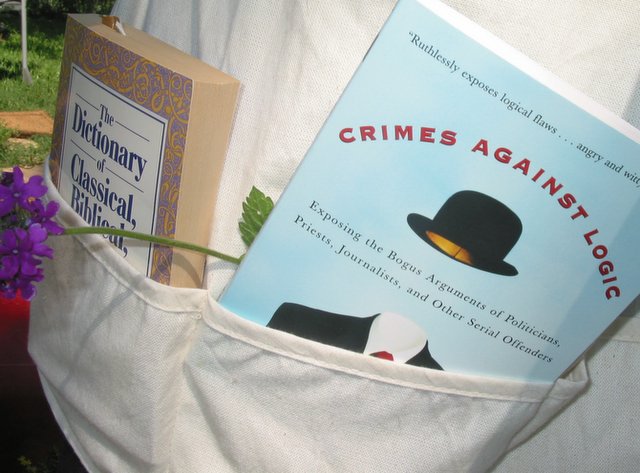
Whyte, Jamie. Crimes Against Logic: Exposing the Bogus Arguments of Policitican, Priests, Journalists, and Other Serial Offenders. Another look at reasoning fallacies with plenty of examples. I always enjoy this sort of thing (although a frequent offender and dupe of several). Not that the book was as informative or amusing as promised, but this quote about being "entitled to my/your opinion"appeals to me: "...a mindset that increasingly impedes the free flow of ideas and their robust assessment. Many people seem to feel that their opinions are somehow sacred, so that everyone else is obliged to handle them with great care. When confronted with counterarguments, they do not pause and wonder if they might be wrong after all. They take offense. ...a serious obstacle to those who wish to get at the truth."

Reuben, Shelly. Tabula Rasa. Hmmm. What to say? I enjoyed it, but found it a mix of fantasy and magical realism in what is purported to be a mystery. Is that possible? I don't know... I thought the characters were fun, but they really seemed to be something out of a witty fairy tale or maybe a kind of Nick and Nora effect? Nick and Nora Charles, that is, not the sleep wear (which I do like!).

Atkinson, Kate. Case Histories. Three seemingly unrelated and unsolved tragedies begin to unravel themselves as Jackson Brodie unintentionally finds that they were knit together in unexpected ways that no one suspected. A most unusual detective story that recounts human failures and human determination and, in the end, a kind of redemptive solution.

Goodman, Carol. The Ghost Orchid. I read The Lake of Dead Languages several years ago and enjoyed it. The plot of The Ghost Orchid focuses on a young novelist (with psychic abilities and a medium for a mother) who has been invited to an artist's retreat in a Victorian mansion and finds the past intruding on the present. Ghosts seeking closure, Munchausen by Proxy, fountains and grottos, tunnels and spy holes. Past is Present...or whatever.

Kellerman, Jonathan. Gone. Typical Kellerman. Lurid, but fast reading. I used to enjoy his books, but each one seems to attempt to "out do" the previous with graphic, sensational stuffing and little meat.

Gray, John MacLachlan. White Stone Day. Lewis Carroll wrote the following words in his diary: "I mark this day especially with a White Stone." Since the author used much from Lewis Carroll's life, times, and surroundings as inspiration for this murder mystery, it is appropriate, perhaps, that he took the title from this quote. A Victorian mystery that examines the underside of the proper Victorian society, it contains 2 darkly humorous villains in Mr. Robin and Mr. Weeks, a less than entirely sympathetic protagonist in Edmund Whitty, a creative and courageous child-woman in Emma, an amoral duke, and various other characters, mostly unattractive. The back jacket compares this novel to Caleb Carr's The Alienist...there are similarities in style and content.

Karon, Jan. Out to Canaan. The fourth in the Mitford Series. I'm still enjoying these.

Karon, Jan. These High, Green Hills. The third in the Mitford Series.

Sunday, April 09, 2006

April reading

Tan, Amy. Saving Fish from Drowning. Not typical Amy Tan and not my favorite by any means. The "note to the reader" at the beginning details Tan's intriguing involvement with the subject matter...when circumstances (serendipity, synchronicity) led Tan to look for shelter from a summer storm in the "American Society for Psychical Research." The "note" hooked me, but much of the novel was slow and less than scintillating. The premise, however, had promise. :)

Harris, C.S. What Angels Fear. Set in Regency England, this novel is billed as historical suspense. Nothing earthshaking, but a fun read.

Karon, Jan. At Home in Mitford. My aunt gave me seven of the Mitford novels, and I started reading with some trepidation, but quickly found that I enjoyed them. They are a bit "Pollyanna-ish," but right now that is the sort of thing my life can use. Father Tim, an Episcopal priest, and the residents of Mitford have a number of low key adventures, strong community feeling, and a religious outlook that is refreshing.

Karon, Jan. A Light in the Window. The second in the series that continues the stories of the various inhabitants of this small North Carolina town.

Vine, Barbara. Minotaur. Although very early on I suspected what the problem with John must be, I would not have known, say, ten years ago. The novel takes place in the 1960's and the diagnosis would have understandably been more difficult at the time--although it was first diagnosed (or labeled) in the 1940's, I believe. Alternately called a disorder, syndrome, and disease, there are more cases now. I don't want to reveal the disorder, but it truly is fascinating and on the rise.

Robinson, Peter. Aftermath. Another Alan Banks. Of course, I enjoyed it, even if some of this one was particularly difficult.

McCarthy, Cormac. No Country for Old Men. The dialogue is sometimes difficult to follow, but the story is intense. Llewelyn Moss stumbles across the scene of a drug murder in the desert and decides to take the money. The violence that ensues is perhaps typical of the drug world, but sends Sheriff Bell into frequent ponderings about the state of society. McCarthy drives home the fact that the dealers are not the only ones responsible for all of the problems created by drugs and drug dealing. There is a market that will be exploited, and those who provide the market are also to blame. I really liked Sheriff Bell, and he is from another time when violence was not as commonplace as now. He is the old man who struggles to understand societal changes that have transformed the country in his lifetime.

McCarthy has won the National Book Award and the National Book Critics Circle Award. I read All the Pretty Horses years ago, but this first book by McCarthy I've read since then.

Furst, Alan. Dark Voyage. A novel that could easily pass as historical reality so skillfully is the story told. "In the first nineteen months of European war, from September , 1939, to March of 1941, the island nation of Britain and her allies lost, to U-boat, air, and sea attack, to mines and maritime disaster, one thousand, five hundred and ninety-six merchant vessels." In April, 1941, the captain of a Dutch freighter is recruited for clandestine activities by the Intelligence Dept. of the British Navy. One word used on the jacket to describe this novel is "authentic." It sure felt that way to me.

Wood, Lee. Kingdom of Lies. I enjoyed this mystery; the first I've read by this author.

Barron, Stephanie. Jane and the Stillroom Maid. Enjoyed this light little mystery featuring Jane Austen as a sleuth. I've read a couple of these, and I've found Barron's Austen a bit of a stretch, but fun reads.

McKillip, Patricia A. Od Magic. Fantasy novel. Felt rushed. Pretty much the way I would feel if I had to write a novel: keep it moving and get it finished . As a reader, however, I don't want to feel rushed.

Willig, Lauren. The Masque of the Black Tulip. Why I finished this one is a conundrum. I started not to even list it. My standards for escape literature are not very high, but this one failed to meet my ridiculously low standards...which doesn't explain why I bothered to finish.

Thursday, March 30, 2006

March, updated 3/31

Bannister, Jo. Echoes of Lies. The first in the Brodie Farrell mysteries.

Bannister, Jo. True Witness. The second book in the series. Have now read all 5 in the series - working backward. Bannister has published one a year starting in 2001, so this year should produce another one. I've enjoyed all of them.

Oyeyemi, Helen. The Icarus Girl . I chose this book based on the title and the cover. Oyeyemi completed the book before she was nineteen. Impressive. And, hopefully, a promise of things to come. The Greek myth of the title is subjugated to the myths of Nigeria, but does surface in a compelling blend of mythology. Jessamy, an eight year old girl with a vivid imagination, a burning intelligence, and some emotional difficulties, is an intriguing protagonist. The psyche, the myth, the doppelganger...

Grabien, Deborah. Matty Groves. Thought I'd like this because it was a mystery connected to old ballads, but I'm not even going to bother with a link.

Robinson, Peter. Close to Home. Rayna Gillman recommended this author, and I'm glad I remembered his name when I went to the library because I forgot my list. Had actually read one of these before and liked it (but didn't remember until I started the book), so it was good to catch up with Inspector Banks and Annie. And just in case it did turn out to be good, I got 3 while at the library and have 2 more to read! Since the Banks/Annie relationship is over--although they continue to work together--I will be interested to see if Banks has better luck with Michelle (who, like Annie, has her own baggage).

Jenny White. The Sultan's Seal. I liked this one because of its view of the Ottoman Empire in the late 1800's. White is an anthropologist and has written several non-fiction works, but this is her first novel and a very skillful one. Her characters have substance, both personal and cultural, and the novel gives an intimate look into a complicated society divided between its own tradition and the English influence. There is a mystery, but the mystery of a divided culture is the most important aspect.

Reichs, Kathy. Deadly Decisions. I'm not much interested in biker's or biker murders. Not my favorite Reichs' novel.

Robinson, Peter. Playing with Fire. Follows Close to Home with Inspector Alan Banks. Dysfunctional families, fire, murder, and art forgery. Good mystery.

Bannister, Jo. The Fifth Cataract. The Clio Marsh series. Not nearly as interesting.

Picoult, Jodi. The Tenth Circle. Although I was interested in the graphic novel approach and love Dante's Inferno, this novel just failed to seem anything other than contrived. Picoult fans will probably disagree, but jeez the family members here are so self-involved that they really have a peculiar flatness. After finishing and thinking back on it, nothing really hung together for me. Picoult offers up the idea of self-deception, but I'm not sure but what the characters were exactly what they seemed. The graphic novel was the best part; the text was a graphic novel that didn't translate. The issues are important, but the novel is trivial. And it will make the best seller list.

OK - just read several reviews, mostly glowing, but Library Journal gives it a rather ambiguous thumbs' up, with the comment "...but something here just missed its mark. Still, this best-selling author is going to be in demand."

Kirkus Reviews: "Picoult fumbles in this 13th novel of, predictably, a family in crisis.... Picoult, who is so often an inventive and compelling storyteller, relies here on convention and sentimentality."

Maybe that is my main problem - I expected more from Picoult. Much of my reading is of the bon-bon kind and when they fall short, I'm not really disappointed. Here, however, I fully expected something more.

Robinson, Peter. Strange Affair. Back to a mystery that is pure escapism and fun. I enjoy seeing the characters getting on with their lives. The three I've read this month were in chronological order and the most recent in the series. There are, however, about 12 more.

Tope, Rebecca. A Dirty Death. Some interesting elements.

Darnton, John. The Darwin Conspiracy. Five or six years ago, I read Annie's Box: Charles Darwin, His Daughter, and Human Evolution by Randal Keynes, Darwin's great-great-grandson who discovered a writing box owned by Annie that contained some of her treasures and notes by Darwin. (They have since shortened the title and changed the book cover) It was fascinating to read details of the Darwin family life documented by Darwin's notes, letters of friends and family, and accounts published at the time. This novel is an interesting fictional theory, and the author's bibliography is impressive as he lists over 30 well known books on Darwin including Annie's Box and Darwin's own published works (The Voyage of the Beagle, Origin of Species, etc.) Darnton, who won a Pulitzer for his journalistic work, has written a fictional account about the reasons Darwin waited 22 years to write On the Origin of Species. My only problem with this novel is my own lack of knowledge; although he used Keynes' work, little of what composes his theory connects with what I remember of the book. I would like to know if there is evidence for the theory, or if he just used the research to lend factual detail to his fictional account...

de los Santos. Love Walked In. ChicLit with one character who appealed to me. Here is a separate entry on this novel...just because I was initially enchanted by Clare.


Rendell, Ruth. 13 Steps Down. I enjoy Rendell's novels even though they almost always make me uneasy and anxious from the first page. Her characters are studied as if they are bugs under a microscope, and thye are more likely to be scorpions than butterflys. No mystery, we know who does what, but an explication of sorts. Psychological suspense.

Muller, Marcia. Cape Perdido. Not a Sharon McCone mystery, but one that deals with environmental issues.

---------
I finally abandoned Ghostwriter on page 313. I liked the way the stories tied together, but didn't like a single character. Also decided that Arthur and George was not for me. Not even the Conan Doyle character could entice me back. Unusual for me to abandon books (maybe 1/50 books will not be finished), I will plod through some stinkers, but I kept finding myself reading (or doing) anything else as they gathered dust. Reluctance that strong must mean something. The books have one thing in common, they fail to engage my interest (and hey, I'm pretty easy), but the authors also have a certain disengagement from their own characters. It wouldn't surprise me that readers who like one, would like the other -- and both Michell and Barnes have plenty of followers out there.


Still reading The World Is Flat and am learning all sorts of things. This book is difficult for me in some ways because the computer and software workings are beyond my ken. And so is economics, for that matter. Friedman, however, balances the technical with break-downs that technodunces such as myself can almost grasp and with enough purely human examples that are both easily understood and interesting.

Monday, March 27, 2006

Cornelia and Clare

I'm reading Love Walked In. A strange choice for me as far as title, but I was first attracted by the cover of a child with brown Mary Janes, and brown knee socks - one gathered around her ankle, the other higher, yet not up to the knobby knees, the brown school uniform, the ivory windbreaker. The picture is from her shoes to about midchest, but doesn't show her face. I liked the cover, but almost put it back because of the title. The author's name, though, is Marisa de los Santos. OK - great cover and lovely name. I really like that name. Pick up the book and look at the back cover and there is de los Santos's picture. Hmmm. I like the way she looks; her eyes are bright and have a hint of smile. And she is an award-winning poet with a Ph. D. in literature. So the cover, her name, the photo, and her credentials said, "Try it."

The first chapter- "Cornelia" - almost lost me. Oh, Romance. I didn't think this would be worth the effort. Foreshadowing is an excellent technique, but should be sotto voce, not loud or direct. The second chapter, however, was "Clare" and here is the beginning of interest. Clare is in the fifth grade and sort of "collects' orphans: Anne Shirley, Sara Crewe, Mary Lennox. Oh, yes, I know these orphans. And More: Heidi, Pippi, Tom and Huck, David, Pip, Estella, Oliver, the Boxcar Children! Why even Heathcliffe and Hareton and Jane Eyre. Harry Potter, the Baudelaires, Scout and Jem.

Well, I'm in for the count with Clare. Then it's Cornelia's chapter again...hurry, let's get back to Clare. First, though, a side bar. Cornelia's life imagery centers on old movies. Clare's on her reading. She sorts things and people into categories and discovers that girls "seemed to fall into two categories: girls who used sweetness and girls who used pluck. Little Women contained both kinds of girls." We all know that - Beth and Jo. Sweetness and Pluck.

Cornelia again.

Back to Clare. Clare decides her only choice is pluck and comes to realize that "just because someone can't notice that you're being mean, doesn't mean you're not..." and makes a list of "People who had let life make them hateful. The characters no one wanted to be." Here she puts "Miss Havisham, Aunt Sponge and Aunt Spiker, Miss Minchin, Uriah heep, Voldemort, and Snape."
---------
Finished, and as much as I love Clare, the novel is strictly ChicLit. At first, I was eager to get throught the Cornelia chapters and back to the Clare chapters, but toward the end, there was little separation. Predictable novel inspite of attempts to provide twists.

However, I like this poem by de los Santos:

Milagros Mourns The Queen Of Scat
Cebu City, Philippines


It is the same each time. Daylight a broad blade
across the floor, then thin, then gone, the door

shutting behind her, the dimness undisturbed.
This church is cool if anyplace is cool

and almost empty. A few prayers, soft moths,
hover above a few bent heads. She kneels,

a series of flinches. Milagros misses
--sharply--grace, her body's old amplitude,

misses, too, a woman, an American,
she knew only as a voice, a story

in a magazine, photographs. In one,
a man beside her holds a trumpet,

and she makes singing look like laughter. From one,
her eyes gaze out, swimming, behind glasses.

The Virgin, blue vertical, occupies
a corner, hands lifted slightly and turned

up, as if to demonstrate their emptiness.
Her face is inward as an almond. The singer

also had a son, Milagros remembers,
and wonders, suddenly, about the soul

and those long intervals, bridges of pure
sound, spontaneous, leaping free from words.

Voice of cold evenings, fur-collared coats,
glittering towers, snow. Voice of dancing.

Voice a refusal of death. She heard it
and felt the atoms of her body shimmer,

along with all the struck, shimmering atoms
of the air. Voice like pomelo, mango,

jackfruit, papaya, voice like slow ripening,
gold juice, orange meat. Voice changeful as water.

Milagros knows it is her own voice, the one
she never used. When she walks home, her feet

will displace dust into the air; her dress,
a long fall of cotton, purple and yellow

batik, with a square neck, will swing below
her clavicle. She will buy warm, dense rolls

and eat one as she walks. She will shout
and shake a stick at dogs. It's time to leave.

Milagros stands. Slight exahalations rise
from the candles, each one breathing miracle .

Wednesday, March 01, 2006

Back to something I enjoy...

The 3 are still in progress, but I'm not really wanting to read them. Last night, to treat myself, I started the first in the series about Brodie Farrell and Daniel Hood by Jo Bannister. I like these little mysteries and have read 3 , but I now have the very first one and the second. Often have to read series backward, and while I might rather start at the beginning, it rarely presents a problem.

Will continue trying on Arthur & George and Ghost Writer, but they may have to be abandoned. A & G came to the point where George is going to be falsely accused and it said "they were the last normal 24 hours of his life." Mmmm. The harassment he has already endured is stressful to me, I'm not sure I need more. Ghost Writer is in separate stories, but beginning each new one is not compelling. The World Is Flat is fascinating, but often technical; it is also mine, not the library's, so I'm comfortable reading a chapter at a time without the sense of being rushed.

Tuesday, February 21, 2006

February

I'm in the middle of three works right now, but these are the ones I've finished.

Jo Bannister - Reflections and The Depths of Solitude - Read one of Bannister's last month and liked it, so two more. These are called Brodie Farrell mysteries, but they aren't really; they are Daniel Hood's novels. His character is the real meat.

David Baldacci - Saving Faith

Stephenie Meyer-- Twilight - Not Joss Whedon, but has room for future vampire adventures and for back story.

Carolyn Haines - Judas Burning

Reginald Hill - The Stranger House -I ended up liking it, but it was a little slow in the beginning and the idea of stigmata made me a bit wary. A bit of the supernatural, priest holes (ah, I always love priest holes and hidden rooms), the real and tragic event of the exportation of British orphans to Australia, mathematics and religion... Not as good as the Dalziel and Pascoe novels which are some of my very favorites.

Martin Davies - The Conjurer's Bird - "in the spirit of Possession" says the jacket blurb. And it is. Less complicated and a quicker read than Possession, but still quite fun if you like parallel stories and time periods and searches for lost objects - which I do. The author's note at the end was particularly enlightening as only then did I realize that "The Mysterious Bird of Ulieta" really WAS discovered on Cook's 1774 expedition of the South Seas, that Joseph Banks was a British naturalist

(damn, I just realized that at some point, I lost an entire edited post) - part of previous paragraph is gone and the entire paragraph about the Painted Veil is gone and it was one of my favorites (book and review). Oh, well, add something later, but I liked the Painted Veil.)

Pari Noskin Taichert - The Belen Hitch - won't be looking for any more of her books.

Still reading The World Is Flat by Friedman, The Ghost Writer by Mitchell, and Arthur & George by Barnes.