Search This Blog

Showing posts with label post-apocalyptic. Show all posts

Tuesday, August 25, 2020

The Trials of Koli by M.R. Carey

M.R. Carey's books are strange and fascinating.  Earlier I read and reviewed The Book of Koli and was eager for this second book in the Rampart trilogy.  Read The Book of Koli first to get the background because this is one of those trilogies that requires an introduction to the post-apocalyptic world and the characters.  It's worth it.

from description:  "Koli never planned to set foot outside his small village. He knew that beyond its walls lay a fearsome landscape filled with choker trees, vicious beasts and Shunned men. But when he was exiled, he had no choice but to journey out into this strange world where every moment is a fight for survival.

And it’s not just Koli’s life that is threatened. Whole villages just like his are dying out.

But Koli heard a story, once. A story about lost London, and the mysterious tech of the Old Times that may still be there. If he can find it, there may still be a way for him to change his own fate – by saving the lives of those who are left."

The Trials of Koli takes Koli, Ursula, and Monono forward on their journey to London.  They are joined by Cup, first as an unwilling prisoner, later as part of the group.  The journey is dangerous and the threats from man and nature are plentiful, but working together the group weathers the hardships and the damages inflicted.

Interesting (and surprising to me) was the addition of a second voice.  Spinner, Koli's friend in Mythen Rood who married a Rampart, begins a second narrative about what happened in Mythen Rood after Koli's exile.  While her experiences are vastly different from those of the group headed toward London, they are just as fascinating and informative.

I've been a fan of M.R. Carey since The Girl with All the Gifts, and I've appreciated both books in this new trilogy.  Now, a wait for the final book.  I do hate waiting.

Read in May; blog review scheduled for Aug. 25.

NetGalley/Orbit Books
Post-Apocalyptic.  Sept. 15, 2020.  Print length:  480 pages.

Friday, April 10, 2020

The Book of Koli (Rampart Trilogy 1) by M.R. Carey

The Girl With All the Gifts and The Boy on the Bridge were books that I loved and that have stayed with me.  Now, Carey has a new trilogy, the first of which is The Book of Koli.

Koli begins by telling us that he has to start at the beginning to tell his tale.  He then recounts his life in Mythen Rood, a small village that struggles to keep safe in a post-apocalyptic world.  

At first, he is Koli Woodsmith, and describes his family, friendships, and much about how the village operates.  Then, at fifteen young people take a new name, and he becomes Koli Waiting.  Those who turn fifteen take the name Waiting as they are housed together waiting for the test that will determine whether of not they become Rampart.  Most young people desperately want to become Rampart because a Rampart can "awaken" the few pieces of tech that have survived.  The Ramparts have a rarefied place in society and are charged with the protection of the village in several ways because certain tech weapons have "wakened" to them.

The beginning is a little slow, but as Koli reveals information in his own particular order, mentioning characters and events, then saying he will get to them later, as he attempts to tell his story in a chronological frame.  Gradually the narrative picks up speed and interest until the reader is immersed in Koli's world and events.

Koli suffers a disappointment at the Testing and realizes he is not able to become a Rampart, and when this is followed by another disappointment, circumstances combine to reveal a shocking truth:  the Testing is not fair and has never been.  Koli, frustrated and angry, makes some choices that will have consequences and long-term effects.

There is an honesty to Koli's account of events.  He includes his mistakes and his shame for some of his behavior, even though he acknowledges his youth, his immaturity, and his lack of knowledge (a result of the isolation of the village).  He gives accurate descriptions of his friends and fellow villagers instead of vilifying them.  The coming-of-age element is an important part of the narrative, especially as Koli meets Ursula and Monomo, and begins what Joseph Campbell refers to as the hero's journey.

OK.  The Book of Koli was a fascinating beginning to the Rampart Trilogy, and if you have enjoyed M.R. Carey's previous books, you may find this one as intriguing and thought-provoking as The Girl With All the Gifts and The Boy on the Bridge.   I can't wait for the next one.  Recommended!

NetGalley/Orbit Books
Dystopian/Science Fiction.  April 14, 2020.  Print length:  416 pages.


Monday, June 03, 2019

The Girl in Red by Christina Henry

Like dystopian novels?  Fairy Tale retellings?  The Girl in Red combines both and exceptionally well.

First there was the Cough, which spread rapidly depopulating areas almost before the danger could be processed.  Red, who has a fondness for science fiction and post-apocalyptic novels and films, considers the situation serious long before others do.  She plans to be prepared and works to convince her parents and brother of the worst-case scenarios.  In the months that pass, things get worse, and by the time Red is taken seriously, it is almost too late.


Eventually, Red convinces her parents and brother that they should go to her grandmother's house, but they need to walk, not drive, avoiding contact with the infected--staying away from populated areas and highways.  A 300 mile trek through the woods and rough country is a daunting scenario, but using everything she has learned from watching films and reading books, Red has a mental idea of what would keep them safe.


The Girl in Red is divided into sections Before the Crisis occurred and After the Crisis changed everything about their former lives.

Of course, plans go awry from the beginning.   No matter how many dystopian and post-apocalyptic novels you've read, circumstances bring new challenges, losses, predators, and unanticipated horrors.  If the Cough was first, the new threat is worse--and man-made.


Oh, and to make things more difficult, Red has a prosthetic leg (because a post-apocalyptic world isn't dilemma enough). 

 "Over the river and through the woods,/To grandmother's house we go...."

Since I like both dystopian novels and fairy tale retellings, I was eager to read this The Girl in Red and found Red and her journey engrossing, satisfying my appetite for both genres.  My only problem is that I genuinely want more of this world and of Red.

Read in May; blog review scheduled for June 3.

NetGalley/Berkely Publishing
Dystopian/Post-apocalyptic.  June 18, 2019.  Print length:  304 pages

Monday, June 27, 2016

The Last One by Alexandra Oliva

The Last One by Alexandra Oliva is a cross between a reality survivor show and a genuine catastrophe, a pandemic of which the contestants and even the crew in their isolation are unaware.  The illness is widespread and rapid, and people die so quickly that there is little apprehension or appreciation of the danger until the population is decimated.

Twelve contestants, who have been given short epithets connected to their careers (Doctor, Tracker, Waitress, Engineer, Zoo), have been chosen to participate in a reality show that will challenge them mentally and physically.  They are all secluded in a wilderness area and unaware of what is going on in the outside world.

The story alternates between the chapters about the challenges the contestants face and the POV of Zoo, a young woman who wants a last big challenge before she and her husband settle down to start a family.

There is unnecessary confusion about who the contestants are.  Zoo will refer to them sometimes by the reality show moniker and sometimes by their real names.  Eventually, some of the characters become clearer, but this uncertainty prevents a real connection to most of the contestants.

 Everything from the reasons the contestants have been chosen, the names assigned to them, the way the film is edited to present a particular point of view and "good television"(regardless of the context).  Incidents are scripted, staged, and amended.  In the meantime, Oliva does the same to her readers, keeping them off-balance.

Eventually, Zoo continues alone in what she believes is a solo challenge.  The stress of the various challenges, an illness she believes the result of polluted water, lack of food, and lack of rest have diminished her ability to reason well, but she refuses to say the words the producers gave the contestants that would signal her desire to quit.  She is determined to finish, and she keeps walking, using every skill at her disposal.  Any question she may have about the changes she sees, she attributes to the show's script, to props, to the theatrical exploitation of both contestants and audience.

An absorbing glimpse at the way we are manipulated by media (more obviously by reality shows--but only slightly more subtly by press, propaganda, and politics).  

A couple of things did bother me, but they would be spoilers, so I'll ignore them for this review.  

Review scheduled for June 27, 2016.

NetGalley/Random House/Ballentine

Suspense/Post-Apocalyptic.  July 12, 2016.  Print length:  304 pages.

Monday, May 02, 2016

The City of Mirrors (The Passage #3) by Justin Cronin

The City of Mirrors by Justin Cronin concludes The Passage trilogy.  If you've read the previous books in the series, you realize that the books are very long and that there are a great many characters.  The Passage was published in 2010, The Twelve was published in 2012, and this final book will be available May 24, 2016. 

 So...I wish I had reread the series from the beginning before starting The City of Mirrors; there are so many characters and so many years pass between books.  (A suggestion to those of you who are hooked on the series, at least review the first two books before reading the final installment.  :) Another tip:  it is still offered on NetGalley and there is a give-away on Goodreads.)  If you haven't read the earlier books, read them and save this last one for later.

Fortunately, I remembered enough scenes so vividly that the characters and events came back pretty quickly, but I still wished I'd reread the previous books, especially The Passage, which remains my favorite.

OK--The Twelve have been vanquished, and for years, nothing has been heard from Zero. The author brings the reader (not the characters) up-to-date about Zero, devoting nearly 200 pages to filling in his backstory.   Does it evoke empathy?  Is/was Zero an evil monster?

The beginning is a little slow, partly because the reader has to re-acclimate to characters and events, but eventually all of the familiar characters' lives are fleshed out.  

Alicia of the Blades and Amy have disappeared and life in Kerrville has gone on without them.  While the other characters wait and wonder what happened to them, the reader is much more informed.  Years pass; the lives of characters change with the times.  Kerrville grows, then depletes, as years go by without viral activity and people form new settlements and townships, moving outside the walls.  

Peter, Michael, Hollis, Sarah, and Greer's roles also change over the years, and a few new characters are introduced.  People eventually begin to believe/hope the world is safe again.

Lucas Greer has a vision, and he and Michael work to make it happen.  Peter Jaxon continues his role as leader, but in a different capacity.  Children grow up.  

Time, however, is growing short.  Something is coming....

It is easy to become involved with the characters, especially those who have been there since the beginning.  We already feel as if we know these people, and we certainly care what happens to them.

 The premise of a military experiment gone wrong (as explained in the first book) is believable and frightening.  The perversion of science to the point of threatening humanity is certainly not a new theme, and yet Cronin's world-building and character development can place the reader firmly in this dystopian framework.

I'm happy to have this epic trilogy completed and to have the details of so many characters wrapped up.  There were a few things that bothered me, but I'll omit them for now;  I'd like to see how others feel about the novel.   Overall, I'm satisfied.

Read in April; blog post scheduled for May 2

NetGalley/Random House/Ballantine

Dystopian/Post-apocalyptic.  May 24, 2016.  Print length:  624 pages.

Tuesday, July 14, 2015

Yesterday's Gone by Sean Platt and David Wright

The authors have a definite bias toward writing serial fiction.  :)  Like Dickens and Wilkie Collins and Alexandre Dumas in the 19th century.  Like Lost and Downton Abbey and Buffey on television. Well, maybe not exactly, more like The Walking Dead. The idea is to release the story in installments, and today, the popular mode of dissemination is the internet.  

I didn't read them in installments, though; I read by season when they were offered on NetGalley.

Yesterday's Gone (Season One)

Survivors of an apocalyptic event struggle with the loss of their families and the terrifying creatures that roam a landscape now curiously devoid of life.  Multiple characters in various locations must re-evaluate their world when at 2:15 AM on Oct. 15, almost everyone vanished.  

There are the good, the bad, and the hideous.

Entertaining, sometimes offensive, and weird.  

NetGalley/Sterling Stone

Post-Apocalyptic.  2011.  Print length:  500 pages.


Yesterday's Gone (Season Two)

While I found the first season entertaining, I found season two much less so.  The connection to season one was confusing, Boricio's role is simply abhorrent even with a twist at the end, too much violence, too little character development, and the plot becomes more complicated, not more complex (a considerable difference).

There are six seasons published so far, and I may read another season if offered on NetGalley, but I'm no longer really curious about what happens.

NetGalley/Sterling Stone

Post-Apocalyptic.  2013.  Print length:  514 pages.


Monday, August 25, 2014

Station Eleven by Emily St. John Mandel

Station Eleven is a dystopian novel, but one with an important theme that I have not seen in the many other dystopian/post-apocalyptic novels I've read.  And the theme is what resonates most with me, setting the novel apart from others in the genre:  "Because survival is insufficient."

The quote comes from a Star Trek: Voyager episode and is adopted by Kirstin, an actress with the Traveling Symphony troupe that travels from outpost to outpost taking Shakespeare and music to the survivors.  A child when the Georgia Flu epidemic hit and decimated the world's population, Kirstin has the quote tattooed on her arm--a reminder that there is more to life than simply managing to survive the devastation and chaos caused by the collapse of society and the infrastructure that supported it.  

The little band of actors and musicians bring the beauty of art and culture to the settlements that have arisen in the fifteen years since the collapse.  It is a dangerous world,  one without hospitals and medicine, with violent bands of marauders and unfriendly settlements, where any mishap can lead to death.  Yet the troupe members feel compelled to practice their arts and to share them whenever possible. Because survival is insufficient -- there must be more to feed the soul, the heart, the mind.  The players and the audience both need the reminders of music and art.

So...how does all of this begin?  With Arthur Leander, an actor playing King Lear; an audience member who sees a situation and jumps on the stage to give aid; a child actor to whom Arthur has been kind; an ex-wife and graphic novelist; and the onset of the Georgia Flu which floods the hospitals which are helpless and unable to stem the rising death toll.

The stories are revealed piecemeal as the book moves back and forth in time:  before the pandemic, the onset that sets our players in motion, and the aftermath, fifteen years later. Mandel manages all of these stories and their backgrounds seamlessly, connecting and inter-connecting them.  An interesting element in the novel involves what people remember from "the time before," what they miss; how old a survivor was at the time of the collapse is important, and the youngest survivors have limited memories, unsure of even those.

And Station Eleven?  Station Eleven is a limited edition graphic novel that plays an important role in several lives and provides its own parallel story.  Art, music, drama, literature, story telling...how important are they in what we consider civilization?

Recommended.

NetGalley/Knopf/Doubleday

Dystopian/Post-apocalyptic.  Sept. 9, 2014.  Print length:  352 pages


Wednesday, August 22, 2012

Two by Paolo Bacigalupi

After hearing Paolo Bacigalupi's Comic Con interview on NPR, I ordered two of his books:  Ship Breaker and The Windup Girl.

I read Ship Breaker first and enjoyed it; however, I'm not sure it rates as a novel, even a YA novel--more like a long short story or novella.  It was interesting to see some possibilities of a post-apocalyptic world, but the story gives no hint of how this "new" world developed.  Yes, the seas rose, but that doesn't give ample explanation for the situation.

Brief synopsis:  Nailer is an adolescent boy who works for a crew that scavenges oil tankers.  (These tankers have been abandoned after whatever apocalyptic event occurred.)  Live is harsh and basic, the strong prey on the weak, survival is paramount for most individuals.

When Nailer discovers a wrecked clipper ship driven on shore by a powerful hurricane, he thinks he has made a Lucky Strike that will provide the means for him survive and to escape his drunken, abusive father.  What he finds, in addition to the dead crew, is a young girl who has survived.  The girl presents a dilemma for Nailer:  if he lets her die, his chances of making the most of his Lucky Strike are much greater -- if he rescues her, he may lose any chance of a better life.

Although I enjoyed the action, the world Bacigalupi builds seems like a facade.  You know, the kind of Western town in movies that has all the fronts of the buildings and nothing behind them.  The scavenging makes sense in Nailer's world, but the tremendous contrast between the "Corporate" world and the poverty and lawlessness of Nailer's environment is never explained or examined.

dystopian novel.  2011.

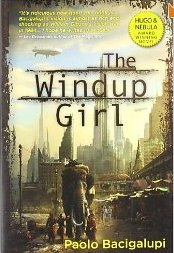
The Windup Girl, on the other hand, is definitely not a YA book.  Despite the novel's having won both the Nebula Award and the Hugo Award for best 2010 novel, I can find little to recommend it...unless you enjoy violence and degradation.

Another dystopian novel, this one takes place in Thailand after the whatever apocalyptic event has taken place.  While both Bacigalupi's world building and prose are widely praised, I didn't find either satisfying.  The characters are thin stereotypes and none of them are really likable.  It is a disturbing story and often very slow; sections feel padded with sentences and paragraphs that fail to add anything new or important.  The dialogue is stilted and the psuedo-science of kink springs, etc. failed to make sense to me.

I admire Bacigalupi's attempts (in both novels) to point out some of the dangerous policies of societies and governments, some of the threats and consequences of climate change, and some of the scary practices of big agriculture.  Unfortunately, not much in The Windup Girl worked for me.  This is just my opinion--I know many people love this novel.

dystopian novel.  2011

Monday, October 03, 2011

Ashes of the Earth by Eliot Pattison

Ashes of the Earth is a dystopian novel.  I'm going to make this a short review for two reasons:  I read it over a month ago, and I was disappointed in it.

I've read three of  Pattison's political thrillers about Tibet.  I loved each one.  They were complex and educational and exciting and full of adventure in the Tibetan mountains.  The novels are about a former Chinese investigator who looked too closely at situations he should have overlooked and ends up exiled to a "gulag" in Tibet.  As a prisoner, he becomes influenced by the Buddhists Monks who are his fellow prisoners and also condemned to forced labor.  The Skull Mantra begins the series, and I loved each of the three books in this series that I have read.


For this novel, however, I'm going to resort to a canned review from Publisher's Weekly:


Having successfully portrayed both modern-day Tibet and Colonial America in two series, Edgar-winner Pattison (Eye of the Raven) launches a third with this brilliant if grim mystery set in the 21st century 25 years after global mega-acts of terror have destroyed all U.S. government entities and almost all infrastructure. Hadrian Boone, one of the cofounders of the struggling colony of Carthage, located near the Great Lakes, is one of those who remembers the former world, as the time before the apocalypse is referred to, but he's on the outs with the community's leaders and on the verge of being exiled. The chance discovery of a body triggers a series of events that reintroduces murder and other crimes to a community reliant on 19th-century technology. Boone's efforts to find the truth and what it implies for Carthage's future put him in harm's way time after time. Pattison blends the bleakness of The Road with a well-crafted whodunit plot for another winner.


I didn't really like the feel of the novel and found the protagonist Hadrian Boone too difficult to believe in.  


On the other hand, I'm reminded of how much I admired the Tibetan series.  These novels are long and involved, complex, frightening, thrilling...and show the horrors inflicted on Tibet as the Chinese try to eradicate the Tibetan culture.


Other opinions:  King of the Nerds, Mystery Maven Blog, --these and other reviews I found are all positive.  I'm odd-man-out.


Fiction.  Post-apocalyptic, Dystopian.  2011.  400 pages.

Monday, May 23, 2011

The Hunger Games by Suzanne Collins

The Hunger Games has been on my radar for a while (so many people have read it and posted positive reviews about this trilogy), but I've only just gotten around to reading it.  I wasn't disappointed in this YA novel.

Set in a post-apocalyptic era, the annual Hunger Games are approaching, and everyone is nervous.  Two young people from each district are chosen to compete until only one survives, as both a means of government control and entertainment.  The Romans had nothing on this dystopian society. 

When Katniss' younger sister Prim is one of the two chosen by lottery, sixteen-year-old Katniss volunteers to take her place. The other lottery "winner" from her district is Peeta, a school mate who once did Katniss a good turn that helped her family survive.

However, since only one individual survives the Hunger Games, Katniss and Peeta will be pitted against one another as well as against the tributes from the other districts. Twenty-four young people will enter the arena with the intention of killing the other participants.

You do have to suspend disbelief, but once you accept Collins' world of Panem, it is easy to become involved with both Katniss and Peeta's attempts to survive as long as possible. 

I'll have to get the next two books in this trilogy because I do want to know what happens next.

There are some similarities to John Marsden's series Tomorrow When the War Began, but also some major differences.  Instead of having a group of teenagers working together against the invaders of their country, these young people are pitted against one another. I have to admit that I enjoyed Marsden's first novel more, his characters all jump off the page, and I loved the whole series.

However, I DID enjoy The Hunger Games and look forward to Catching Fire.

Fiction. Dystopian/YA. 2010.  384 pages.

Sunday, January 09, 2011

The Passage by Justin Cronin

The Passage is a dystopian novel that begins with a horrific military experiment that, bad as it is to begin with, ends up essentially destroying the known world.  It has lots of flaws and is exceptionally long, but I was engrossed from beginning to end.

The experiment gone awry produces almost invincible vampires, but not the beautiful, sexy vampires in most of today's fiction.  These deadly creatures are hideously ugly and insatiable, destroying or converting their victims into their own image.

Civilization is reduced to chaos and survivors have to begin again in the most primitive manner as attempts to destroy the "virals" have led to warfare that has destroyed the infrastructure that modern man takes for granted.  

The novel begins in a world in the not too distant future, but then resumes nearly one hundred years later.  A few colonies of survivors exist, but in situations mostly pre-technology, and while the colony the novel focuses on does try to find others, they have been unsuccessful.  Roads have been destroyed or left to the vagaries and ravages of nature, cities mostly destroyed, virals roaming beyond the barricades... a pretty much pioneer society.

Into this failing society, comes a strange girl.  One of the original (unwilling) participants in the experiment.  Amy, "The Girl from Nowhere--the One Who Walked In, the First and Last and Only..." and decisions must be made.

Although quite long and full of characters, I thoroughly enjoyed the novel, the characters, and the action.  There is a sense of conclusion, but there will be another book that I will be sure to read.

Fiction.  Dystopian/Post-apocalyptic.  2010.  766 pages.

Monday, September 20, 2010

Veracity by Laura Bynum

Veracity is a post-apocalyptic, dystopian novel about a totalitarian state that controls the population by "slates" --chips inserted into the neck that monitor the spoken word.

The most interesting element in this novel is the concept that the government has a Red List of words that cannot be spoken without dire consequences.  Many words are so completely unknown by the general populace that only those who have survived the pandemic and remember the "beforetime" have any knowledge of them.  However, since the government continues to add words to the list, even the younger population remains in danger of speaking forbidden words, deliberately or inadvertently.

 What fascinates me about the concept is the fact that the brain allocates space according to the most sensitive parts of the body in understanding and discovering the world.  As a result-- the illustration of the motor/sensory homunculus, the little man in the brain.

Where is most of our sensory information stored?  In our face and hands.  Notice the size of the lips in this version.  Another version in one of my books shows the tongue as large as the lips.

Images of the homunculus (and most books about the brain include versions of this little man in the brain) demonstrate the importance of these motor/sensory elements to our survival.

Consider what would happen to the brain if language were to be severely limited.  The old "use it or lose it" maxim applies to the brain as well.  Orwell introduced the "thought police";  Bynum envisions word or language policing.  Without language, how do we form ideas and thought?  By gradually reducing the number of words in our language, complex thought would also be gradually limited.

What would the end result be?  Silence?  How would the homunculus illustration appear if the tongue and lips were used only for eating and tasting?  Would that area of the brain shrink accordingly?

So...what I really liked about this novel is the way it connected to my "brain books."  The idea of gradually limiting language fascinates me.

  Not only thought, but in many ways, our humanity is facilitated, encouraged, and perpetuated by language.  The removal of words from the spoken language, the destruction of all written literature, the lack of writing materials (other than a stylus and computerized notepad that can be monitored and are used by only government offficials) further hamper mental and emotional development. In this monitored society there is no music, no literature, no art.  These creative endeavors have been destroyed, and few remember even the idea of them.  

 What about the rest of the book?  The author did manage to keep me in suspense, but the narrative itself didn't quite fulfill the potential of the novel's concept. 

Plot:  Harper Adams, a sentient and monitor for the state, has always resented the government's control and after a traumatic event, is recruited by the Resistance.  She prepares for her break and becomes a successful runner.  For some aspects of the novel, it was a little difficult to suspend disbelief, but Bynum does keep the suspense going.  Certain areas lacked sufficient development and explanation, keeping things moving without appropriate depth.

Sometimes writing a review without spoilers is more difficult than others, so I think I'll leave it there. 

Overall, I liked the novel a great deal because it connected to areas that interest me and made me think.  I also liked the respect shown to The Book of Noah, which as the last extant copy, is revered and treasured by the Resistance, feared and reviled by the State.  The value of this forbidden volume has a nice twist, and even rumors of the book present a problem for the government.

Despite the failings in the plot, this novel will remain with me.

Fiction.  Science Fiction/Dystopian/Post-Apocalyptic.  2010.  384 pages.

Sunday, June 14, 2009

World Made by Hand

Kunstler, James Howard. World Made by Hand.

As I mentioned in a previous post, I enjoy post-apocalyptic novels and imagining how civilized society would cope with the loss of the technology we take for granted. Forget about computers, telephones, television, and our instant communication and entertainment luxuries and think about water and electricity. Neither of these would be automatically available with the turn of a tap or flip of the switch.

Kunstler imagines a world that has learned to cope (as best it can) with the loss of technology in the aftermath of several rather vague disasters including bombings, loss of access to oil, financial and governmental collapse, and a deadly flu pandemic (oddly enough, called the Mexican Flu).

The small town of Union Grove in upstate New York is one of the isolated communities trying to function after having lost most of their conveniences and a high per centage of their population. The protagonist, Robert Earle seems pretty well-adjusted to the state of things, although even he misses the occasional cold beer.

When a group called the New Faith order arrives in town, Robert and Union Grove must begin further adjustments. Here is where the novel becomes unpredictable (in several ways). Brother Jobe, the leader of the New Faith group, throws several wrenches into the town's ways of thinking and doing things. In spite of his namesake, the original Job, Brother Jobe doesn't seem to be suffering any more, and actually, considerably less, than any other survivor.

In addition to the fact that the New Faith people add an unpredictable factor into the events, there is an unpredictable aspect or atmosphere in the feel of the novel. Initially, Brother Jobe's arrival feels ominous, adding a sense of dread. Then there is an almost comical feel to the presence of the group and its members. At times, the group seems perfectly normal. This ominous/normal emotional charge moves back and forth about the kind of changes the group represents for the citizens of Union Grove.

Although I was a little nitpicky about some of the post-apocalyptic details, the first of the book was pretty interesting. However, toward the end, things got downright weird. Some supernatural stuff kind of crept in without ever being explained. It was as if Kunstler was going somewhere with several strange events, and then decided to leave them hanging.

Many of the characters, especially the women, had little development, and the novel's direction never seemed quite clear to me. Quite a few events, characters, and situations were introduced without attempt at resolution:

-why the emphasis on the young woman accompanying Brother Jobe when he arrived in town, to have her appear only once more and without emphasis?
-why did Brother Jobe feel Bullock was a dangerous man?
-why was Bullock's industry so questionable? (he seemed the one most capable of building a future, but the author appears to frown on him)
-both Bullock and Brother Jobe are leaders, does the author favor Brother Jobe?
-what the heck with the bee hive analogy?--boy, was that left hanging!
-and the prophecy?
-why was the treatment of Loren so brutal and of Robert so mild?
-what about the mystery of Brother Jobe and the jail cell?
-Bridget and Jane Ann?

There was never a point that I wanted to put the book down, but there was never a point that I didn't have questions. None of them were answered.

I'm glad I read the book because it has provided several days of pondering, not only about what was going on in the novel, but about the adjustments society would have to make to survive if society's infrastructure collapsed. Not just the physical difficulties of food and water and basic survival, but in social organization, how would isolated societies function?

In many ways, this was a pretty positive look at the future, at least in comparison to The Road, Alas, Babylon, Lucifer's Hammer, and I, Legend.

I could have sworn I read something about this novel on one of the blogs I visit frequently, but I couldn't find it.

Do you have a favorite post-apocalytic novel?

Other Reviews: Where There's a Will..., Reading Is My Superpower, Sublime Oblivion, Fizzy Thoughts, The Indextrious Reader

Fiction. Futuristic/Post-Apocalypse. 2008. 317 pages.