Search This Blog

Showing posts with label R.I.P.. Show all posts

Sunday, August 10, 2014

Waiting for Fall

I finally finished this fella'.
He went through a couple of incarnations.
My Halloween Eccentrics
have had a good run this summer.
Still have a couple in progress from early July.
When I run out of ideas,
and they have personality issues,
I leave them alone until they 
decide who they want to be.

My Goblin and Frank-N-Stein
have been stalled for a while.
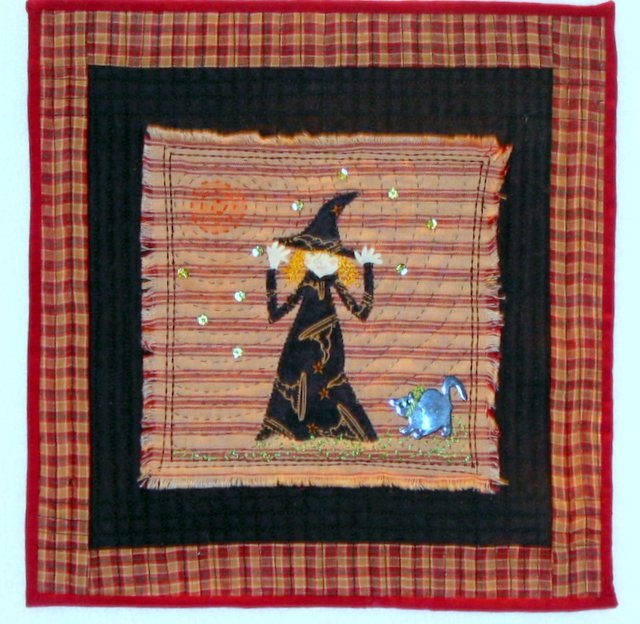
And the witch that I abandoned 
along with them also needs attention.
--------
I just finished Tana French's
latest book:  The Secret Place!
Is there anyone better 
at creating atmosphere?
I loved it and will review it soon.
I do love NetGalley.

I'm still adding to my R.I.P. challenge list, 
and eagerly awaiting the date I can begin reading.

Have you thought of good choices 
for Carl's challenge?
I'm eager to add to my list.


Tuesday, July 29, 2014

Added to Wish List and Two R.I.P. Books

Just added two books to my wish list after reading Wendy's post about Stiff:  The Curious Lives of Human Cadavers by Mary Roach.  I wasn't familiar with Mary Roach, but found several other nonfiction lay science books that she has written that sound fascinating.  I love lay science!

The other book Wendy mentioned was The Mind at Night: The New Science of How and Why We Dream by Andrea Rock.  I've read a couple of novels lately about dreaming (The Vault of Dreamers-post scheduled for Aug. 20--loved, and The Anatomy of Dreams- post scheduled for Sept. 2- not so much).  I also read articles in The Guardian like Sleep May Help Memories Form by Creating New Synapses and Sleep's Role in Memory Formation and Lucid Dreaming Can Be Induced by Electric Scalp Stimulation (my own lucid dreams are rare, but appreciated).

Sleep and memory are also discussed in How We Learn by Benedict Carey (this one was so good, but I haven't scheduled my review yet).  In fiction and fact, dreams are intriguing to most of us.

---------
I've got two great possibilities for Carl's R.I.P. Challenge lined up:


The Pierced Heart by Lynn Shepherd.  "The shadow of Bram Stoker’s Dracula looms large over the darkest mystery yet faced by Victorian detective Charles Maddox—as the acclaimed author of The Solitary House and A Fatal Likeness once again pays homage to a literary classic, in a chilling tale of superstition, dangerous science, and shocking secrets."  

I've read both The Solitary House and A Fatal Likeness by Shepherd and expect this one to be a perfect R.I.P. book.


The Lazarus Prophecy by F.G. Cottam.  A copy cat Jack the Ripper, a connection to the Templars, and a prophecy that is even older.  

I've never read this author before, but the content and the cover make
it look suitable for R.I.P. 


Now, I must leave these two alone until the Challenge begins.  I MUST not go ahead and read them UNTIL the Challenge begins.  


Saturday, July 26, 2014

The World's Coolest Bookstores & Other Miscellany

Via CNN Style, this slide show of fascinating bookstores has articles describing each in more detail if you scroll down.

From the famous Shakespeare and Company in Paris to a bookstore in China where backpackers can stay overnight; from a former glove factory in Detroit converted into the largest new and used bookstore in the world to the John King Used & Rare Books, also in Detroit, which has a copy of the writings of Thomas Aquinas published in 1482 in Venice.  Beautiful pictures and interesting details.
---------------------

Have you heard of Bookbub?  Free and discounted ebooks - nice.  This article in the NY Times explains more about these one day deals.  "At HarperCollins, executives said they have seen books designated as daily deals go from 11 copies sold in one day, to 11,000 copies the next."
-----------------------

OK - I have a weakness for genius kids, robots, and androids. Have therefore decided I must watch at least one episode of Annedroids to see what Anne comes up with in her junkyard laboratory.
-----------------

I've finished Visions by Kelley Armstrong, an ARC that arrived in the mail.  I read Omens last year and was so excited to have another Cainesville interlude.  I've become a big fan of Armstrong and will review it soon.  Also recently in the mail, Bitter River by Julia Keller.  Another very good book and yet to be reviewed.  And on Wed., an uncorrected bound manuscript by Louise Penny arrived:  The Long Way Home.  I haven't even started it, but it is Louise Penny so I expect to love it.

A couple from NetGalley that I'm looking forward to are now on my Kindle.  What a book glutton am I!  
------------------

I've finished more Halloween figures and still have a few in progress.  Working on altering a book as a Book of Spells for a Halloween prop.  Love Halloween!  More details on my other blog.  
-----------

It is getting close to time for Carl's R.I.P. challenge.  Any good suggestions for this year's R.I.P. challenge?  I'll suggest Edgar Cantero's Supernatural Enhancements which I recently reviewed.  And if you haven't read any Wilkie Collins, The Woman in White is a perfect book for the challenge--well, any Wilkie Collins, but Woman in White is my favorite.  

A few favorites from previous R.I.P. challenges:

The Thirteenth Tale by Diane Setterfield
Renfield: Slave of Dracula by Barbara Hambly (Hambly has quite a few good possibilities)
Almost anything by Sax Rohmer (especially if you want a vintage twist)
Dissolution by C.J. Sansom (plenty of Gothic elements)

I think I've reviewed all of the above during one challenge or another.

Hope you are having a great weekend!

Saturday, October 15, 2011

Previous R.I.P. Reads

I've tried to corral some of my previous R.I.P. Challenge books.  They are in no particular order.

Lolly Willowes by Sylvia Townsend Warner
The House on the Borderland by William Hope Hodgson
The Haunted Hotel by Wilkie Collins
The Wyvern Mystery by J. Sheridan Le Fanu
Death in the Garden by Elizabeth Ironsides
The Woman in White by Wilkie Collins (a reread, and just as good as the first time)
The Thirteenth Tale by Diane Setterfield
The Woman in Black by Susan Hill
The Keep by Jennifer Egan
A Coldness in the Blood by Fred Saberhagen

Grave Sight by Charlaine Harris
The Loving Huntsmen by Sylvia Townsend Warner
Season of the Witch by Natasha Mostert
The last Apprentice by Joseph Delaney
The Moonstone by Wilkie Collins (another reread)
New Moon by Stephanie Meyer
A Great and Terrible Beauty by Libba Bray
Ghostwalk by Rebecca Stott
Dissolution by C.J. Sansom
The Sisters Grimm Book One by Michael Buckley

Renfield: Slave of Dracula by Barbara Hambly
Homebody by Orson Scott Card
Rebel Angels by Libba Bray
Bat Wings by Sax Rohmer
Souless by Gail Carriger
The Return of Dr. Fu-Manchu by Sax Rohmer
The Society of S by Susan Hubbard
The Blackstone Key by Rose Melikan
The Little Stranger by Sarah Waters
I Am Legend by Richard Matheson

Dark Celebration by Christine Feehan
Four and Twenty Blackbirds by Cherie Priest
Shakespeare Undead by Lori Handeland
The Haunted Abbot by Peter Tremayne
The Insidious Dr. Fu-Manchu by Sax Rohmer

I had to really hunt for these because I didn't label all of them as R.I.P. books. Some were excellent, some were not.  This year I'd already read a lot of Gothic or Supernatural books that I should have saved for the challenge. I'll add this years books to the list when the challenge is over.

Sunday, September 23, 2007

Rebel Angels (R.I.P #7)


Bray, Libba. Rebel Angels. I enjoyed the first book in this series much more than this one. Gemma has lost much of her independence, individuality, and quirky humor. The feisty and funny character at the beginning of A Great and Terrible Beauty is now too easily swayed by her friends.

Gemma, Felicity, and Ann take their Christmas holidays in London, but as things are not going well in the realms, they make frequent visits there. Gemma finds Pippa disturbing, but she is the only one who sees a problem (makes one wonder about Felicity and Ann, who appear undaunted by the deterioration in both Pippa and the realms), but Gemma does little to explain her doubts to the girls--maybe because she knows it its hopeless. Kartik plays a bigger part in this book (a good thing) and seems to be set up to play an even larger role in the next one. There is a bit of "romance" with Simon Middleton, but it is a sideline because Gemma must keep Circe from gaining control in the realms. Who is Circe? In order to fight her, Gemma must determine Circe's identity.

The anagrams may fool the twelve-year-old audience, but I'd think that by thirteen or fourteen most girls would catch on to this twist. Gemma's response to Simon's behavior at the party seems particularly obtuse, and her tendency to allow her friends to browbeat her-- seems at odds with "Lady Hope" and the idea that she is heir to magical powers beyond those of any previous member of The Order. I hope that in the third novel, Gemma comes into her own again.

fiction. Gothic / YA. 2005. 548 pages.

Friday, September 21, 2007

The Last Apprentice: Revenge of the Witch (R.I.P. #6)

Delaney, Joseph. The Last Apprentice: Revenge of the Witch. A YA book for ages 10 and up, according to the jacket. This YA novel doesn't patronize young readers, and I like that. Thomas Ward is the seventh son of a seventh son, and since his eldest brother will be inheriting the family farm, young Tom must be apprenticed elsewhere. His mother has made plans for this: Tom will be apprenticed to Old Gregory, the county Spook. The Spook is responsible for binding boggarts, capturing witches, and taking care of any evil that appears in the county.

Twelve-year-old Tom must learn the trade in order to take over the position from Old Gregory because a Spook is necessary for the safety of the county's residents; but... there have been 29 previous apprentices who were not successful. Will Tom, with the inchoate magic of the 7th son of a 7th son, be able to succeed where the others failed?

The trials and tribulations of Tom as a new apprentice are many. He has notes to take, spells to learn, and chores to perform, and then-- he meets Alice of the pointy shoes and becomes entangled in a dangerous mission that could end very badly, indeed.

I think young people would love the book for all the deliciously frightening events and for the magical education Tom is receiving.

The next in the series is The Last Apprentice: The Curse of the Bane.

Fiction. YA/supernatural. 2005. 343 pages.

Monday, September 17, 2007

The Sisters Grimm Book One (R.I.P. #5)

Buckley, Michael. The Sisters Grimm: The Fairy-Tale Detectives. Written for very young readers (grades 4-6), The Sisters Grimm feature two young sisters whose parents have disappeared. After spending over a year in and out of foster care, Sabrina and Daphne are placed with a grandmother they did not know they had. Sabrina is suspicious of Granny Relda and plans on making an escape. The girls, however, find themselves in the town of Ferryport Landing where humans and characters from fairy tales exist side by side, and they are quickly required to solve a mystery and locate their Granny Relda before it is too late.

I'm of two minds on this book: first, I think it would appeal to very young readers. On the other hand, I'm one of those who doesn't really care for watered down fairy tales. The book takes a humorous approach, but I find the altered personalities of some of the characters disconcerting.

Fairy tales-- the very scary and often very sad kind-- were a part of my early childhood. I read and cried over The Little Match Girl, too many times to count. I found Hansel and Gretel terrifying--what father would obey a stepmother and lead his children into the woods in order to abandon them? Fairy tales made me grieve, they frightened me, and they made me think. I knew no stepmother could ever change my father's love, but what about those children whose parents didn't seem as committed to each other or to their children as my parents? My imagination moved events back and forth from the fairy tale world to the real one.

Memories of one leather-bound set that I loved are as clear as anything in my childhood. That set belonged to my aunt, and my cousins (all boys) were not interested in them, but I loved the embossed and gilded leather of those books and remember turning over and over to certain volumes and certain stories. Aunt Janice treasured those books from her childhood, and so did I. What ever happened to them, I wonder. I can still conjure up the images I formed then, as well as the sense of right and wrong that evolved as I judged the tales and the characters. The original Grimms and Hans Christian Andersen told the fairy tales I loved, feared, delighted in, not Disney.

I don't think the modern, tidy, sanitized versions hold up as well because they skim the surface and avoid the depths; children deserve more credit.

So... what do I think of The Sisters Grimm? It's fine if you want pancakes, but if you want meat and potatoes, the book will not quite satisfy. Or maybe I'm just too old to make a contemporary judgment... I loved Nancy Drew when I was young, not exactly thought-provoking, but thoroughly entertaining. We all want pancakes some of the time. Then, as now, I was an indiscriminate reader, bouncing from adult novels to children's books and from fiction to nonfiction without blinking an eye. Remember the biographies for young readers? And the books about wasps and ants?

I ordered the second in the series, The Unusual Suspects, at the same time and will read it as well. The series may grow on me. I do love the covers!

This site has a great atmospheric piece of music and other info on The Sisters Grimm series.

Fiction. Young reader/ mystery/ fairy tale. 2007. 284 pages.

Friday, September 14, 2007

The Moonstone (R.I.P. #4)

Collins, Wilkie. The Moonstone. T.S. Eliot admired The Moonstone and called it "the first and greatest English detective novel." He also added that it was "the longest" of its kind. Collins himself is considered the "father" of the modern English detective novel, but The Moonstone is much more than a detective story: it experiments with multiple narrators of varying degrees of reliability and pertinent information, speaks to British colonialism and racial assumptions, raises questions of class, treats religious fanaticism satirically and humorously, and shows a contempt for the hypocrisy of certain philanthropic organizations.

Collins begins with a background of the moonstone (a huge yellow diamond) and its violent theft, then moves to the narrative of Gabriel Betteridge who gives a background to the Verinder family. The moonstone, with its curse, is presented to Rachel Verinder on her eighteenth birthday, but by the next morning has disappeared.

Through the narratives of various individuals, the mystery of the diamond's disappearance and its aftermath is gradually related. The novel first appeared as a serial in Dickens' All the Year Around (which also published such authors as Edward Bulwer-Lytton and Elizabeth Gaskell) in 1868. It is easy to imagine the eagerness with which the audience would have looked forward to the installments that ran from January through August of that year. Rather like a soap opera or a television mini-series, The Moonstone must have been responsible for myriads of conversations and speculations among the Victorians.

As I mentioned in an earlier post, I remembered the solution to the mystery, but little else, so it provided an enjoyable reread after 4 decades. While, in my mind's eye, I retained the image I formed of the actual theft, the references to Robinson Crusoe, the narratives of silly Miss Clack and the sadly alien Ezra Jennings were lost over the years. In many ways, it turned out to be a completely different novel that what I remembered, but just as rewarding. The Moonstone is a classic for good reason...

Fiction. Mystery/detective. Signet Classic. 493 pages.

Tuesday, September 11, 2007

Another Amazon order and books in process

Antonina's List a review by D.T. Max of The Zookeeper's Wife: A War Story by Diane Ackerman. I've ordered this one. Darn, whose idea was it, anyway, to make ordering books so easy? My determination to hold off on ordering has gone down the tubes...again.

Still need to review Long Ago in France by M. F. K. Fisher and busy reading The Moonstone by Collins and the The Art of Eating, another Fisher. Actually, as Dark Orpheus mentioned, The Art of Eating is an omnibus of 5 of Fisher's works, the first is Serve it Forth. This omnibus may take the full 6 months of the Unread Authors Challenge, because it is (at least so far) very different from Long Ago in France, a fascinating and short memoir. Fisher was so young when she wrote Long Ago in France, as new bride. The nightly marathons continue.

I read The Moonstone (eons ago, when in high school). When I reread The Woman in White last year, I was delighted that it did not disappoint. The Moonstone, however, while not disappointing, is so different from my memories. I had no memory of the humor or of so many of the characters; I retained only the solution to the mystery. So...in my rereading, I'm perhaps too much in the know about the mystery, but completely surprised with Collins' character/narrators (Gabriel Betteridge, Miss Clack, Mr. Bruff, Ezra Jennings--a few of the various narrators) and with Collins' view of "do gooders" and religious proselytizers. Have to wonder about who in Collins' real life aroused his sense of the ridiculous and invited his satirical eye.

Monday, September 10, 2007

Season of the Witch (another R.I.P & Unread Authors Challenge)

Mostert, Natasha. Season of the Witch. I found this one disappointing. The characters, with the exception of Frankie, who was barely necessary to the novel, seemed cold and flat.

I was willing, but unable to"suspend disbelief." The novel read quickly, I did want to finish, and there were some aspects that I found quite interesting, but it just didn't have the quirky charm of A Great and Terrible Beauty, nor were the characters or the narrative as well developed as in Dissolution.

Aspects that did appeal:

  • references to Stargate, the secret government program (dismantled in the 90's) that involved research into telepathy, clairvoyance, psychic abilities. I've always been interested in this program.
  • The Art of Memory and memory palaces. I do agree with Minnaloushe that with all of our modern technology, we no longer need to use our long term memory as much as in the past and that, as a result of books and technological aids, our long term memories have become less capable. I mean, when pre-literate societies could memorize entire histories to pass on orally, you have to admit that our abilities today are pretty meager. Scops that could memorize Beowulf and other epic works may have been the most talented "memorizers" of their time period, but without written works, everyone had to be better at memory tasks.
I had never heard of memory palaces and was interested in learning more about them. Here, and here, and here, are some sites with information about Memory Palaces.


Fiction. Gothic/mystery. Dutton. 2007. 395 pages.

Saturday, September 08, 2007

Dissolution (R.I.P. & Unread Author Challenges)

Sansom, C.J. Dissolution. I put this one on my TBR list sometime back, then Jill posted about it and renewed my interest; when the R.I.P. and Unread Author Challenges came up, I finally ordered the book. Given Jill's recommendation, the subject matter (dissolution of monasteries), time period (Tudor era), and genre (mystery), I was pretty sure that I would like this one...and I did.

Matthew Shardlake is a lawyer, a royal commissioner under Thomas Cromwell, and a hunchback. When Cromwell orders him to solve the murder of another royal commissioner at the Scarnsea monastery, Matthew has no choice. He and Mark Poer find a complicated set of individuals and behaviors at the monastery and evidence of quite a few misdeeds and secrets. Then...another murder.

Gothic elements: monks, monastery, mystery, secret passages, etc. Historic tidbits include information about the Reformation and various viewpoints, the dissolution of the monasteries, the power-hungry and greedy attitude that accompanied many "reformers," a bit out about Ann Boleyn, Jane Seymour, and Mark Smeaton.

Matthew Shardlake is a genuine believer in the Reformation, but is forced to confront some of the aspects to which he has willfully blinded himself...about his master and about religious reform. Shardlake is intelligent, flawed, interesting, and ethical in a difficult time.

In May, Jill mentioned Dissolution again and posted some great links that you might want to check out. Mary and Ann have also given it a thumbs up.

I will certainly want to follow up with Dark Fire and Sovereign.

An interview with the author
.

Fiction. Historical/mystery. 2003. 390 pages.

Thursday, September 06, 2007

A Great and Terrible Beauty (first R.I.P & Unread Authors)


Bray, Libba. A Great and Terrible Beauty. It is 1895, and sixteen-year-old Gemma Doyle is in that awful adolescent stage that often leads to great conflict between mother and daughter. Gemma wants to go to London and escape the boredom of India, but her mother refuses to give her permission. Gemma reacts with teenage pettiness, behaves badly, argues with her mother, and then runs off into the crowded streets of the Bombay marketplace.

Lost and frightened, Gemma has a vision in which she witnesses the deaths of her mother and the Indian man who minutes earlier had approached them and said, "Circe is near."

Two months later, we find Gemma in London, but under the heavy circumstances of her mother's death and her father's decline. Her brother is escorting her to Spence, a girl's finishing school, where Gemma will learn the art of finding a husband.

The tale is full of Gothic elements: the supernatural, an old building (in this case, not a castle, but a large school with one wing locked because of fire damage), omens, portents, mystery, suspense, females somewhat at the mercy of a male dominated society. But it is an updated Gothic, a kind of contemporary Gothic.

While the novel is set in 1895, many elements are anachronistic. Gemma is a much more modern female in both attitude and language than would have been the norm in the late Victorian period; she is independent, stubborn, and has a satiric bent that is modern in its realization. Her voice, especially at the first of the novel, is distinct, and I could easily identify with some of her withering assessments of the school and the girls. She is no mild-mannered, withdrawn, self-effacing Jane Eyre. She immediately goes into battle mode as she tries to win herself a place in the school's social hierarchy.

My favorite part was the first half of the novel where Gemma takes on the school clique; entertaining and humorous encounters because of Gemma's own attitude. The main characters all have their secrets and, regardless of how their lives may appear, their own wounds.

The sequel is Rebel Angels and yes, I'll be looking for this as soon as I can get some of my stack of books squared away.

Fiction. Gothic and YA. Delacorte Press. 2003. 403 pages.

Friday, October 27, 2006

R.I.P. List and SciFi: Evolutionary Split?


Thanks to Carl for the entertaining R.I.P Challenge. I read some interesting books and have accumulated a long list of TBR titles from participating bloggers. I'm still waiting for about 5 more books that will go into the bonus R.I.P. category.


My R.I.P. list:

  1. House on the Borderlands - W.H. Hodgson

  2. Lolly Willowes - Sylvia Townsend

  3. Death in the Garden - Elizabeth Ironside

  4. The Wyvern Mystery - Sheridan LeFanu

  5. The Haunted Hotel - Wilkie Collins

Only one of these authors (Wilkie Collins) had I read before, although LeFanu was one I kept saying I was "going to read" --someday. I think I learned something from all of them.

(favorites, by a long shot, #3 and #5; all have been reviewed somewhere on this blog)

Bonus R.I.P:

  1. The Keep - Jennifer Egan

  2. A Coldness in the Blood - Fred Saberhagen

  3. Grave Sight - Charlaine Harris

(favorite, #3)

Carl and Angela (and anyone else interested in science fiction), here is an article that could be developed into countless science fiction novels! Not that most of it hasn't been done before, but it provides a new impetus for futuristic novels.

Tuesday, September 12, 2006

The Loving Huntsman (or "a room of her own")

Interesting tid bit:
1926 - The Book-of-the-Month Club in New York City chose as its first selection, "Lolly Willowes" or "The Loving Huntsman" by Sylvia Townsend as the offering to its 4,750 members.

I didn't realize that the Book-of-the-Month club started in 1926. Wonder how many members it has now, 80 years later...

Finished Lolly Willowes, a strange little book; another short one -- only 222 pages. Approximately the first 100 pages cover LauraWillowe's life as first daughter, living at home until nearly 30, then maiden aunt, living in the small spare room in her brother's home.

At home with her father, Laura is content with reading and botany and her father's brewery. She is interested in neither marriage nor an active social life. Her life is not exciting, but pleasant.

On the death of her father, Laura finds herself taken over by her elder brother Henry's family who move her to London to live with them. Their intentions may have been good, but after trying and failing to set Laura up with a suitable mate, they begin to rely on her as a sort of nanny for their children. This portion of the novel is deadly slow and reveals the 20 years that "Aunt Lolly" lives a stagnant life without questioning it. Her sister-in-law Caroline "was a good woman and a good wife. She was slightly self-righteous, and fairly rightly so, but she yielded to Henry's judgment in every dispute, she bowed her good sense to his will and blinkered her wider views in obedience to his prejudices" (50-51).

Laura thinks that "the law had done a great deal to spoil Henry. It had changed his natural sturdy stupidity into a browbeating indifference to other people's point of view. He seemed to consider himself briefed by his Creator to turn into ridicule the opinions of those who disagreed with, and to attribute dishonesty, idiocy, or a base motive to every one who supported a better case than he. This did not often appear in his private life, Henry was kindly disposed to those who did not thwart him by word or deed. His household had been well schooled by Caroline in yielding gracefully, and she was careful not to invite guests who were not of her husband's way of thinking" (51).

Laura, however, after 20 years of occupying this empty existence decides to make a change. She announces her intention to move to Great Mop, and despite being forbidden to do so, she follows through with her plan.

At his point, the supernatural elements begin to make a gradual entrance, and Laura discovers she is a witch by avocation.

The novel depicts a woman's struggle for independence, in a time that still views women only in circumscribed and conventional roles. Laura becomes a witch to escape this role and "to have a life of one's own, not an existence doled out ...by others..."

The devil appears, but not the demon we might expect. Not the "Wild Huntsman" of myth, but "The Loving Huntsman" who protects his own. Laura is not a typical witch, but a woman whose decision to take control of her own life could only have been achieved with supernatural help.

Information about The Wild Huntsman and the Wild Hunt can be found here. (I'm always gonna' go with folklore and myth.)

And this source: In other places the Hunter was not a God, but the leader of the fairies, such as Gwyn ap Nudd who was seen as the leader of the Welsh fairies (the Tylwyth Teg) and who led the Hunt in Wales and the West of England. [3] Toward the end of the middle ages, however, the Wild Hunt became more and more associated with witchcraft. Instead of saying that the Hunt was led by a spirit of God and featured many other spirits, it began to be said that witches participated in the Hunt and that their leader was either Satan himself or a demonic spirit. This belief also seems to have become muddled up with the idea that Witches rode in procession to Sabbats upon animals, or flew in the sky, and this idea became one of the major charges used in European witch hunts.
...
The Wild Hunt is a popular and very long lasting myth, perhaps arising out of the pre-Christian Pagan religions of Europe, and it is remarkable that it managed to survive being associated with Witchcraft during the witch mania. Herne and his counterparts have rightly been rescued from children's tales and brought back to be a positive male image in Paganism, which sometimes seems in danger of being unbalanced by an over-concentration on the female aspects of the Divine.

So Sylvia Townsend Warner has managed to associate a woman's independence with Satan (how dare a woman assert herself...unless the devil made her do it), and has chosen the Loving Huntsman as a means to remove Laura from a controlling, conventional family.