Search This Blog

Saturday, January 20, 2007

Maximum City


Mehta, Suketu. Maximum City: Bombay Lost and Found.

When Suketu Mehta returned to Bombay, he didn't find the city he left behind in 1977 at fourteen. Of course, there is no way he could have found the same city because at 14 our memories of place are so limited and intimate. The Bombay he left was the Bombay of his childhood and the Bombay to which he returned as an adult could never be the same. The city of nostalgic childhood memories has undergone huge changes in 21 years, rapid and drastic changes.

Mehta then goes about learning this new city. Not that he hasn't visited in those 21 years because he has, many times. Many Indians in America yearn for their homeland and question Mehta about his experiences when he moves his family back in 1998. Can they go home again?

Mehta ponders the question asked by those who consider a return: "To what India do you want to return? For us, who left at the beginning of our teenage years, just after our voices broke and before we had a conception of making love or money, we kept returning to our childhoods. Then, after enough trips of enough duration, we returned to the India of our previous visits. I have another purpose for this stay: to update my India, so that my work should not be just an endless evocation of childhood, of loss, of a remembered India. I want to deal with the India of the present." He concedes, however, that the "terrain is littered with memory mines."

Gradually, and with much difficulty, the Mehta family comes to terms with the "country of No" and learns to negotiate the hazards and the difficulties of a country that operates in a manner unique unto itself. Mehta, a journalist, begins learning his new India by researching the 1993 riots, Bal Thackeray, and the Shiv Sena. He interviews murderers and politicians. He examines the role of the police. This is fascinating stuff. Often dismaying stuff. The moral compass seems awry. How can this murderer seem so normal? How can politicians be so callous, so corrupt?

Mehta also examines the gangs and gangwar; bar dancers; the movie industry- actors, directors, and gangsters, again; social advancement; religious differences... Every story is a story of an individual, of humanity, of a city in transition. And every story is compelling.

This book was a Pulitzer Prize finalist and deservedly so. I found it absolutely compelling. It is long and complex, informative, intriguing.

Non-fiction. Journalism, travel, memoir. 542 pages. Copyright 2004.

Also wrote about this one here.

Finished and In Progress


Finished Maximum City last night (well, about 1:30 AM) and will review it later, but a thoroughly satisfying read.

In process, Phantom by Terry Goodkind and The Yellow-Lighted Bookshop by Lewis Buzbee.
Phantom is, unfortunately for me, number 10 in Goodkind's Sword of Truth series! I doubt the library has more than one or two of these -- I just picked this one up from the New Book shelves.
So far I'm enjoying it, but that means backtracking for 9 (NINE) books.

I prefer, of course, to begin at the beginning. However, that does not always happen to be the way things turn out. When there are only 3-4 books in a series, I don't feel overwhelmed, but starting with the last one in such a long series is a bit intimidating. So far, I'm enjoying it, and it reads really quickly, but it had better be excellent, or I'm not sure I'll go to the trouble of getting all the previous books.

Have just barely dipped into Buzbee's book. I couldn't resist, but knew I didn't want to have too many books going at once; now that Maximum City is out of the way, maybe I can give the thought required to read this book about reading.

Have also (I'm so easily tempted) tasted a bit of Paglia's Break, Blow, Burn and am very familiar with most of the 43 poems (she's included many of my favorites - the woman has excellent taste!). This one can be picked up at any time, and I love her critical analysis. Why? Because it mostly agrees with my own interpretations! She's chosen poems I love and her analysis (on the ones I've read) is exactly what I think, but in such perfect phrases. She also has included nuances that I've never noticed, but that make perfect sense. For anyone looking for a good book on poetry, Paglia is literary criticism at its best: insightful, erudite but readable, and full of enthusiasm.

And there are more responses to the Meyer-Briggs test in the previous post.

Thursday, January 18, 2007

Which Acronym Are You? Re-visited (more additions)

Updates on personalitiy types according to the Meyer Briggs test (from this post and comments) :

Dark Orpheus - IFSJ
Bluestalking Reader -
Lotus Reads -EFSP
Carl V. -
Andrew - ISFJ
Pages Turned (Susan)- INTP
Dorothy W. - INTJ
Acquisitionist - ENTJ
SuziQ - INTJ
Stefanie - INTJ
Deb R. - INFP
Framed - ISTJ
Debra Hamel - ISTJ (100% introverted!)

Angela - ESTJ
Cam - ISTJ
Ann - INTJ
Dovegreyreader - ISFP

:) The majority are, indeed, I's. You can check out the comments here.

I kept the page that explained the types pulled up and had fun reading the additional info and the famous people who fell into your particular type. I've enjoyed having this bit of additional knowledge available. Thanks to all of you who played! Anyone else who is interested should try it - most people found it to be very accurate.

Wednesday, January 17, 2007

Synchronicity, again

Updating a draft from 1/14/07:

NPR interviewed Suketu Mehtu about Maximum City in December.

Pico Iyer's article.

Since then, I've discovered placeblogger, an interesting site recommended first by Time Goes By, then on an interview on NPR's Smart City. I love this program which airs on Friday nights in our area, and I often catch part of it as I'm heading home, then later, catch up online.

For some reason, I've always love the idea of city planning - what works; what mistakes have been made and how they are being corrected; how to make city living better, more convenient, more environmentally effective; green spaces; traffic problems; housing, etc. Smart City covers all of these topics and more.

On the Dec. 21 program (of Smart City), Steven Johnson, author of The Ghost Map was interviewed. Two synchronicitous items: he mentioned placeblogger (and I found a placeblog in Mumbai) and his book is about the Cholera Epidemic in London in 1854 (which relates to the novel The Great Stink - which was in many ways interesting, if not enjoyable).

I love the way information and life intersect, branch off, return, crossover, in such an intricate pattern of connections. All of those strands that tangle, coil, and form an intricate and complex series of links and bridges--sometimes quite naturally, sometimes in such unexpected ways. The way one thing leads to another, and another, and back again...

And one last intersection, Anjali of Lotus Reads met Mehta and his father and send me this photo. She suggested cropping everyone out but father and son. Trying to map all of the convoluted paths of a "reading itinerary" becomes too complicated.

Monday, January 15, 2007

Which Acronym Are You?

The Meyer-Briggs test for personality type is making the rounds on several lists. My results were, predictably, INFJ. Even after answering in my most social mood, my results are 89% introverted. That sounds worse that it is. Here are different profiles of the INFJ type. I'd bet that most readers and book lovers fall into this category although with various per centages.

Take the test and let me know where you fall. I'm nosy. And I do bet that the majority of you are introverted to some degree. :)

Saturday, January 13, 2007

Now reading... (with thanks to Lotus)


Maximum City: Bombay Lost and Found by Suketu Mehta (originally discovered by way of Lotus Reads). So far, while certainly educational, the reading is almost like following the adventures in a novel. Excellent.

Mumbai (what was once called Bombay) is, in a strange way, a model city. It is an example of what can happen when too many people and too rapid expansion occur with too little foresight. And foresight is not a strong characteristic of governments or political parties anywhere in the world. Thus, Mumbai reminds me of examples of futuristic cities in some science fiction novels: A place where events have gotten ahead of themselves, where additional layers are added onto faulty foundations, where great technological advances and unimaginable poverty exist side by side, where space is at a premium and dependable infrastructure at a minium, where crime is often the only way to improvement, where the crucial necessity of water is difficult to come by and often contaminated, where those who work tirelessly for improvement are met with impossible odds. Where giving up and throwing up one's hands would be easier than battling what must seem inevitable. It is an example that the world should be paying attention to if there is to be hope for the future. For many of the problems this Maximum City faces exist all over the world...in incipient form and in smaller locations. Mumbai is a wake-up call of sorts.

Mehta's voice is comfortable, skilled, ironic, witty. I'm reading about events that have escaped my notice in my comfortable suburban world, but that have had huge effects on millions of people in Bombay. I'm reading with more comprehension than might have expected because Mehta manages to balance the humanity, the history, and the political so well.

Again, I read non-fiction much slower than fiction; yet, each time I pick up this book, my hands eagerly seek out my place, and I'm soon immersed in Mehta's Bombay.

The Rest Falls Away

Gleason, Colleen. The Rest Falls Away. This is the novel I won in the drawing over at Carl's. The first in a series by Gleason concerning the legacy of the Gardella family and their age-old battle with vampires. It is sort of "froth and furious" (the description of our heroine's attire as she attends the parties of the ton is the meticulously frothy aspect). The furious is the battle against evil in the form of vampires. Victoria's dreams lead her to the recognition of her role in this battle, and guided by her Aunt Eustacia, she undergoes an unusual education that prepares her for her dangerous vocation. Three men. A beautiful young woman. An ancient, but lovely and seductive vampire queen. Secrets, errors in judgement, adventure. A fun read.

347 pages.

Oops! Guess I hit "save as draft" instead of "publish." I thought this was published yesterday...

Friday, January 12, 2007

Voltaire Almighty

Pearson, Roger. Voltaire Almighty. Chapter One is titled "Of Uncertain Birth" as Voltaire was probably a bastard. Indications are that his mother's association with the chevallier Guerin de Rochebrune resulted in Voltaire's birth, although he was ostensibly the son of her husband, Francois Arouet. He was born in 1694.

He was a precocious child who, according to one legend, memorized and was able to recite a 73 line poem by the age of three. Pearson leaves this story in the realm of legend, but the young Voltaire was obviously not an ordinary child. Educated by Jesuits, Voltaire developed a life-long antipathy toward the Catholic Church. I loved this passage: "Not so much an old-school-tie network as a cassock conspiracy to maintain power and influence through the advancement -- and consequent loyalty -- of the brightest men in France. And abroad. For at that time the Jesuits directed some 700 schools throughout the world." Regardless of his anti-Catholic stance, Voltaire received the best education available, although it was strictly regimented and often boring. Pearson relates a good deal about the strictures involved and the curriculum. In spite of his disdain for the Catholic religion, Voltaire did absorb many tenets from the Jesuits, including the "greater emphasis on God the heavenly Father, a compassionate deity with a broad understanding of human frailty and a limitless capacity to forgive us our sins." Jesus received less emphasis. The Jesuits were also characterized by their "urbane intellectual and moral flexibility" and these concepts marked Voltaire.

Difficulties began on graduation, as Voltaire did not want to become a lawyer; he wanted to be a poet. Arouet senior and junior found themselves at odds. The young Voltaire began keeping "bad company" and was a wild and willful young man determined to say what he thought. His outspokenness put him in actual physical danger as he published satires that could, and did, often result in visits to the Bastille. Voltaire was twice incarcerated, and it made an impression.

He wrote plays, tales, and poetry that were often outrageous, but were lively and witty, and his company was always entertaining. Remember that I chose this book partly based on the portrait on the cover and the sparkling nature of the eyes. I'm not the only one who noticed this: "Ah, those eyes! Everyone mentioned them, men as well as women, and they always would--even in his last years when he had become quite indisputably 'dried-up and bony'."
And all of his portraits emphasize those twinkling eyes, as do even pen and ink drawings.

On his meeting and subsequent relationship with Emilie du Chatelet, the biography becomes not just a historical review of events, but an absorbing drama. Emilie was married, but her husband interfered not at all and, in fact, allowed Voltaire to improve the marquis' chateau, adding an entire wing and many luxuries. Emilie, a "delectable, passionate, fun-loving, tempestuous, unpredictable, unreasonable, extremely intelligent" young woman, was the "leading female scientist and mathematician of her day."

Their long relationship, until her death at 43, was not always easy, but the meeting of their minds seems to have overcome all (and there were many) difficulties that threatened to destroy their love/friendship. She died giving birth to a lover's child, but Voltaire, who also had another relationship at the time (with, uh, his niece) was present. His recovery from her loss was slow.

This biography, although initially difficult to follow, seemed to coalesce as it proceeded. Voltaire's relationships, his writings, his money troubles (until the lottery and good financial decisions made him quite wealthy), his publishing difficulties, his exiles, his fear for his life, his founding of his own "kingdom," his attacks on Cathololic principles and support of Deism, his feuds with other important figures of his time, his egotism, his illness (real and imagined), his various homes and travels, his innovative practices at Ferney, his influence in overturning unjust sentences and support of the victim's families, his final return to Paris... a remarkable life. A fascinating life. An absorbing read.

Biography. 420 pages + (14 pages of Dramatis Personae! A chronological listing of events, notes, bibliography). Copyright 2005.

Difficulty

I started my new post reviewing Voltaire's biography on a draft in Bayou Quilts. Now, I can't seem to copy and paste it here. Drat.

Also finished The Rest Falls Away, and need to review it, but I'm out of time. Have to get ready to go to Minden.

Thursday, January 11, 2007

More Books and more books and...


I've finished Voltaire Almighty. You see all the flags? Must go back and refresh myself on some of these points so I can write the review. Reading this biography was a rewarding experience, and I do want to read more about Voltaire and Emilie. Checked at the library yesterday, and they don't have copies of the other biographies I wanted, but they do have one called Voltaire in Exile which is listed in the bibliography of Voltaire Almighty. Unfortunately, I forgot what I was looking for while browsing, and so it will have to wait until my next visit. My time was limited, but can also look at getting copies through interlibrary loan.

Here is a stack of books that await my time. Which to choose next?

I've already gotten over half way through The Rest Falls Away - taking a desert after a full meal is always a pleasure.

My friend Beth also brought me a bag full of books that I'll need to get through as well. She waits at the door of B & N when a new book in one of her series is due--while she will wait for the next one to be published, once it is in print, there is no delay.


My library books (refrained from getting the usual number as there are so many books-in-waiting at the current time) -

Browsing led me to an old copy of one of Gladys Tabor's books of essays which I remember enjoying years ago. A biography of Anne Boleyn, another favorite topic. And more. Oh, again, all of my choices look tempting, which to choose to follow the adventures of Victoria in The Rest Falls Away...

Monday, January 08, 2007

Home Again

I'm fairly close to the end of Voltaire Almighty and must say that even though the author frequently includes (what seem to me to be) non sequiturs, causing me to back track and try to figure out where that sentence came from...he has completely drawn me into Voltaire's life. And what a life!

My book has flags sticking out everywhere! Here, because of an interesting bit of information; here, to mark a quote; here to remember a surprising incident, or fact, or person, or method of doing things. Lots and lots of flags.

My copy of The Rest Falls Away by Colleen Gleason arrived this weekend while I was in Baton Rouge (visiting my daughter and her family), so I had that nice surprise on returning home. Today has been rather too hectic and tomorrow will be the same, but I've gotten a few things accomplished and had time to read tonight - a good thing, as I didn't have a chance to read much this weekend.

I tried to get caught up on emails and blog stuff today, but have had limited time. Received 3 Netflix movies and don't know when I'll have a chance to watch them, but that's the beauty of Netflix, I don't have to worry about fines or deadlines. The library is another story, and I must make time for that tomorrow.

Friday, January 05, 2007

Voltaire and Emilie

Slowly making progress with Voltaire Almighty. He's met and begun his relationship with Emilie (Gabrielle-Emilie Le Tonnelier de Breteuil, marquise du Chatelet). I remember now, reading a review recently on Passionate Minds: The Great Love Affair of the Enlightenment, Featuring the Scientist Emilie du Chatelet, the Poet Voltaire, Sword Fights, Book Burnings, Assorted Kings, Seditious Verse, and the Birth of the Modern World by David Bodanis. Maybe the memory of that review is partly what drew me to Voltaire Almighty. While searching for Passionate Minds on Amazon, I also discovered Voltaire in Love by Nancy Mitford and La Dame d'Esprit: A Biography of Marquise Du Chatelet by Judith Zinsser.

Candide is one of the Winter Classics choices of Framed and Booked. Maybe, during the course of this year, I can take a step into French literature with more biographies and Candide. We will see how that develops.

More on the topic of Resolutions and Improvements

Here is a link to my post on Bayou Quilts about Ben Franklin's Virtues. I'm not making resolutions per se, but I do want to keep in mind certain aspects that I want to work on. The Uberlist is not a list of things I've resolved to do, but a list of things that need to be done or that I'd like to accomplish. Possibilities. I wrote that post on Dec. 30, and I have been working on it.

Kim at SkybelleArts has created a quilted fabric collage listing the Nine Noble Virtues. What a creative reminder!

About 1/4 of the way through Voltaire Almighty. France was certainly a tricky place in which to maneuver for someone like Voltaire. He's already been in the Bastille - twice. Not in the worst of circumstances, though, as someone less well-known may have been.

Thursday, January 04, 2007

A Bit of an Outcry on Library Purges

The Wall Street Journal's response to the Fairfax County Public Library (VA) method of determinating which books to discard: "libraries should seek to shore up the culture against the eroding force of trends..."

and "The particulars of this task will fall upon the shoulders of individual librarians, who should welcome the opportunity to discriminate between the good and the bad, the timeless and the ephemeral, as librarians traditionally have done. They ought to regard themselves as not just experts in the arcane ways of the Dewey Decimal System, but as teachers, advisers and guardians of an intellectual inheritance,"

and "The alternative is for them to morph into clerks who fill their shelves with whatever their "customers" want, much as stock boys at grocery stores do. Both libraries and the public, however, would be ill-served by such a Faustian bargain." Go, Wall Street Journal!

Thanks to Jill of My Individual Take (On The Subject) for the link to Library Stuff which discusses the WSJ article and also provides a link to The American Spectator which questions the Fairfax County Library's use of circulation numbers in discarding books.

"Other selections expunged from various branch libraries are Charlotte Bronte's Jane Eyre, Harper Lee's To Kill a Mockingbird, and Virgil's The Aeneid.

Among the more contemporary authors excluded from some libraries are the likes of Kate Millett, Jack Kerouac, and Maya Angelou."

Now, that is downright scary, don't you think? To discard the above books to make room for John Grisham, David Baldacci, James Patterson, Nelson DeMille, and Stephen King... Not that I haven't enjoyed books by these authors, but they are not in the same class as many books that are being purged.

Wednesday, January 03, 2007

"So Long, Hemingway?"

I just visted Dark Orpheus, and her post reminded me of the article I read by Camille Paglia on Salon. Looked it up and here is the link. The interview covers some of her political observations, not literary criticism. Her new book, Break, Blow, Burn sounds fascinating, so I ordered it.

3:00 PM Jeez! I thought I published this before I left the house to meet the Tai Chi in the Park group. And here it still sits...a draft.

However, I've discovered another interesting article about Library Purging, which only relates something I recently realized to be true. Several times lately, I've looked for books that my library had previously had on the shelves (some classic, some just books that I wanted to read again - which is why I had to order The Lady in White in the fall). Not all of the books purged are old, they are simply the ones that have not been checked out in a certain period of time and that probably depends on the library's space considerations. I do understand that in order keep purchasing and shelving new books, libraries must make room for them and that sometimes the decisions of which books to cull are difficult ones. But so much trash is written and published and purchased by libraries (I ought to know as I read a great many books that have no lasting value beyond the entertainment of the moment) and these should be the first to go.

I'm glad I'm not a librarian - I wouldn't want to make those decisions, and I wouldn't want to have to take all the rejects home with me, which would be my tendecy.

Tuesday, January 02, 2007

And So It Goes...

Here is why I picked up the Voltaire biography. Don't you think he has nice eyes? I read nothing at all yesterday, and I have only 30 minutes left of today to get any reading done- don't think it is going to happen.

Yesterday, I was too busy eating blackeyed peas, corn bread, cabbage, and pork chops. The annual New Year's Day dinner around our house. Fee is more particular about this menu than he is about having turkey for Thanksgiving. After lunch, I took Laddie down to the country for a tour of Raft Bayou, checking out the winter wheat, bird watching, etc. We also trucked on down to the Lake Bisteneau land to check on things, but forgot to check and see how much water the new pond was holding after the recent rains. Then Fee and I watched a couple of movies last night.

Tonight I went to Tai Chi - my version of Carl's Uberlist includes getting back into a schedule of at LEAST 3 weekly sessions, whether regular classes or Tai Chi in the park. I used to do 3 lessons and 3 park days without missing many sessions, but not for a while. I suffered a bit, as I had not been in so long, but felt much better at the end of 2 1/2 hours. Didn't get home until nearly 10:00 and have piddled with a variety of things, but haven't read a single page. Non-fiction always takes me longer than fiction, but when the book just sits there unopened...well, it could take forever. It isn't as if it isn't interesting either; I simply haven't been in the mood.

I got quite a bit accomplished today - some chores and some things that just needed to be taken care of like letters and phone calls and appointments. A little yard work and a conflict with fire ants. Figuring out how to use the new photo editor to resize pictures and making copies of OLD family pictures (including one daguerrotype) for my niece. More of that kind of thing is on tomorrow's agenda as well, but I'm not stressing about any of it as long as I get some done each day.

Now, only 3 minutes left in today. Think it is time to post this and go to bed.


Listing and Musing

I've been busy creating an "uberlist" - the link is to Carl's explanation. I do have a talent for list making. I have 35 items so far, and some of those have subtopics. Truthfully, some of "my" list entails my husband's items; quite a few, actually. :) The talent for list-making does not necessarily extend to completion, but boy, can I create a good list.

Yesterday resulted in not a line read in a book of any kind. Very unusual, as I almost always devote time in the evening to reading. I'm not too far into the Voltaire biography (I really need a French history update), but I am enjoying it so far. Will I read Candide? That would be a start to an interesting reading itenerary. Or maybe something on the French Revolution, or Marie Antoinette, or ... well, of course, the possibilities are endless.

My knowledge of French literature is mostly limited to names and titles, not to content, and there are so many excellent authors and poets. Poetry, though, stands the chance of losing so much in translation, which is why I don't think I've ever been too drawn to French poetry. (That is an excuse, of course.) I do love some of Montaigne's essays, and translation doesn't appear to lose the wit and sense of companionability there. The language is so convoluted and the syntax so archaic, however, that I have to read a great while with little understanding before I settle in to make sense. Whole paragraphs, escape me (and have to be re-read) then I happen a single line or sentence that is abundantly clear. For example, the following is one sentence (though quite a long one) that is as true today as it was in the 1500's. He is advising a young woman who has requested his opinion about the education of children:

'Tis the custom of pedagogues to be eternally thundering in their pupil's ears, as they were pouring into a funnel, while the business of the pupil is only to repeat what the others have said: now I would have a tutor to correct this error, and, that at the very first, he should, according to the capacity he has to deal with, put it to the test, permitting his pupil himself to taste things, and of himself to discern and choose them, sometimes opening the way to him, and sometimes leaving him to open it for himself; that is, I would not have him alone to invent and speak, but that he should also hear his pupil speak in turn.

Monday, January 01, 2007

A New Beginning

Maybe Blogger and I will stick together a while longer. It is New Year's Day, and things are looking up. Have run out of time to experiment, but I've managed to upload the first picture in weeks. I'm thrilled. Now, back to the cabbage, blackeyed peas, etc.

Sunday, December 31, 2006

Year's Review - 2006

Most Memorable Reads in 2006

Fiction (in no particular order)

1. The Penelopiad - Margaret Atwood
2. The Space Between Us - Thrity Umrigar
3. The Historian - Elizabeth Kostovea
4. A Thread of Grace - Mary Doria Russell
5. Black Swan Green - David Mitchell
6. Parnassus on Wheels - Christopher Morley
7. The Thirteenth Tale - Diane Setterfield
8. The Woman in White - Wilkie Collins (re-read)

Non-Fiction

9. The Tipping Point - Malcolm Gladwell
10. Wild Swans: Three Daughters of China - Jung Chang
11. May and Amy: A True Story of Family, Forbidden Love, and the Secret Lives of May Gaskell, Her Daughter Amy, and
Sir Edward Burne-Jones
- Josceline Dimbleby (What a title! And although it may sound titillating, it wasn't. It was, however, an excellent biography of mother and daughter, and a fascinating look at the Victorian time period.)

Most Disappointing - for whatever reasons, sometimes covered in my reviews, these were books I looked forward to, but that did not appeal.

The Tenth Circle - Jodi Picoult
Saving Fish from Drowning -Amy Tan
Case Histories - Kate Atkinson
The Sea - John Banville

I read 146 books this year. There are only two other years that I've read this many books, but so much of what I read are fast-reading (and often, forgettable) mysteries. My normal average is approximately 120 per year. This year has been slap full of quick reads!

Not as much non-fiction this year, only about 8; this might be an area I want to improve on next year. All of the non-fiction I read, I enjoyed. I've begun a biography of Voltaire and may make a biography a month a goal.

Mostly, I will choose from what is available at the library, but The List (that ever-growing, out-of-control organism) includes many books that I've not found at our library.

I look forward to finding new titles and authors through your blogs, fellow readers. When I started this blog to remove all the book stuff from the other blog, I had no idea what wonderful adventures and book sharing awaited me.

Happy New Year To All of You! And Thanks for all of the comments on my blog and the wonderful pleasure of reading your reviews and suggestions on your blogs!

Wednesday, December 27, 2006

December Reading - update

Gur, Batya. Murder in Jerusalem. I've been reading Gur's mysteries featuring Michael Ohayon for years. The earlier ones were terrific. This latest one is not. I persevered through the opening chapters and the excruciatingly annoying dialogue, wondering what had happened to a previously talented author. Annoyed that this novel was not living up to her previous work, I fumed and fussed to myself. Finally, as I picked up the book to continue the painful process, I flipped to the back flap and realized that Gur had died in 2005. Checked the copyright date -2006. Did some online research and discovered she died of cancer (her obituary). I finished the novel with a different attitude. Although by no means up to the standard of her previous novels, the novel is a farewell to Ohayon, Eli, Balilty, Tzilla, and Shorer...

Tepper, Sheri S. Singer from the Sea. I read a couple of Tepper's novels in the early 90's and enjoyed them. She definitely writes from a feminist perspective. This novel is one of her far-future fantasies. I really enjoyed the first 3 quarters of the book, but the last quarter was less appealing. Genevieve has been brought up in the Covenants that govern the behavior of women on the planet of Haven. The submissiveness and subservience taught by the Covenants has been somewhat deflected by the secret teachings of Genevieve's mother, who unfortunately died when Genevieve was quite young. When it becomes necessary, however, Genevieve is able to draw on these teachings. uncover the reason for keeping young women submissive, and fulfill her destiny. The men, both good and evil, in this novel are curiously flat. The most interesting men are minor characters: Jeorfy Bottoms, librarian, and Veswees the dressmaker. Women are good; men are bad; exceptions are few.

Abraham, Daniel. A Shadow in Summer. Abraham has created a different world. It requires a bit more attention than the normal science fiction/ fantasy novel because it doesn't follow the patterns that have been set by previous authors. An interesting element is the inclusion of posture and gesture that I visualize as something like Buddhist Mudras, but far more inclusive. These ritual poses can convey all kinds of subtleties that have variations similar to tone of voice. A Shadow in Summer is Book One of The Long Price Quartet. Abraham creates an interesting and intricate world and sets in motion a chain of events that threatens nations.

Hardie, Kerry. The Bird Woman. Another author that I want to read again. The Bird Woman is a strangely compelling novel about imperfect humanity, love and hate, relationships and hurt, grudges carried from childhood, prejudice, misjudgements and mis-steps.

Set in Ireland during the time of the troubles, the novel opens a window into those separate worlds of North and South, Protestant and Catholic. Ellen McKinnon has the ability to see the future - not in every circumstance and not all the time, but sometimes she has flashes of events that later occur, although not always precisely as she sees them. Later, McKinnon develops another ability, finding herself capable of healing by the laying of hands. You would think that this would be the essence of the novel, but it is not.

It is a novel that speaks to the Protestant/Catholic problem - the way that what a child is taught to believe becomes so ingrained that even when thinking logically, the illogic of feeling and emotion is still there underneath.

Ellen's brother, Brian explains that although some things have changed, others have not: "Hatred," he says slowly. "That's what it's always been about. Three hundred years that was yesterday. We got their land, they want it back, and they want us away to hell. And they want to walk on our faces just like we walked on theirs." He stops, and I think he's finished but he hasn't. "you can add in fear to that. They were afraid, living under us, and now we're afraid of living under them. They say if we can't take what's coming we should go back where we came from. But it's not as simple as that, Ellen. No one wants us, we've been here too long, there's nowhere to back to."

It is a novel about understanding that doesn't come easily or without pain. And forgiveness. It is about the things that set Mother and Daughter into conflict and that come between husband and wife. About the blessing of friendship.

Paolini, Christopher. Eragon. Kind of Tolkien "light." Not bad at all for a kid of 19. Not much on character development and very Tolkien derivative. I think this is one where the movie might be better than the book. Still, as the first novel in a series, and by a very young man, there is promise.

French, Nicci. The Red Room. The second novel by French this year and a very good one, too. Quite different from Beneath the Skin (reviewed in October Reading). Dr. Kit Quin must make an assessment of a man found shouting in the street. At police headquarters, Michael Doll, the disturbed derelict, freaks out, breaks a coffee mug, and slashes Kit's face. Months later, Doll is suspected of murder, but Kit doesn't think he is the one responsible.

Rimington, Stella. At Risk. "Stella Rimington joined Britain's Security Service (MI5) in 1969. During her nearly thirty-year career she worked in all the main fields of the Service's responsibilities--counter-subversion, counter-espionage, and counter-terrorism and became successively director of all three branches." She also became the first woman to hold the post of director general of MI5 (all this from author info on jacket). Pretty impressive credentials. When I first read about the book, I wanted to read it because of Rimington's expertise; that her writing is lucid and efficient and that she knows how to tell a story made this a satisfying read.

Liz Carlyle is an intelligence officer with MI5 and becomes involved in an operation concerned with an imminent terrorist threat. Chatter has it that an "invisible" has entered the country intent on an act of terror. Who, what, where? The writing is brisk, crisp, and suspenseful. The author's first hand experience helps create the details that build tension and suspense. I look forward to more from Rimington.

Rhys Bowen. Evan Can Wait. A short mystery (part of the Constable Evans series) set in Wales. Constable Evan Evans is assigned to assist a film crew who have come to his little town to film a documentary about a WWII German plane that crashed into a mountain lake. One of the filmmakers manages to deliberately offend almost everyone with whom he comes into contact and eventually ends up dead.

Shaara, Lila. Every Secret Thing. Chic-lit attempting to be...I'm not sure what. A former lingerie model who now has a Ph.D. in religious studies is now teaching at a small college. This book doesn't seem to know where it is going - there are all kinds of "secret things" going on; too many and not too coherently. Gina Paletti hates being beautiful and dresses down to hide her beauty, but it is the only thing others see. And Gina manages to get this fact in every paragraph of the first person narration. There is a murder, a dysfunctional family, a Catholic nun who had an illegitimate baby (Gina's aunt), a mobster (Gina's uncle), the grasping family of her first husband, her mean-spirited, hateful mother, and offensive men who accost Gina at every opportunity (not sure if I covered every secret thing - there were too many). Pretentious and self-contradictory. Shallow Gina hates shallow people. No wonder she has problems. Yuck.

Deaver, Jeffrey. Cold Moon. Lincoln Rhymes and Amelia Sachs are on a new adventure against the meticulous Watchmaker. Full of twists and turns as usual, this installment had some flaws that bothered me. One was the "fact" that the duct tape used by the Watchmaker was CUT into precise strips when most criminals tear it off the roll with their teeth. Huh? Come on, Linc. With their teeth? Duct tape?

Initially, Sachs is lead detective on an apparent suicide. (O.K., here is another detail that bothered me. Why did it take the widow's assertion of murder to make people question the suicide if ...)

I really hate it when my involvement in a storyline is interrupted over and over by questions about details. Read, read, huh? Do ya' think it might have taken 2 people to do that? Read, read, huh? Bit of a contrast to be SO meticulous and so careless. Read, read...well, you get the idea.

Having missed so many details earlier, Rhymes' "insight" into the overly complicated agenda of the Watchmaker at the end...makes you wonder. One more picky detail: I no longer bother to read the forensic lists that are so useful to Rhymes.

O.K. I really did like the new character, Katherine Dance. Expect to see her again.

Hillerman, Tony. The Sinister Pig. I love Jim Chee and Joe Leaphorn, the settings of Hillerman's novels, the cultural differences of the various tribes. Bernie Manuelito takes a job with the Border Patrol to remove herself from the presence of Jim Chee, but she finds herself targeted because of photographs she's taken of an exotic game ranch. Connections to Washington? To a murder that Cowboy Dashee and Jim Chee have been working on? To the billions of dollars in Indian oil, gas, coal, timber royalties that the Department of the Interior can't account for? (and the 176, 000,000 dollars in royalties is a very real problem for the Dept. of the Interior - fact not fiction)

Hillerman's novels are fast and fascinating reads. He develops complex novels that don't feel complicated, he attends to details, his writing is lucid and unobtrusive.

Snyder, Maria V. Magic Study. Saw this one on some one's blog, so when I saw it on the library shelf, I pulled it. Found the beginning a bit confusing and quickly realized that it was not the first in the series. While it would have been nice to start at the beginning (Poison Study), enough background is provided for it not to be a huge problem. This one is fantasy and perhaps more in the YA category. The novel felt a bit rushed, a bit surface, but still an enjoyable read. I prefer the more detailed fantasy of Robin Hobbs' trilogies (the Farseer Trilogy, Live Ship Trilogy, and Tawny Man Trilogy (all inter-related and each complete trilogy 1500-2500 pages long - this is a world you can enter into almost as completely as Tolkein's world) .

Magic Study was a light read, fun, very quick, and when the characters from Ixia show up, things improve greatly.

And the Winner Is...

I won! Me! Carl drew my name, and I get a copy of Colleen Gleason's The Rest Falls Away! Things have been so hectic around here that computer time has been almost non-existent, but yesterday, I checked my email and received Carl's note. Cool, huh? Wasn't expecting anything but checking in on email and got a surprise gift book! Looking forward to the first in this vampire series.

Still not much time available right now, but I'm trying to update my December Reading. I realized this morning that I put it on "draft" the other day when I updated...and left it there. Now I have more to add.

Hope everyone had a Merry Christmas! Like everyone else, I enjoyed reading all the entries in Carl's G.I.F.T Challenge and now this Christmas is added to those memories.

Oh, and speaking of Carl, a while back he recommended the BBC series Mulberry with Geraldine McEwan. I watched the first disc before Christmas and have to admit that I, too, fell in love with both the series and the star. If you want a pleasant "movie" experience, you really should try this one. Thursday should bring the second disc, and I can't wait. Another set of characters as eccentric and lovable as you could hope for.

Sunday, December 24, 2006

Buttonhook Tree

I've been unable to upload pictures for days. After hours of work, I finally managed to upload a few pictures of our buttonhook tree to my other blog. I don't have time to try to go through the strange process again right now - so here is a link to the tree.

Merry Christmas to all of you who have brightened this blog with visits and comments this year!

Friday, December 22, 2006

G.I.F.T Challenge #4

This tradition is an important one in our family and began about the time Erin was born when I saw a production of A Child's Christmas in Wales by Dylan Thomas performed by The National Theater of the Deaf. I bought a copy at that time (1973-74) and have treasured it ever since.

One Christmas was so much like another,
in those years around the sea-town corner now
and out of all sound except the distant speaking
of the voices I sometimes hear a moment before sleep,
that I can never remember whether it snowed
for six days and six nights when I was twelve
or whether it snowed for twelve days and
twelve nights when I was six.

All the Christmases roll down toward the
two-tongued sea, like a cold and headlong moon
bundling down the sky that was our street;
and they stop at the rim of the ice-edged,
fish-freezing waves, and I plunge my hands in the
snow and bring out whatever I can find.
In goes my hand into that wool-white bell-tongued
ball of holidays resting at the rim of the
carol-singing sea, and out come Mrs. Prothero
and the firemen.

It was on the afternoon of Christmas day...

It is referred to as a short story, but my copy is a very small, 5 1/2 x 5 1/2 inch book with original woodcuts by Ellen Raskin. I've copied a bit from it to show you that, unlike some versions, mine is set in as poetry. Dylan Thomas was first and foremost a poet and even his prose is poetry.

I would give a lot to see the National Theater of the Deaf performance again. Poetry spoken by the narrator and poetry in motion as the actors sign the poem and act out the drama. Wonderful!

Listen to it here
Read it here

My copy is a very small, 5 1/2 x 5 1/2 inch book with original woodcuts by Ellen Raskin. I've copied a bit from it to show you that, unlike some versions, mine is set in as poetry. Because Dylan Thomas was first and foremost a poet and even his prose is poetry.

I would give a lot to see the National Theater of the Deaf performance again. Poetry spoken by the narrator and poetry in motion as the actors sign the poem and act out the drama. Wonderful!

Thursday, December 21, 2006

Shakespeare's Language and Caloric Benefits

Book World pointed the way to this article in the Times. "Reading Shakespeare excites the brain in a way that keeps it fit," according to researchers.

"Monitoring participants with brain-imaging equipment, they found that certain lines from Shakespeare and other great writers such as Chaucer and Wordsworth caused the brain to spark with electrical activity because of the unusual words or sentence structure."

I agree, whatever gets those synapses firing is good, for more reasons than preventing dementia. Shakespeare's language excites the brain, imagination, appreciation of beauty, sense of humanity, curiosity, admiration of courage and loyalty, sympathy, empathy, sense of humor, and more.

And Maggie posted an interesting fact: You burn more calories reading than watching television! Isn't that wonderful? If I were still teaching it would be one of the things I posted on the board and left all year. Check out the rest of Maggie's post.

Wednesday, December 20, 2006

#3 G.I.F.T. Challenge

This is another of my favorite poems. I love T.S. Eliot, and this one has a much different affect from many of his others; while full of imagery and symbolism, it is much more straightforward in narrative form.

The Journey of the Magi

"A cold coming we had of it,
Just the worst time of the year
For the journey, and such a long journey:
The ways deep and the weather sharp,
The very dead of winter."

And the camels galled, sore-footed, refractory,
Lying down in the melting snow.
There were times we regretted
The summer palaces on slopes, the terraces,
And the silken girls bringing sherbet.
Then the camel men cursing and grumbling
And running away, and wanting their liquor and women,
And the night-fires going out, and the lack of shelters,
And the cities hostile and the towns unfriendly
And the villages dirty and charging high prices:
A hard time we had of it.
At the end we preferred to travel all night,
Sleeping in snatches,
With the voices singing in our ears, saying
That this was all folly.
Then at dawn we came down to a temperate valley,
Wet, below the snow line, smelling of vegetation;
With a running stream and a water-mill beating the darkness,
And three trees on the low sky,
And an old white horse galloped away in the meadow.
Then we came to a tavern with vine-leaves over the lintel,
Six hands at an open door dicing for pieces of silver,
And feet kicking the empty wine-skins,
But there was no information, and so we continued
And arrived at evening, not a moment too soon
Finding the place; it was (you may say) satisfactory
All this was a long time ago, I remember,
And I would do it again, but set down
This set down
This: were we led all that way for
Birth or Death? There was a Birth, certainly,
We had evidence and no doubt. I had seen birth and death,
But had thought they were different; this Birth was
Hard and bitter agony for us, like Death, our death,
We returned to our places, these Kingdoms,
But no longer at ease here, in the old dispensation,
With an alien people clutching their gods.
I should be glad of another death.

--T. S. Eliot

Tuesday, December 19, 2006

More on Scrooge (a Dickens' Diagnosis)

Charles Dickens created some fascinating characters and his attention to detail was remarkable. This article examines Dickens' treatment of quirks and eccentricities in characthers--that might now be diagnosed as disease states.

For example: "In 'The Pickwick Papers,'Dickens writes about Joe, a young man known for his love of food, generous build and uncanny ability to fall asleep anywhere. In 1956, 120 years after 'The Pickwick Papers' began serialization, Dr. C. S. Burwell and his colleagues published a medical case report titled 'Extreme Obesity Associated With Alveolar Hypoventilation: A Pickwickian Syndrome.' ”

In my favorite Dickens' novel: "Another character, Mr. Krook, an eccentric shop owner in 'Bleak House,' is described in the following way: 'He’ll never read. He can make all the letters separately and he knows most of them separately when he sees them ... but he can’t put them together' to make words. This is thought to be the first recorded example of a case of dyslexia — a difficulty that wasn’t recognized as a neurological disorder until nearly 50 years later. "

The article, however, begins and ends with Scrooge. What pathological process could be responsible for his Christmas Eve experience? What form of dementia? There are some interesting possibilities.

The author concludes: "It’s clear that once again Dickens has identified a disease, in this case a full century and a half before medicine did. What then of Scrooge’s miraculous transformation from stingy, miserable wretch to the embodiment of giving and generosity? No disease can account for that. Perhaps that is the true miracle of the story and, maybe, the real meaning of Christmas."

Monday, December 18, 2006

Bah, Humbug!

I posted this on my other blog several weeks ago, I listened to it again this morning (feeling very Scrooge-ish and full of complaints) and decided to share it with you. It will make you laugh and put things in perspective. The Helsinki Choir does a masterful job of complaining about all of the irritating facts of life and makes me smile to think that all over the world, we all complain about the same small annoying things.

Now that I've finished cleaning up the leaves and mowing the yard for the last time this year, things are looking up. Not exactly Christmassy at 80 degrees, but closer.

Sooooo, now that I've recovered from the "Humbug" feeling, I'm going to do a post for Carl's G.I.F.T. Challenge. For many years now, we have decorated our tree with button hooks. These are some of the 130 or so that we have. They are all sizes from large ones of about 12 inches to the small ones of about 3 inches. Some are advertisements for shoe stores (there is only one in the photo above with the quarters). One is also used as a shoe horn (the pink one in the bottom of the other photo that I cut off). The tiny ones were used for buttoning baby clothes, collar buttons, or gloves. We hang them upside down by the hook with ribbons. Fee is out of town, and I'm waiting to do the tree when he comes home.

We bought our first one on our honeymoon and have been collecting haphazardly ever since. One year Fee suggested putting them on the tree, and the button hook tree is a treasured tradition. (If you read about these on my other blog, forgive me for subjecting you to a repeat!)

Sunday, December 17, 2006

More books

I've finished and reviewed three more books in December Reading. An A, a C+, and a D-.

These 3 books are on order from Amazon (Thanks, Lotus!):

Maximum City: Bombay Lost and Found - Suketu Mehta,
Palace Walk (Cairo Trilogy) - Naguib Mahfouz,
and Weight: The Myth of Atlas and Heracles -Jeanette Winterson.

Weight was already on my Wish List; it is part of the Canon Gate revisionary myth series. The Penelopiad by Margaret Atwood is one of the more intriguing books I've read this year.

I've bought 3 art books in the last couple of weeks.

Hiroshige: One Hundred Views of Edo. I posted about this on my other blog, but here is a link to all of the prints. Love it.


The Great Masters of European Art full of beautiful reproductions and details.


And most recently, A Child's Book of Art. All three purchases were inspired by a post on Blair's blog about children and art. So I started looking for things for my grandchildren...and got a little sidetracked.


I've always had art books around, but had not thought of them for my grandchildren, even though my kids certainly perused the ones at the house. The availability of so many excellent books on artists, styles, paintings makes a good gift possibility for kids.


The other book purchase lately (and I may start tonight) is Eragon. Scifichic rated it highly.


I'm also now on the look out for the John Scalzi novels reviewed by Carl.

Wednesday, December 13, 2006

The Tall Book

I can't get the 2006 G.I.F.T. Challenge logo to load. Will try again later.

Here are Carl's suggestions:

What you agree to do, if you choose to participate, is to partake of and/or post on any 4 of the following:
Christmas movies

Christmas novels/short stories
Christmas songs
Christmas poems
Christmas traditions
Christmas memories

One of my favorite books when I was young was The Tall Book of Christmas. Out of print for many years, it is now available again, and I bought this copy several years ago, almost breathless with excitement to see it again in print. The copyright date is 1954.

The book begins with the The Christmas Story and has several excellent (if a bit old-fashioned) stories, poems, carols and songs. Mother read it to us when we were very young, then I read it myself for several years, then I read it to our children. It warms my heart each time I bring it out and flip through the pages...

Here is an illustration from The Great Walled Country.

"Nobody who lives there ever grows up. The king and the queen, the princes and the courtiers, play a great deal of the time with dolls and tin soldiers."

This story by Raymond MacDonald Alden was first published in 1906. The illustrations are, of course, from the 1954 edition, but have an innocence and charm that still appeals to me.

by heart...

I've been looking for this quote for a long time. I find and lose it regularly over the years. Always, my intention is to file it where I can easily find it again, but somehow, it is never right at hand. Now it is recorded here, and maybe I'll remember where this copy is.

[The] most important tribute any human being can pay to a poem or a piece of prose he or she really loves … is to learn it by heart. Not by brain, by heart; the expression is vital.
George Steiner

Monday, December 11, 2006

Lady Ottoline

Book World, in a recent post, mentioned Lady Ottoline Morrell. Lady Ottoline was a fascinating, flamboyant, and influential woman who cast a large net during the early part of the 20th century. I found Lady Ottoline's Album in an antique store a few years ago and was delighted because she is so often mentioned in literary circles of her time, and an accomplished photographer, she took wonderful snapshots of friends and frequent visitors - including T.S. Eliot, Siegfried Sassoon, W. B. Yeats, Virginia Woolfe, Vanessa Belle, Thomas Hardy, Lytton Strachey, Bertrand Russell, and on and on.


You will need to click on the images for the quotes by Bertrand Russell and Virginia Woolf.


Lytton Strachey was a particular friend and the photos of Strachey and Woolf are plentiful in this "album."


There are a number of photographs of T. S. Eliot.


Three of my favorite poets - Eliot, Yeats, and Sassoon - were frequent visitors of the Morrells and favorite photographic subjects of Ottoline.

Alduous Huxley and D.H. Lawrence returned her friendship with unflattering fictional portraits in Chrome Yellow and Women in Love, but evidently most of her friendships endured, even if sometimes tempestuous. The photos of Huxley make him look like a giant! Very tall, very skinny.

Saturday, December 09, 2006

the spiritual and the mundane

A few days ago, I mentioned that the following poem is one of my favorites. It calls for a balance...all the way through, emphasized in content and structure. There are some conversations going on at various book blogs concerning the spiritual and the divine. Meinke's poem says it all for me as far as the balance of the demands of daily life and the importance of something more, something spiritual. This poem pretty much agrees with Maslow's pyramid - that both physical needs and spiritual needs are necessary. Religion isn't mentioned, but the symbols are evident. These symbols are spiritual symbols and do not relate to a specific religion. Or even an organized religion. I realize that others may interpret this poem differently.

Advice to my Son
by Peter J.Meinke

The trick is, to live your days,
as if each one may be your last
(for they go fast, and young men lose their lives
in strange and unimaginable ways)
but at the same time, plan long range
(for they go slow: if you survive
the shattered windshield and the bursting shell
you will arrive
at our approximation here below
of heaven or hell).

To be specific, between the peony and the rose
plant squash and spinach, turnips and tomatoes;
beauty is nectar
and nectar, in a desert, saves -
but the stomach craves stronger sustenance
than the honied vine.

Therefore, marry a pretty girl
after seeing her mother;
show your soul to one man,
work with another,
and always serve bread with your wine.

But , son,
always serve wine.


The other poem I use in connection with these ideas is one that Lotus mentioned in the poetry meme:

Abou Ben Adhem
by Leigh Hunt

Abou Ben Adhem (may his tribe increase!)
Awoke one night from a deep dream of peace,
And saw, within the moonlight of his room,
Making it rich, and like a lily in bloom,
An angel writing in a book of gold:
-Exceeding peace had made Ben Adhem bold,
And to the presence in the room he said,
'What writest thou?'
- The vision raised its head,
And with a look made of all sweet accord,
Answered 'The names of those who love the Lord.'
'And is mine one?' said Abou.
'Nay, not so,' Replied the angel.
Abou spoke more low,
But cheerly still; and said, 'I pray thee then,
Write me as one that loves his fellow-men. '
The angel wrote, and vanished.
The next night
It came again with a great wakening light,
And showed the names who love of God had blessed,
And lo! Ben Adhem's name led all the rest.

I learned this poem by heart very young, in grade school; it was one of my mother's favorites and encapsulated religion for me.

Later, I discovered Meinke's poem which I love equally as well and that says,essentially, (this is my personal interpretation) that physical welfare and spiritual welfare should be intertwined. Bread and Wine. We are not complete with just one. Bread symbolizes physical sustenance; wine, spiritual sustenance. The practical and the beautiful, the mundane and the spiritual. Existence and transcendence.

For me, again a personal take, Hunt's poem says behavior is more important than words.

My opinion - religion is not necessary for spirituality, but is present more often than not. An aid, not a requirement?

Nancy Drew, the 60's version

Found these old Nancy Drew mysteries that I bought at a flea market a year or so ago. They were published in 1960 & 1961, so they are old, but not nearly as old as some. I'd love to have some of the really early ones. I used to be a big flea market visitor and shopper, but have not been very active in the last few years. Which is probably a good thing, since leaving without a purchase of some kind is a skill I've yet to master.

Watched Disc 3 of Firefly last night. :)

Thursday, December 07, 2006

Dead as a Doornail

A while back, I discussed Grave Sight by Charlaine Harris. I enjoyed this novel and will look for more in this series. However,

I just finished Dead as a Doornail, part of Harris' Southern vampire mystery series, and found it less appealing. One thing that did amuse me was Harris' setting: north Louisiana. Bon Temps (which sounds like Cajun country, not north Louisiana), Sookie Stackhouse's hometown is Bon Temps - which sounds like Cajun country, but definitely not north Louisiana - and is located somewhere near Shreveport. In the novel, Shreveport is home to an enclave of werewolves (and other supernatural creatures as well). Ruston and Louisiana Tech are also mentioned. Harper Connelly and her brother Toliver Lang (characters in Grave Sight) even make a brief appearance in the novel.

Reading the names of familiar places in connection with all of the supernatural happenings was kind of fun, but I think I'll give the rest of this series a pass (while looking for more with Harper and Toliver).

Wednesday, December 06, 2006

The Woman in White


Wilkie Collins' The Woman in White is a complicated Victorian mystery which, unlike many Victorian novels, remains as fascinating today as it was when it was first published in 1860.

My last reading of The Woman in White was so long ago (high school, OMG) that all I remembered was the young artist Walter Hartright's strange midnight meeting of a frightened and confused young woman dressed in entirely in white at a crossroads as Harkright made his way home to London. That image of the startled young man approached by a strange, solitary young woman in the moonlight has remained vivid, that image and the powerful affection I've felt for the novel ever since.

The novel is a fine example of the gothic tradition with lots of mystery, deception, and suspense. My copy is 563 pages, and I was lost in the story from beginning to end - confirming my faith in my fondness for this book.

I marvel at Collins' ability to keep track of all of the details, characters, places, and events in this intricate mystery. He wrote in long hand. How many hours must have been involved! How difficult to manage and keep up with the narrative as it expanded over the hundreds and hundreds of pages of handwritten manuscript pages!

The characters include Walter Harkright, the honest, faithful, and determined young artist; Laura Fairly, the sweet, innocent, and insipid young woman Harkright loves; Marion Halcombe, the courageous and forthright half-sister of Laura. And there is poor Anne Cathericke, the mysterious young woman in white whose appearance at the crossroads as she escapes from the asylum (the Asylum!) has such impact on Harkright and the narrative.

There are two main villains - one is a rather bland and offensive baronet; the other, the fascinating, complex, HUGE, intelligent, cultured, witty, charming, contradictory Count Fosco. Fosco is a strangely sympathetic, but frightening villain, and there really is no novel without his forceful personality. He is a unique villain, breaking most stereotypes.
Names: if I notice the symbolism of names, I usually pursue it. Very Victorian, very Dickensian. Harkright, Fairly, Glyde, and Fosco are the ones that stand out. Fosco...what does it mean in Italian, I wondered. An English synonym is "dismal." Another source: fosco,-a adjetivo 1 (pelo) wild 2 (cielo) gloomy, dark

BBC Radio 2 has a reading of the novel here.

Tuesday, December 05, 2006

Two posts in one day...

Fauxto - When an author's jacket photo looks nothing like them.

More "Exciting new literary terms" here. Found this fun list over at Maggie Reads. "Fauxto" is my second favorite.
Guess which is my favorite.

Assorted books and blather

I finished re-reading The Woman in White yesterday and am happy to say that my fond memories were justified. I'll review it later, but Wilkie Collins had a mind for details, organization, and tying up loose ends.

Zen and the Art of Motorcycle Maintenance - Oh, how many years since I read Pirsig? Reading the article makes me want to revisit this one.

Time for another trip to the library, and one book that I want is Marking Time, the Vol. 2 in the Cazalet Chronicles...before all of those characters begin to fade from my mind.

Finished all but one of the books on my list for the Stacks Challenge. The one book unread is The Haunted Bookshop - which I included in my Stacks list because it was ordered in September, and I counted it as "in my stacks." However, Amazon eventually shipped all of the other books...with this one exception, although I continue to get email updates, I do not have the book.

Watched Disc 2 of Firefly Sunday night. :) Now awaiting Discs 3 & 4, and the movie; love that Netflix que!

Sunday, December 03, 2006

Netflix, Novels, and Santas

Last night, after an entire afternoon of Christmas shopping with Laddie and then dinner at his favorite Country Tavern, I came home and found Netflix had delivered Discs 1 and 2 of Firefly. It was a little after 7:00, so I found some hand work to do, pulled up the ottoman, turned on the lamp, arranged scissors, thread, & glass of diet coke, hi-jacked the throw from my "reading chair," and settled into the "sewing and television chair" -- for a delightful evening. (discovered this morning that Carl had also watched a little Firefly) Joss Whedon - love him!

After finishing the first Disc of Firefly, I read a little more on The Woman in White before going to bed. It has been so long since my first reading (not telling how many years!) that discovering over the last couple of days that this well-loved book still brings the same pleasure and suspense that it did all those years ago has been a source of joy. Danielle has Armadale by Wilkie Collins awaiting her, and Dark Orpheus commented that Armadale is her favorite Collins' work. So...when I finish The Woman in White (and some of the others in the stacks), I'll be on to acquiring copies and re-reading The Moonstone (and reading Armadale for the first time).

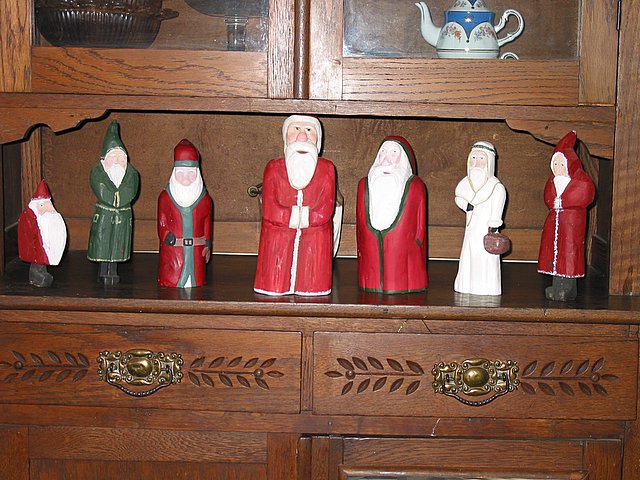
Just a preview of some of Fee's Santa's . He carved these (and probably 20 more several years ago, and they are part of our standard Christmas search. Where t0 put them all?

Friday, December 01, 2006

Poetry Meme

Cam's Poetry Meme

1. The first poem I remember reading/hearing/reacting to was...
I really can't remember-- Nursery Rhymes, children's poetry, and adult poetry were all available in our house.

2. I was forced to memorize (name of poem) in school and........
I don't remember having to memorize any for school, but I memorized dozens inadvertently from constant reading and re-reading. Lotus mentioned "Abou ben Adhem" by Leigh Hunt and without intending to, I memorized it as a child and even without re-reading can still remember much of it. The same with Ella Wheeler Wilcox and "Solitude"--the lines lend themselves to easy memory. Later, I deliberately learned poems by heart because I loved them.

3. I read/don't read poetry because....
Poetry has always been part of my reading. Poetry evokes so much in such little space, and the meaning of a poem can increase on every reading and can change with the events in your own life.

4. A poem I'm likely to think about when asked about a favorite poem is .......
"Advice to My Son" by Peter Meinke, "In My Craft or Sullen Art" by Dylan Thomas, "Spring and Fall" by Gerard Manley Hopkins, and well, too many to mention and too hard to choose.

5. I write/don't write poetry...
I'm too conscious of the lack of poetic ability.

6. My experience with reading poetry differs from my experience with reading other types of literature.....
Re-reading. I can read a poem several times at a sitting and the same poems over and over year after year.

7. I find poetry.....
A revelation. A poet can say perfectly in a phrase or a line - exactly what I feel or think.

8. The last time I heard poetry...
Was on NPR - Galway Kinnell

9. I think poetry is like....
An onion. Not my original analogy, but I can't remember who said it. Good poetry can have layer after layer of meaning.


Two of my favorite quotes about poetry:

Poetry is the language in which man explores his own amazement. ~Christopher Fry

Poetry is the synthesis of hyacinths and biscuits. ~Carl Sandburg

Favorite Reading Chair


When I visit Librarian Avengers, I often find something I like. For example, these chairs from popgadgets are fun and practical for a reader. So thanks to the Avengers, once again, for an interesting take on "my favorite reading chair."
What about your favorite reading chair? Or couch or spot? Is it the same all year round? I know in warm weather, I have a chair outside that sees a lot of service, but the faithful recliner sees me all year. Post a picture of your chair and leave a link here in the comments section so we can see the various seats of imagination. Here is a link to mine.