Bring Me One of Everything was an ARC from Grey Swan Press. Book Description:
"Bring Me One of Everything is a novel which weaves real-life facts and fiction into an eloquent tale of suspense and intrigue. The title of the book is based on what the management of the Smithsonian is said to have demanded when sending ethnographers to native villages to gather artifacts for its collection: "Bring me one of everything." The novel is several layered stories centered around a troubled writer, Alicia Purcell, who has been commissioned to create the libretto for an opera about an anthropologist named Austin Hart. He earned fame in the 1950s for cutting down and bringing back to museums the largest remaining stand of totem poles in the world. They belonged to the Haida tribes who inhabit the Queen Charlotte Islands in British Columbia. Hart's subsequent suicide creates the mystery Alicia attempts to solve as she consults present-day tribe members, Hart's friends and family, and his personal journals. Added to the complications of her search are Alicia's imperious though ailing mother, a cast-off lover, a narcissistic composer, and her own demons of disaffection. But an overarching question dogs her and the reader: why she is so obsessed with Austin Hart and this quest?"
Leslie Hall Pinder's writing is a poetic examination of several themes: the role (and ethics) of museums in acquiring Native Indian artifacts, parent/child relationships, suicide, betrayals and reconciliations, and Haida myth and culture. The novel is at least partially inspired by the life of Wilson Duff, the Canadian anthropologist who became immersed in the world of Haida art and culture and eventually committed suicide.
Alix Purcell must examine the life of Austin Hart who, like the real-life Wilson Duff, becomes obsessive in his study of the Haida, and who also commits suicide. In her pursuit of background on Hart for the libretto she has been commissioned to write, Alix must confront her own youthful intention to end her life which was thwarted by a strange, almost prescient phone call from her mother, a distant and dominating presence during Alix's youth.
Now in her forties, Alix must re-examine and re-work her relationship with her ailing mother as she researches the material for her libretto. Although she was "no longer host to the suicide visitor" that her mother had banished when Alix was 18, her fascination with and need to understand the reasons for Hart's suicide becomes consuming. She feels a distinct connection to Austin Hart and a compulsion to decipher his reasons for his ending his own life.
Fiction. Psychological. 2012. 331 pages.
Search This Blog
Sunday, February 12, 2012
Friday, February 10, 2012
In Progress
I've been reading The Eight by Katherine Neville, a complicated conspiracy novel that pre-dates Dan Brown's The Da Vinci Code. I've marveled at how many historic characters Neville managed to include or mention in the novel: Marat, Robespierre, Talleyrand, Jaques-Louis David, Ben Franklin, Jefferson, Wordsworth, Blake, James Boswell, Rousseau, Napoleon, Catherine the Great, Bach, the mathematician Euler, Benedict Arnold, and on and on. The French Revolution, modern and historic chess players, the Freemasons, OPEC are all included.
It's pretty silly, really--shifting from the period of the French Revolution to the 1980's and back again with a grand and ancient conspiracy of good versus evil in which almost every historic personage has played a part.
------
Today, I picked up the book A Visit to Vanity Fair: Moral Essays on the Present Age by Alan Jacobs. Coincidentally:
1) the epigraph is a quote from W.H Auden, and I am currently rereading The Dyer's Hand, essays and lectures by Auden, and
2) the introduction includes references to Boswell, Blake, and Rousseau, although certainly not in the line of the fantastic conspiracy of The Eight, but rather in the sense that the three were famous essayists.
-------
I've just finished The House of Silk, a modern Sherlock Holmes mystery. Holmes and Watson are always fun; Laurie King writes my favorite modern Holmes' stories featuring Mary Russell, but I've also enjoyed Carolyn Douglas' Irene Adler series.
Sherlock Holmes is well-represented in both films and television. The British television series with Jeremy Brett and some of the old movies with Basil Rathbone have great atmosphere. In sharp contrast, the new series Sherlock starring Benedict Cumberbach, features a modern Sherlock who uses cell phones and texting.
I'm planning to watch Guy Ritchie's Sherlock Holmes tonight. Even if the reviews were pretty bad, it will be fun to watch Robert Downey, Jr. and Jude Law--I hope.
On my list of Holmesian books/movies: They Might Be Giants (a 1971 film in which George C. Scott imagines himself to be Holmes) and The Final Solution by Michael Chabon. I like Chabon and don't know how I missed this one.
Thursday, February 09, 2012
How Far Behind...
can I get in reading blogs? Very, very far.
As I try to catch up, I have to stop and write down titles of books and names of authors, check them out on Amazon, add some to the wish list and, after reading several reviews of Moonwalking with Einstein, finally placing an order. I could have waited to get a copy at the library, but this is one of the "brain" books that I'm sure I'll want to keep.
Algonquin has sent me a bunch more ARCs, I have books I've purchased sitting in a stack by my reading chair, I have overdue library books. A surfeit of reading material and still not reading at my usual pace.
I do have a couple of books to review and have 3 books in progress, but I'm still spending most of my time upstairs in the studio stitching away on prayer flags. I love the idea of having these little flags sending prayers on the breeze.
"Traditionally, prayer flags are used to promote peace, compassion, strength, and wisdom. The flags do not carry prayers to gods, a common misconception; rather, the Tibetans believe the prayers and mantras will be blown by the wind to spread the good will and compassion into all pervading space. Therefore, prayer flags are thought to bring benefit to all."
Mine aren't the traditional Tibetan version with their bright, symbolic primary colors. Mine are usually more subdued, but I've had fun choosing words to include on my flags and embroidering each flag is a meditative process.
I think I've made about eight so far. I spend hours each night stitching while watching Netflix, instead of reading, which is my usual evening activity.
However, I really must return my library books, read some of the backlog of books that have accumulated, and write a couple of reviews!
Sunday, February 05, 2012
A Place of Secrets by Rachel Hore
A Place of Secrets (an ARC) sounded so interesting. Jude works as an appraiser of old books for an auction house, and when she takes a call asking for an evaluation of old books on astronomy, she must go to a country estate in Norfolk to evaluate the library's collection.
While going through the books on astronomy, Jude also discovers the notebooks of Anthony Wickham, the eighteenth century amateur astronomer who collected the books, and she becomes interested in Wickham's own work in astronomy. Then the handwriting changes, and Wickham's daughter Esther is making notations of their studies of the night sky. A woman astronomer adds even more interest and value to the books and instruments in the collection.
In the meantime, Jude is re-connecting with her grandmother, her sister, and her young niece who live near Starbrough Hall where Jude is staying, appraising and researching the library. Old memories and dreams begin to coincide as an ancient mystery and generational repetitions appear. Can dreams be part of a family's inheritance?
Unfortunately, the interesting possibilities never quite work. The writing never fully engages the reader, nor do the characters. The writing takes potentially suspenseful situations and renders them tedious. The author should have stopped after the conclusion to the main mystery, but no, more and more information continues to dribble out, diluting any possible effect of the climax.
The highlights are connected with Euan, the naturalist author living in the game keeper's house on the estate. His character remains pretty flat, but I like his comments about the book he wants to write about astronomy and its cultural importance: "I'm passionate about the necessity of the stars to us as people. Living in cities and towns, and with so much artificial light, we're in danger of losing our connection to the night sky--that sense of wonder about the universe and our place in it."
Close to the end of the book, Euan takes Jude into the woods at night on a moth hunt. Using a mercury vapor light and other equipment, Euan attracts hundreds of moths and Jude records the various species. He tells Jude that "There are twenty-seven hundred species [of moths] in the U.K." and "only sixty-four kinds of butterfly."
I liked these small sections because I love the kind of books that Euan is supposed to write--books about science and nature written for the layman; books that engage the general populace in terms we can understand and with imagination and wonder.
I've just finished reading some very positive reviews by people who found the novel "riveting," but my own opinion is quite different. I liked several elements, but not the book.
Some stringent editing might have been able to pull the many threads together better and weave them together into a more cohesive whole.
Fiction. Historical Mystery. 2012. 382 pages.
Tuesday, January 31, 2012
1Q84 by Haruki Murakami
I'm still not sure what I think about 1Q84. It is the first book I've read by the celebrated Murakami, who has a large and devoted following.The book is so very long that even though I read with interest, when I'd put it down, I felt no great longing to return to it. I ended up reading several books even as I kept plugging away at this one.
The plot is strangely uncompelling, especially given the weird details like a dead goat that functions as conduit for...something, but still not clear what, an air chrysalis that produces...a doppleganger?, a weird cult, and a parallel world with two moons.
Curiosity about how all the strange events hung together and about a possible solution brought me back to the book.
Some disjointed thoughts about style and content:
-filler...paragraph after paragraph, detail after detail
-repetitions--characters repeat themselves, the author repeats himself; literally and in paraphrase
-lots of allusions to popular culture, music, and literature; mostly Western
-loose ends: his father, his mother/the nurse in cat town/the girl friend, the professor, Fuka-Eri, Janacek's Sinfonietta, Sagikake-its strange perverse rituals and its purpose
-such a strange landscape of a novel; vague, amorphous; dream-like
In the end, I found that loose ends remained. My curiosity--unsatisfied.
The novel is purported to be a love story, and I suppose it was. My final opinion hasn't gelled on any aspect of the novel. I didn't hate it. I didn't particularly like it. But I suspect that images from this novel will remain with me which, considering the books I've read that have totally evaporated from my mind whether I enjoyed them or not, is saying something.
Who else has read this? What do you think?
Fiction. I don't know how to classify this one. Alternate history? Dystopian? Magical Realism? 2011. 944 pages.
Monday, January 30, 2012
And Yet More Books in the Mail
Well, I finished 1Q84 last night. I've thought about it off and on all day. Tomorrow, I'll try to order my thoughts and write a review. What to say? What to say? So very strange.
More of the books I ordered from the used book sellers at Amazon arrived:
A Visit to Vanity Fair: Moral Essays on the Present Age by Alan Jacobs. I really wanted The Pleasures of Reading in an Age of Distraction, but this seller didn't have it, so I took what was on offer. I read the review over at Of Books & Bicycles some time ago, and she included it in her Best of 2011.
Making a Garden: Reliable Techniques, Outstanding Plants, and Honest Advice by Rita Buchanan. It is time to begin thinking about gardening.
Moominpappa at Sea by Tove Jansson. I've wanted to read something by Tove Jansson for some time, and I saw that this seller had a couple from the Moomin children's series. The seller didn't have The Summer Book (also recommended by Of Books and Bicycles) or A Winter Book by Jansson; I'll get to them eventually.
So...more books to add to the stack by the reading chair.
Sunday, January 29, 2012
More Books in the Mail
So what has arrived lately?
Nora Ephron's I Feel Bad About My Neck. Recommended by Nancy (Pomegranate Trail)
Kathereine Neville's The Eight. This was one of Annie's (Buttery Books) choices of books to give. I know I've read other positive reviews, but Annie's mention reminded me.
Cara Black's Murder in the Marais (first in Aimee LeDuc series). Recommended by Teresa, who doesn't have a blog, but should because she reads, crafts, and is involved in so many interesting activities including her neighborhood restoration organization and working with children.
Mary Gostelow's A World of Embroidery and Mary Gostelow's Embroidery Book...because over at Bayou Quilts I've slipped into that embroidery cycle again with a vengeance. The reason I'm not reading so much right now is because I'm spending my time with needle and thread. Way too much time.
I ordered all of the above through the used books sellers at Amazon; most of the cost less than $1.00, some as little as one cent. Plus shipping, of course. Certainly a bargain!
These join about 10 others that are on the table (and floor) by my reading chair, next to the overflowing bookcase.
Saturday, January 28, 2012
Black Diamond by Martin Walker
Black Diamond is the third of the Bruno Courreges series. Bruno, the beloved Chief of Police in the small village of St. Denis, has such charm. I'm glad to continue this series, although I haven't read the first one, I really enjoyed The Dark Vineyard, reviewed here.
The black diamond, or winter black truffle, is often referred to as the Perigord truffle. Bruno is an avid truffle hunter and is establishing his own "truffle orchard" with the help of his expert friend Hercule. When he is asked to investigate some irregularities in the truffle market, he finds himself learning more about the economic and political influence of truffles.
Where to start on this novel? There are several sub-plots that Walker manages to connect with great skill: corruption in the truffle market, the murder of his good friend, Asian gangs, illegal immigration and human trafficking, environmental, political, and cultural differences.
Yet it all works and flows together sensibly. In addition to all of the above, there is some fascinating information about truffles and some interesting French history (from Viet Nam to Algeria to Bosnia) easily incorporated. And...the food! Oh, I'm not a gourmand, but Bruno and his friends are, and the meals delight to the point of making my mouth water.
Good characterization, an interesting plot--I'm more a fan of Bruno, Chief of Police than ever.
Fiction. Mystery/Crime. 2011. 320 pages.
Tuesday, January 24, 2012
In the Mail
The Pub Across the Pond by Mary Carter. From a Bookish Librarian--Thanks, Deborah! A disillusioned young woman buys a raffle ticket to own a pub in Ireland...and wins. Sounds like fun!
ARCs:
If You Ever Need Me, I Won't Be Far Away by Bruce Farrell Rosen; a memoir of award-winning writer Bruce Farrell Rosen--some very positive reviews.
A Place of Secrets by Rachel Hore; will be released for sale Jan. 31; a mystery-- an appraiser of books for an auction house, an old estate in Norfolk with a wonderful library and some very valuable books on astronomy to be evaluated. Yes, I like all of the elements!
Bring Me One of Everything by Leslie Hall Pindar
(I've begun this one--I've already flagged a couple of pages for quotes! Love her writing.) Canadians might be especially interested in this one. "The title of the book is based on what the management of the Smithsonian is said to have demanded when sending ethnographers to native villages to gather artifacts for its collection: "Bring me one of everything."
Mr. Langshaw's Square Piano: The Story of the First Pianos and How They Caused a Cultural Revolution by Madeline Goold; nonfiction; "A handwritten note inside a neglected Broadwood square piano built in 1807 leads Madeline Goold on a quest to uncover the remarkable history of these now almost forgotten musical instruments."
I've also ordered a few used books from Amazon that have been on my wish list for a while. Oh, and there are still library books that I haven't gotten through.
What books are in your TBR pile?
Monday, January 23, 2012
The Hypnotist by Lars Kepler
The Hypnotist is a Scandinavian crime novel by a husband and wife team. Reviews on the book are pretty evenly divided. While I had several problems with the book, I still read through it avidly.
The book opens with a gruesome triple murder and the only survivor is so severely injured that he may not survive. Detective Joona Linna asks Dr. Erik Bark to hypnotize fifteen-year-old Josef to get some information about the killer. The information gleaned from Josef gives the case a surprising turn.
One of the problems with the book is that one of the plot lines feels abandoned (and was never quite clear on certain details) when the second plot line takes over. The protagonist doesn't have much of a role in the first half of the novel, and several plot elements seem over-the-top. Details of police procedure seem haphazard and unlikely, as do certain hospital details. The book "feels" like it was written by two different people, and perhaps should have been two separate books. Some writing teams manage to make everything coalesce; other aren't quite as successful.
Nevertheless, I did find the book a page turner. I liked Joona Linna, the detective, and would have preferred that he play a larger role throughout the book. The main characters were well-drawn, and although Josef and his sister Evelyn were a pretty thin, Erik Bark, his wife, son, and father-in-law develop nicely (if not entirely believably).
If the author(s) would tone down some of the violence and shock value stuff, give Joona Linna more attention, and tighten up the plots, I would enjoy seeing this become a series. As it is, it doesn't meet the standards set by other translated Scandinavian crime novels.
Fiction. Scandinavian/Crime/Police Procedural. 2011. 528 pages.
Saturday, January 21, 2012
Now, I Can Begin a New Reading Year
Ahhhh, it feels better to have finally finished reviewing all of the 2011 reads. And my reading this month is picking up after a long January dry spell.
Still reading 1Q84 by Murakami, reading Black Diamond by Martin Walker, and re-reading The Dyer's Hand and Other Essays by W.H. Auden after reading Stefanie's posts (and enjoying it as much as the first time).
Finished The Hypnotist by Lars Kepler, another Scandinavian crime novel. It has some problems, but it certainly kept my interest!
Started The Lantern by Deborah Lawrenson, but it wasn't keeping my interest, so I set it aside for a while. I know a lot of people really liked it, so I'm sure eventually it will get my full attention.
I'm going to fix myself a cuppa and read this evening. Sounds like a plan to me. :)
Friday, January 20, 2012
Clockwork Prince by Cassandra Clare
Clockwork Prince is the sequel to Clockwork Angel (which I reviewed here). A little steam punk (in the best way--there are real characters and a plot--which much of the steam punk fiction I've read simply fails to provide), action, romance, mystery, literary references, and Victorian atmosphere blend well in Clare's latest installment in her Infernal Devices series. The Shadowhunters continue to battle evil and are darn cute while doing it.
When Benedict Lightwood seeks to unseat Charlotte as head of The Institute, everyone must step up to prevent her replacement. Charlotte has been given two weeks to locate the Magister, and in the search for this arch villain, we learn more about Will's background and see Tessa and Jem grow much closer. Will begins to open up and let his defenses down just as Tessa and Jem are beginning a romance. Oh, those pesky triangles.
I could do with a little less emphasis on the romance--don't get me wrong, it is crucial to the dynamics of the story, but in a Victorian society, I think there would be fewer situations in which a young woman would risk so much. So... there were a few minor details that were a bit annoying (Tessa's admiration for Will's looks gets repetitive; I have to admit that Will sounds gorgeous, but Jem is nothing to sneer at either).
Nice touch-- the Warlock Magnus Bain and the connection to the Aesthetes. There are plenty of references to books and poetry, and Will's love of books and reading increases my regard for this bad boy.
The series is YA fiction, but I've enjoyed it very much so far and look forward to the newest addition due out in 2013. That's a long wait, folks.
----------
Last review of books read in 2011! Finally!
Fiction. YA, Steam punk, Fantasy. 2011. 528 pages.
Thursday, January 19, 2012
Wicked Autumn by G. M. Malliet
Wicked Autumn is a cozy mystery featuring Max Tudor, a former MI5 agent turned Anglican priest. Sound intriguing? I wish I'd found it so, but I didn't even find it very interesting.
Few of the characters come to life. There are quite a few characters as almost everyone in the village has had some kind of conflict with the bossy, manipulative Wanda Batton-Smythe, who is so annoying that it is hard to work up any sympathy concerning her demise. If you don't care about the victim, then it is even more important to care about the other characters, but I couldn't drum up much enthusiasm for any of them either.
_____________
Next to last review of 2011 books! Almost done!
Fiction. Mystery/Cozy. 2011. 320 pages.
Monday, January 16, 2012
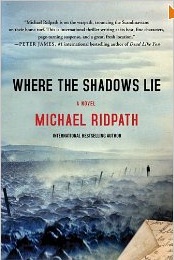
Where the Shadows Lie by Michael Ridpath
Where the Shadows Lie offers lots of Icelandic atmosphere. When Magnus Jonson, a Boston police officer, finds himself the target of a drug cartel, his boss seconds him to the Iceland police force which has requested someone with experience to aid them with their own rising drug and gang related crime. Magnus, born in Iceland, and with duel citizenship, fits the bill. The assignment would also keep him safe from the cartel's attempts to eliminate him before he can testify at the trial that would seriously damage the cartel.
On his arrival in Iceland, he is assigned to the recent murder of a professor of Icelandic myth and legends. Magnus doesn't exactly fit in with the Icelandic force and makes mistakes, but does find himself involved with a beautiful woman who has a definite connection to an ancient Icelandic saga that her family has kept secret for generations and, through her father's friendship with J.R.R. Tolkien, a link to the reason for the professor's murder.
Lots of interesting details about the myths and sagas of Iceland (that Tolkien studied and admired and used in his own LOTR work). Myth and murder and Magnus' personal quest to find his father's murderer all intertwine.
"One Ring to rule them all, One Ring to find them, One Ring to bring them all and in the darkness bind them. In the Land of Mordor where the Shadows lie...."
LOTR fans will find this one interesting for more reasons than the mystery aspect.
Fiction. Mystery. 2011. 352 pages.
The Cuckoo's Child by Marjorie Eccles
The Cuckoo's Child is a historical mystery set in 1909. When Laura Harcourt is offered a position cataloging a library in a small Yorkshire village, she accepts partly because she needs some time to consider what her own direction in life is to be. Laura comes from a wealthy family, but longs for a life of independence and purpose; a removal from her current life might give her time to determine her own path.
When Ainsley Beaumont, the elderly man who hired her, is murdered, Laura discovers that he has left her a small fortune in his will. Laura realizes that her employment was much more deliberate than she had imagined and sets out to discover why Ainsley Beaumont hired her in the first place. (Well, of course, we have a definite clue from the title, but Laura must discover the truth of her situation for herself.)
Some history must be unraveled for Laura to find the answers she needs, and she already has one clue in a partial manuscript that she had discovered in Beaumont's library. At first it was a matter of general curiosity, but after Beaumont's death, Laura recognizes that the manuscript has personal significance.
Fiction. Historical Mystery. 2012. 240 pages.
Saturday, January 14, 2012
:) So this is what they get up to!
Thanks, Nancy!
------
Recently watched When Paris Was a Woman, a documentary of the literary and artistic scene in Paris between the two World Wars:
"Between the World Wars, Paris was the world's artistic capital, attracting cultural titans like Gertrude Stein and others. Through home movies and intimate storytelling, this documentary re-creates the mood of this unique female artistic community."
One particularly interesting aspect was the information about Shakespeare & Company (the original bookstore opened by Sylvia Beach in 1919, not the later one opened by George Whitman). Another thing that was interesting was the flourishing of the lesbian community in Paris in the twenties and thirties. Who'd a thought.
The behavior of James Joyce surprised and disappointed me, but many of the most influential writers of the time found support at Shakespeare & Company and many supported the book store in return.
----
Two more reviews down, but I still have a few more 2011 books to review and hope to finish them by tomorrow.
Friday, January 13, 2012
The Moon Maze Game by Larry Niven & Steven Barnes
The Moon Maze Game is the third in the Dream Park series. A detail that I wasn't aware of when I added the book to my library bag. I have enjoyed previous Larry Niven books, even some he wrote with other authors--not this one, however.
The plot centers on live action role playing, as previously described in earlier books in the series. I don't know if those books were better written and/or had better plots and characterization because I haven't read them. From the beginning I found the skipping around from the characters on earth and those in the lunar colony a distraction, jumpy in a way that felt unnecessary and lacking in continuity. From the less than compelling beginning...it moved into a less than compelling middle and end.
There are almost two plots. Almost--because the plot about the designer of the game and his goals peters out almost immediately. The plot about the kidnappers who enter the game setting was supposed to be exciting, but was actually tedious and lacked suspense.
I would read a little and then put it aside and read another book, then come back to it, but I finally finished it (when I'd run out of other books to read) without ever becoming involved with plot or characters.
Fiction. Science Fiction. 2011. 368 pages.
Me Before You by JoJo Moyes
Me Before You was an ARC from Penguin, UK.
I've been unable to find a good way to describe the book, so I'll begin with a product synopsis:
Synopsis
Lou Clark knows lots of things. She knows how many footsteps there are between the bus stop and home. She knows she likes working in The Buttered Bun tea shop and she knows she might not love her boyfriend Patrick.
What Lou doesn't know is she's about to lose her job or that knowing what's coming is what keeps her sane.
Will Traynor knows his motorcycle accident took away his desire to live. He knows everything feels very small and rather joyless now and he knows exactly how he's going to put a stop to that.
What Will doesn't know is that Lou is about to burst into his world in a riot of colour. And neither of them knows they're going to change the other for all time.
All the way through the book, I enjoyed the characters and their experiences, marveling at the way Moyes balanced an accurate description concerning details of a quadriplegic's life and the struggle Lou has in her attempt to improve Will's situation. Plenty of light moments offset the grimness of certain aspects of Will's life, and Moyes manages to include both humor and grim reality without becoming maudlin or sentimental.
Let's face it, the life of a quadriplegic is a struggle for survival with so many medical issues in play. Will is often angry and sarcastic and depressed, but Lou's presence in his life keeps him interested. Moyes handles the subject with sensitivity and tackles some serious issues concerning freedom of choice.
Lou and Will are characters worth meeting, their stories are interesting, and although there may be tears, overall, the novel is uplifting.
Fiction. 2012. 481 pages.
Wednesday, January 11, 2012
Long Absence
I still haven't reviewed the rest of the books from 2011. It has become a challenge, and I'm determined finish those reviews before the week is out.
In the meantime, I haven't finished a single book in 2012. Nearly two weeks without finishing a book! Almost unheard of around here. I have been reading 1Q84 and enjoying it, but it sits alone and neglected most of the time; the new year is certainly getting a slow start. Last year, I read 160 books, a new record for me. This year, however, I hope to read fewer books, read better books, and read more nonfiction. That is the goal at least.
So what have I been doing that has taken up reading time? Making prayer flags, eco dyeing, embroidering (while watching the UK version of Being Human and Stephen Fry's Kingdom), and sculpting or finishing up a couple of dolls.
I've also been taking some Yang style tai chi classes. Haven't done tai chi in several years and learned Wu style originally; the differences may be small, but are difficult. My body wants to convert movements to Wu style and needs frequent reprimanding, but I'm enjoying the larger, looser movements of Yang.
After a long holiday break, I'm also trying to get back to my yoga classes. Both tai chi and yoga are good for both body and spirit, and I always feel lighter after classes.
Fee and I went to see Tinker, Tailor, Soldier, Spy this past weekend. It has been so long since I've read LeCarre that all I could remember about the novel were George Smiley and Karla--not a bit of the plot. Of course, I read it in the late 70's or 80's and when I can barely remember what I wore yesterday, it isn't surprising that the plot seemed brand new!
OK - back to my original thought: I will finish reviewing last year's books by the end of the week. Fingers crossed.
In the meantime, I haven't finished a single book in 2012. Nearly two weeks without finishing a book! Almost unheard of around here. I have been reading 1Q84 and enjoying it, but it sits alone and neglected most of the time; the new year is certainly getting a slow start. Last year, I read 160 books, a new record for me. This year, however, I hope to read fewer books, read better books, and read more nonfiction. That is the goal at least.
So what have I been doing that has taken up reading time? Making prayer flags, eco dyeing, embroidering (while watching the UK version of Being Human and Stephen Fry's Kingdom), and sculpting or finishing up a couple of dolls.
| Autumn is finally finished. She languished half dressed for at least a month, maybe more, before I made her trousers. |
| Getting ready to make prayer flags. The strips are 5 x 11", then the top is folded down to make a passage for the twine to pass through. Finished size is 5 x 8" -- I have 8 in progress now. Check out the Prayer Flag Project for more information about prayer flags and check here to see examples. Jotted down possible embroidery designs on an envelope; I'm using some of my eco dyed fabrics, linen, and muslin for the flags -- raw edges, unsophisticated style. |
![]() |
| eco dyed blues from, of all things, red cabbage |
| This lady now has a cap and white hair. |
| Experimenting with fly stitch and blanket stitch variations on Prayer Flag #1. |
After a long holiday break, I'm also trying to get back to my yoga classes. Both tai chi and yoga are good for both body and spirit, and I always feel lighter after classes.
Fee and I went to see Tinker, Tailor, Soldier, Spy this past weekend. It has been so long since I've read LeCarre that all I could remember about the novel were George Smiley and Karla--not a bit of the plot. Of course, I read it in the late 70's or 80's and when I can barely remember what I wore yesterday, it isn't surprising that the plot seemed brand new!
OK - back to my original thought: I will finish reviewing last year's books by the end of the week. Fingers crossed.
Friday, December 30, 2011
Mind's Eye by Hakan Nesser
Mind's Eye , translated by Laurie Thompson, is the first in the Inspector Van Veeteren series by Nesser; so now I've read three novels in this series.
When Janek Mitter awakens one morning with a serious hangover, he finds the bathroom door locked from the inside. His wife doesn't answer, so Mitter uses a screwdriver to open the door and finds his wife drowned, face down, in the bathtub.
Although he vehemently denies having murdered his wife, Mitter has no memories after a certain point in the previous evening. Van Veeteren thinks it is likely that Janek Mitter is guilty, but he admits that he isn't completely convinced. Van Veeteren attends Mitter's trial, still vaguely bothered about the crime, and although Mitter is convicted and sentenced to a mental institution, Van Veeteren remains uneasy about the man's guilt.
When someone stays after visiting hours at the mental institution and murders Mitter, Van Veeteren enters the investigation with renewed determination.
Why was Eva Mitter murdered and what prompted the killer to wait so long to murder Janek Mitter, when he could have done so at the same time he killed Eva? The answers lie in the past and Van Veeteren's only clue is a letter Janek Mitter wrote shortly before his death.
In order of their original publication (although not in order of English translations):
Mind's Eye
Borkman's Point
The Return
Woman with a Birthmark
The Inspector and Silence
I've read the titles in italics and look forward to reading Borkman's Point and The Inspector and Silence which have also been translated.
Fiction. Crime/Mystery/Police Procedural. orig. publ. 1993. Eng. trans. 2008. 277 pages.
The Hand that Trembles by Kjell Eriksson
The Hand that Trembles is translated by Ebba Segerberg and features Swedish Inspector Ann Lindell. I've read one other novel by Eriksson that features Lindell, The Princess of Burundi and didn't have any strong feelings one way or the other about it (I read it in 2006). I liked this one better.
The Hand that Trembles begins in 1956 with the relationship between the boy Sven-Arne Persson and his Uncle Ante who fought the fascists in Spain. The relationship is unusually strong, but not always easy.
As a middle-aged adult, Sven-Arne has become a county commissioner with the reputation of a man to watch for further political achievement. Then one day, he walks out of a meeting and disappears. The case remains unsolved, but no reason for suicide, kidnapping, or just abandoning his wife is uncovered. Twelve years later, the son of a neighbor recognizes Sven-Arne in Bangladore, India.
Back in Sweden, Ann Lindell is disturbed that her mentor in the police department has become old and discouraged after surgery for a brain tumor. She tries to interest him in the Sven-Arne case when the reports of his sighting in India become known. Berglund remembers the case, but isn't terribly interested. He decides to delve into one his own unsolved cases involving the murder of an old man in a wheel chair, a cold case that has continued to haunt him.
In the meantime, Lindell is assigned to an investigation involving the discovery of a severed foot in a lonely rural area where the few inhabitants know each other well, yet remain somewhat isolated from each other. Her investigation meets a lack of response from the inhabitants, who deny knowing of any missing woman in the area. The foot definitely belonged to a small woman, but how did it end up in this small rural community, who was she, and who killed her?
In the midst of the different investigations, Ann Lindell attempts to come to grips with her own life as a single mother, with her sense of abandonment by her mentor who is not recovering emotionally as quickly as she would like, and with some differences in views among her colleagues.
The various strands and investigations are eventually tied together or resolved separately according to the situation. There are a quite a few threads to this novel, many involving the sense of separation and aloneness that the characters are experiencing. Whether or not they are physically isolated, many of the characters are emotionally isolated in some way.
Fiction. Mystery/Police Procedural/Crime. 2011. 310 pages.
I have one more Scandinavian author to review (Hakan Nesser's Mind's Eye), a mystery set in Iceland by an English author (Where the Shadows Lie by Michael Ridpath), a historical English mystery (The Cuckoo's Child by Marjorie Eccles), and an ARC that I'm not sure how to classify (Me Before You by JoJo Moyes). Then I'll be finished with this year's reviews!
Thursday, December 29, 2011
Until Thy Wrath Be Past by Asa Larsson
Until Thy Wrath Be Past by Asa Larsson; translator: Laurie Thompson, who has translated Henning Mankell, Hakan Nesser, and Ake Edwardson. Another Rebecka Martinsson mystery, Until Thy Wrath Be Past begins with seventeen-year-old Wilma describing the day she and Simon died.
Wilma's voice is so charming that I couldn't help but form an attachment to her character immediately. Although the supernatural element could have presented a problem, Larsson manages to weave it into the story effortlessly, making it feel entirely appropriate and necessary.
Rebecka Martinsson, who has recovered from her last awful outing, has left her old firm and become District Prosecutor for Kiruna, the rural area where Martinsson grew up. In a period of transition in both her work and her personal life, Martinsson finds herself resisting the pleas of her lover to return to Stockholm. She knows she has choices to make, but she isn't ready to make them.
When Wilma's body is discovered, Wilma has the strength to move about and is no longer confined under the ice of the river in which she was found. In keeping with her character, Wilma has plans for solving her murder. This is never stated implicitly, but Wilma's behavior is obvious. She visits Martinsson in a dream and tells her that she didn't die in the river where she was found.
The next day when Martinsson is informed about the discovery of Wilma's body, she visits the pathologist and "wonders" if Wilma actually died in the river. A test of the water in the girl's lungs determines that Wilma died elsewhere and was moved to the river.
The characters are all three-dimensional and the novel has a psychological aspect that works easily in tandem with the supernatural element. Familiar characters from previous novels appear and gain substance, and Larsson's portrayal of one of the bad guys creates a surprisingly well-developed character.
Another engrossing thematic thread is one that appears over and over again in Swedish crime fiction--the Swedish collaboration with the Germans during the war. It appears in the work of Henning Mankell, Jo Nesbo, Steig Larsson, Asa Larsson, and others. Sweden's conflicted/ambiguous position during the war appears to be an unresolved and pervasive issue in Swedish society.
The novel provides some unexpected turns. Not surprising plot twists that leave you with your mouth open, but rather interesting developments that digress from a straight-line plot sequence. I did have a quibble about a segment of the resolution, but found it easy to overlook.
Larsson's debut work Sun Storm (original title, The Savage Altar) received the Swedish Crime Writer's Association's prize for best debut novel. The sequel, The Blood Spilt was chosen as Best Swedish Crime Novel of 2004. As with all Scandinavian crime fiction that I've read, there is a particular darkness to Larsson's work, but I enjoy them.
Originally, I had titled this post "Three Scandinavian Mysteries," but the review of Until Thy Wrath... became longer than intended (and still just skims the surface), so I'll review the others separately, too.
Fiction. Crime/Mystery/Police procedural. 2011. 256 pages.
Wednesday, December 28, 2011
Revenger by Rory Clements
Revenger is a historical mystery set in the Elizabethan period. The novel casts John Shakespeare (Will's older brother) as an "intelligencer" for Sir Francis Walsingham, the great spymaster who gathered intelligence both at home and abroad that might help protect and strengthen Queen Elizabeth's reign. Walsingham's intelligencers provided information that helped prevent several domestic plots against the queen and also proved extremely useful in foreign diplomacy.After the death of Walsingham, John Shakespeare retired from the game and now runs a school for boys. Robert Devereaux, the Earl of Essex, recruits John to locate a young woman who may be Elizabeth Dare from the vanished Roanoke Colony. If it is Elizabeth, how did she survive the fate of the rest of the colonists and return to England?
Robert Cecil, who replaced Walsingham as Elizabeth's Secretary of State, then approaches John and requests that John keep a close eye on the Earl of Essex, who may have some dangerous plans of his own. Cecil and Essex have a personal rivalry, but Cecil has specific suspicions regarding Essex's current activities.
The Catholic/Protestant divisions have a great deal to do with the uncertainty of the times, and Clements addresses the danger of being a Catholic or even having Catholic sympathies during Elizabeth's reign. Clements also covers many other unpleasant elements of the period: the double-dealing and intrigue, the use of torture, the violence, the poverty, and the political machinations. While many of the situations are purely fiction, they give insight into Elizabethan political and social conventions.
Although the explanation about what happened to the Roanoke Colony and about the Earl of Essex's marriage plans are speculative fiction, the novel includes plenty of actual events.
Fiction. Historical Fiction/Mystery. 2011. 448 pages.
Tuesday, December 27, 2011
The Rose Garden by Susanna Kearsley
The Rose Garden is both a time travel novel and chic lit. As much as I love the idea of time travel, I find a lot of fantastical things --magic, fairies, and colonies in outer space-- much easier to accept. For some reason, I always quibble with time travel. Not when I read about the possibilities that quantum mechanics hypothesizes; I'm ready to entertain the real possibility, but I find fictional accounts impossible to reconcile.
I liked the setting and liked the characters (almost too many characters were very likable). If the Cornish smugglers felt a little gentlemanly for their trade, that was OK, too. And if so many romances worked out well, I can enjoy a few happy endings once in a while.
However, likable as some of the characters are, they felt like placeholders, and the romances were a bit conveniently coincidental. The time travel simply had too many discrepancies--or too few "logical" explanations.
Go ahead and make up a "logical" explanation for what causes the slippage, for the differences in the amount of time spent in past and present, for the arrival in a particular period or location--something more than the house being built on ley lines--and maybe I could suspend my disbelief.
I had no problem reading it, no place that I wanted to walk away without finishing, but neither was it a particularly memorable experience.
Fiction. Chic Lit. 2011. 430 pages.
Wednesday, December 21, 2011
3 Mystery/Police Procedurals
A Restless Evil - Ann Granger - from Library Journal: "About 20 years ago, the woods at Lower Story were frequented by a still uncaught serial rapist. Now, shortly after a hiker discovers skeletal remains in the woods, a female churchwarden meets her untimely end in the local church: could the two events be connected? Supt. Alan Markby (Shades of Murder) thinks so, especially since he failed to find a perpetrator in the earlier case. With assistance from lover Meredith, he delves into the rumors and facts surrounding both cases, hoping for a break. This is a rock-solid British village procedural, complete with detailed setting, slightly degenerate denizens, and ongoing personal conflicts. "
Not bad. I enjoyed it enough to be interested in other Mitchell & Markby mysteries, especially since other reviewers indicate that this is not the best in the series. If A Restless Evil kept me interested and it wasn't the best, then maybe I'll enjoy others in the series, too.
Fiction. Mystery/Police Procedural. 300 pages. 2002.
Among the Departed - Vicki Delany. A constable Molly Smith novel. When bones are discovered in a wilderness hiking area, an old missing persons case comes back into play. As it turns out, the bones belong to the father of one Molly's childhood friends. Brian Nowak's disappearance fifteen years earlier has left the Nowak family weird and dysfunctional. Many had written Brian's disappearance off as an escape from his wife, but the bones prove otherwise.
Nicky Nowak returns home for the funeral, and the small town of Trafalgar, BC must look again at a disappearance that is now classified as a murder.
Fiction. Mystery/Police Procedural. 277 pages. 2011.
Woman with a Birthmark - Hakan Nesser. This is the second Inspector Van Veeteren mystery that I've read; only four of his 20 Van Veeteren novels have been translated into English. I read The Return earlier this year and plan to read all English translations in the series.
Hmmm. Just discovered that there are several films based on Nesser's books. Will be adding to Netflix que.
If you enjoy Scandanavian crime fiction, do give this series a try. Woman with a Birthmark finds Van Veeteren and his crew confronted with a strange murder and no indication of a motive. Then another similar murder, and Van Veeteren, Reinhart, and the other detectives begin searching for any connection between the two men. And then another murder....
Fiction. Mystery/Police Procedural. 1996. Trans. 2009. 336 pages.
Two to Skip
Brainrush - Richard Bard - a 99 cent Kindle read. Product description: "When terminally ill combat pilot Jake Bronson emerges from an MRI with extraordinary cognitive powers, everyone wants a piece of his talent--including Battista, one of the world's most dangerous terrorists. To save his love and her autistic child, Jake is thrust into a deadly chase that leads from the canals of Venice through Monte Carlo and finally to an ancient cavern in the Hindu Kush Mountains of Afghanistan--where Jake discovers that his newfound talents carry a hidden price that threatens the entire human race.
An original weave of current events bound by colorful locations and cutting-edge technology, Bard's novel is a must-read for fans of Michael Crichton, James Rollins, Clive Cussler, and Brad Thor. A dynamic mix of fast-paced action and thought provoking soul, this book challenges the reader to keep pace with every sharp turn and shocking twist. Acclaimed by fans of action, sci-fi, and political thrillers alike, Brainrush is one of the most innovative and entertaining books of the year."
Started out fine, but quickly went downhill. It has gotten great reviews and was OK for the price (almost free), but the characters had no depth and were sterotypical, the plot was too fantastic and too wide-ranging--from newly discovered brain capabilities to international terrorists to love story. Oh, yeah, a deeply moving love story based on a few hours acquaintance. And by the way, the product review mentions the love interest's autistic child, but she has no children. There are autistic children being experimented on, however, to turn them into terrorists. blah.
A Dozen Deadly Roses -- Kathy Bennett. Another 99 cent Kindle. Oh, when will I learn! Another superficial and silly disappointment. Product Description: "Los Angeles Police Officer Jade Donovan is being hunted. There’s the lieutenant who’s out to get her, the psycho who’s stalking her and leaving dead roses at her door, but most frightening of all, she’s been assigned to partner with her son’s father, Mac Stryker. Mac doesn’t know he’s Donnie’s dad, and Jade will stop at nothing to prevent him from finding out and possibly taking away her son. She will protect and defend him at all costs."
Although, once again, the majority of the reviews are positive, read the 2 star reviews to get a better idea of content.
Sunday, December 18, 2011
The Tin Ticket: The Heroic Journey of Australia's Convict Women by Deborah J. Swiss
The Tin Ticket is an enthralling examination of the lives of women convicts who were sentenced to deportation to Van Dieman's Land (modern Tasmania) and who, along with the many male convicts, became part of the founding generations of Australia.
The book focuses on four women convicted of minor crimes and sentenced first to the horrors of Newgate prison (Ludlow Tetter's young daughter accompanied her to prison and to Van Dieman's Land), then to the four month sea journey in disgusting conditions, to arrive in Van Dieman's land and be incarcerated in the House of Corrections where they endured hard labor and shocking abuses.
The treatment of the poor in general and poor women and children in particular, the ways in which they were exploited and mistreated may come as a surprise even to Australians who are well aware of the convict past that helped populate the land. What passed for justice in the UK was often a way to remove the poor from their doorstep and deposit them where slave labor was needed. "Under the Transportation Act of 1718, 162,000 women, men and children were exiled to Australia from 1788 to 1868." At least 25,000 exiles were women.
The sentences were generally for seven years. Seven years of hard labour, mistreatment, sexual abuse, separation from their children, and more, for crimes of petty theft or forgery. Stealing a loaf of bread to feed one's children could easily mean not only imprisonment, but exile.
My only complaint is the way the author tries to "novelize" certain segments, but her research is thorough and well-documented, the book is informative and fascinating, and the ultimate triumph that many of these women achieved is amazing given the circumstances.
The following video shows some interviews with descendants of some of the women.
This book is another book that I read during October/November and am just now getting around to reviewing.
The Tin Ticket was an ARC from Jocelyn Kelley of Kelley and Hall. Thank you very much for the opportunity to read this book.
Nonfiction. History. 2011. 352 pages.
Friday, December 16, 2011
The Affair by Lee Child
The Affair is the latest in Child's Jack Reacher series. I read this back in October or November, and as anyone who reads this blog knows, Jack Reacher is one of my favorite characters. Lee Child writes great action-packed adventure and never fails to keep me wanting more Jack Reacher.
The Affair flashes back to Reacher's days as an elite MP and gives insight into the reasons Reacher leaves the military and begins his Paladin-like career as a wanderer. Sent undercover to find out who murdered a young woman and to do damage control if necessary, Reacher ends up in a small Mississippi town near an army base. Looking into the current murder, he discovers that it wasn't actually the first by this killer (how the authorities fail to connect murders of young women in a fairly short period of time in a small town seems a leetle bit incompetent, but there you go). Yes, there are certainly elements that recur from book to book and no, the plots aren't always plausible, and yet Lee Child continues to captivate his audience.
This was not my favorite by any means, but it was still a page-turner.
Fiction. Action/Adventure/Mystery/Suspense. 2011. 416 pages.
Sunday, December 11, 2011
Hey girl.
I fell in love with the Handmade Ryan Gosling site only to discover that there is also a Literary Ryan Gosling site and a Librarian Ryan Gosling site!
Friday, December 09, 2011
Veil of Lies by Jerry Westerson (Merely Mystery Challenge)
Veil of Lies is a medieval mystery set in the same period as Cassandra Clark's Sister Hildegard series (The Red Velvet Turnshoe, Hangman Blind, The Law of Angels). In 1383, Crispin Guest is a disgraced knight, stripped of rank, lands, and possessions after being implicated in a plot against Richard II. His mentor, John of Gaunt, managed to save his life, but for political reasons abandons Guest to his fate.
Guest has established himself as a man who finds things and has earned the title "The Tracker," but his skills just barely keep him in food and lodging. In this debut novel, Guest has been hired by a wealthy merchant, but before he could report back, the merchant is found murdered in a locked room.
For various reasons, Guest pursues this new conundrum and finds puzzle after puzzle to pursue. Crispin Guest is full of flaws and is having serious difficulties connecting with individuals who are so far below his previous rank. His previous friends (including John of Gaunt, the Duke of Lancaster, and Geoffrey Chaucer) are no longer available to him because of his connection to the treasonous plot against the king. Associating with them would put them in danger.
Chaucer is actually a mere mention, but I have hopes that his character will become more important in the next two novels in this series.
I enjoyed the mystery, and even if I have some criticisms, I look forward to the next one in the series.
First in the Merely Mystery Challenge.
Fiction. Historical Mystery. 2009. 288 pages.
Wednesday, December 07, 2011
Merely Mystery
A mystery challenge at Musings of a Bookish Kitty is right up my alley. Find out more about the Merely Mystery Reading Challenge 2012. Check it out and join in!
I love all kinds of mysteries, and this challenge will be a great excuse to indulge myself. Not that I wouldn't be reading mysteries anyway, but it sounds better if there is a reading challenge to give it gravitas.
Subscribe to:
Posts (Atom)