Search This Blog

Monday, December 05, 2011

5 More Catch-up Reviews

I have gotten so far behind on reviews that using product descriptions, etc. and grouping them together seems the only way to get back on track.


The Silent Governess by Julie Klassen was a Kindle bargain buy.

from Booklist:  When Olivia Keene arrives home to find her father strangling her mother, she picks up the nearest blunt object and bashes him on the head. Fearing that she will be charged with murder, Olivia, with her mother’s help, flees. While en route to a potential position with an old friend of her mother’s, Olivia finds herself caught up in a series of dangerous adventures culminating in her arrival at Brightwell Court, where she accidentally eavesdrops on a conversation between Lord Edward Stanton Bradley and his father, the Earl. Realizing that the information the now speechless Olivia unknowingly possesses could ruin him, Edward insists that she accept a position in his family’s nursery, never expecting that the silent new governess might be his one hope of salvation. Klassen expertly infuses her Regency-set inspirational tale with a gothic atmosphere, resulting in a sweetly intriguing romance worthy of Victoria Holt. --John Charles


My opinon:  :)  I have to say that I enjoyed this romance.  It was a fun read.


A Beautiful Blue Death by Charles Finch was another Kindle bargain read.


from Publisher's Weekly:  Set in England in 1865, Finch's impressive debut introduces an appealing gentleman sleuth, Charles Lenox. When Lady Jane Grey's former servant, Prue Smith, dies in an apparent suicide-by-poisoning, Lady Jane asks Lenox, her closest friend, to investigate. The attractive young maid had been working in the London house of George Barnard, the current director of the Royal Mint. Lenox quickly determines that Smith's death was a homicide, but both Barnard and Scotland Yard resist that conclusion, forcing him to work discreetly. Aided by his Bunter-like butler and friend, Graham, the detective soon identifies a main suspect, only to have that theory shattered by that man's murder. Finch laces his writing with some Wodehousian touches and devises a solution intricate enough to fool most readers. Lovers of quality historical whodunits will hope this is the first in a series. (June) 


My opinion: Yep!  I liked this one, too. I will look for more in this series.  Light, but entertaining.


The Sunday Philosophy Club  -Alexander McCall Smith-

Amazon description:  Introducing Isabel Dalhousie the heroine of the latest bestselling series from the author of the No. 1 Ladies’ Detective Agency. Isabel, the editor of the Review of Applied Ethics and an occasional detective, has been accused of getting involved in problems that are, quite frankly, none of her business. In this first installment, Isabel is attending a concert in the Usher Hall when she witnesses a man fall from the upper balcony. Isabel can’t help wondering whether it was the result of mischance or mischief. Against the best advice of her no-nonsense housekeeper Grace, her bassoon playing friend Jamie, and even her romantically challenged niece Cat, she is morally bound to solve this case. Complete with wonderful Edinburgh atmosphere and characters straight out of a Robert Burns poem, The Sunday Philosophy Club is a delightful treat from one of our most beloved authors.


My opinion:  I did NOT find it a delightful treat. I found it annoying and am surprised it didn't go into the DNF file, but I hung in there until the bitter end.


No Trace  by Barry Maitland-- a  Brock and Kolla mystery.

Amazon description:    Cited as one of the top ten crime novels of 2006 (Kirkus Reviews), No Trace is the finest novel yet by one of best crime novelists of our time.
In a London neighborhood known for its artists and bohemian style, six year old Tracey Rudd is abducted from her home without any warning, or sign of violence. She is the third child abucted under similar circumstances in recent weeks. But this case is different. She is the daughter of notorious contemporary artist Gabriel Rudd, best known for the grotesque "Dead Puppies," a work centered around his wife's suicide five years earlier. While Rudd exploits Tracey's abduction as an inspiration for a major new work in his upcoming exhibit, D.C.I. David Brock and Detective Sergeant Kathy Kolla hunt for the missing girls' kidnapper, who is suspiciously connected to the eccentric community of artists, dealers, and collectors in the neighborhood.

My opinion:  Some very tense moments in this one.  I'll be giving another one in the series a try.


Silent Mercy by Linda Fairstein is an Alexandra Cooper novel.

Publishers Weekly:


In Fairstein's exciting 13th novel to feature New York ADA Alexandra Cooper (after Hell Gate), a middle of the night call brings Alex and NYPD detectives Mike Chapman and Mercer Wallace to Harlem, where the decapitated body of a young woman has been burning on the steps of the Mount Neboh Baptist Church, originally a synagogue until the neighborhood changed. Initially, the authorities suspect a hate crime until another dead woman turns up at a cathedral in Little Italy a few days later. A religious motive emerges, especially since both victims were considered "outcasts" because of their uncompromising demands about the role of women in organized religion. Meanwhile, Alex is prosecuting a defrocked Catholic priest accused of molesting boys, a high-profile trial that a politically connected bishop wants stopped. Fairstein excels at describing New York's complicated religious history as well as the vagaries of the city's legal and religious politics. 12-city author tour. 

My opinion:  I usually enjoy Fairstein's novels and this one was no exception.  I always like the historical information about New York that she includes.

--
OK, I'm making headway on reviews.  Trying to catch up on some blog reading, too.  

Saturday, December 03, 2011

Sewing, Dyeing, Surface Design

For the last month, I've done a lot less reading of fiction because I've been busy with the following books and with dyeing fabric, embroidering, and doll-making.

I've still got several fiction books to review, but I'm grouping all of these non-fiction books together as they easily fit into one broad category.  Many of them I read in August and September.

Sew Wild - Alisa Burke - Various techniques of painting, stamping, stenciling, and other surface design techniques for fabric.  Not exactly my style and nothing really new, but informative, and I can adapt some of the techniques for some projects.

Create with Transfer Artist Paper - Lesley Riley - I still haven't tried this, but am eager to.  I have some of Riley's transfer paper and plan to use it in some of my projects, but have been too busy with the eco dyeing and eco printing.

Stitch Alchemy - Kelly Perkins - More surface design techniques.  As with the previous two, I've read them and intend to use them, but haven't yet.

Plaster Studio - Stephanie Lee, Judy Wise - Using plaster in mixed media projects.  I really like this book, and it will be useful when I get around to actually trying the techniques.

The Art of Manipulating Fabric - Colette Wolf - I didn't find this one particularly useful, but it will be a good reference.

Three-Dimensional Embroidery - Janet Edmonds - not exactly what I wanted.  Not useful for me, although certainly might be for others.

Hand Dyeing Yarn & Fleece - Gail Callahan - a good dyeing reference, although right now I'm interesting in eco dyeing, rather than synthetic dyes.

The Art and Craft of Natural Dyeing - J.N. Niles - haven't actually finished this one, but the dyes in this one call for some mordants that are toxic, and I don't want to fool with disposal.  Some dye recipes might be useful, though, if I use other mordants.

And My Favorites:


**Eco Colour - India Flint - I've had this since the summer, have read it twice all the way through, and consult it frequently.  India Flint is an inspiring resource for eco dyeing and printing.

**The Handbook of Natural Plant Dyes - Sasha Duerr - Another inspiring book on natural or eco dyeing.  Very useful.


Some dyed with acorn dye, some with a leaf mixture dye, and some with cranberry.  Also some leaf prints from bundling and steaming.  Fabrics:  some habotai silk, some muslin, some flour sacking.

Habotai silk embroidered, gathered, twisted.

Several dolls in progress.


More progress.

Friday, November 04, 2011

As a Mystery Lover

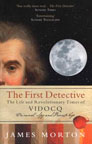
I am interested in this book:


The First DetectiveJames Morton
The First Detective: The Life and Revolutionary Times of Vidocq: Criminal, Spy, and Private Eye (2004; Overlook Press 2011) is an entertaining biography of the inspiration for both Gaboriau's Lecoq and Poe's Dupin. Eugene-François Vidocq (1775-1857) led an amazingly complicated life. His adventurous "career" began with ripping off his parents and going on the lam, although his mother repeatedly bailed him out and followed him around France. Vidocq enlisted in the French army at an early age, where he engaged in many a fencing duel before deserting. His military career was typified by repeated enlistments and desertions. Frequently imprisoned, he demonstrated his innate abilities by quickly adapting to the prison power structure, while also acting as a snitch. Vidocq was also a talented escape artist; when the authorities managed to catch him, they had a difficult time holding onto him. When Vidocq tried to go straight, he had to fend off his former associates, but also found jobs for many of them as police or private detectives. Ultimately, his fame rests on his dual role as founder of the Brigade de Sûreté (undercover police detective force) in 1811 and as creator of the first private detective agency (Bureau des Renseignements) in 1833, as well as inspiring Poe, Gaboriau, and other authors. His 1827 ghost-written autobiography and other memoirs are unreliable, but Morton has sorted through the historical records and provides a densely detailed account, with interesting asides reminding us of the wild and crazy criminality and chaos of Vidocq's time. Footnotes abound in this relatively brief and highly readable biography.  (via SYKM newsletter)


And as a Historical Mystery lover, I was saddened to learn that there will be no more in The Mistress of the Art of Death series featuring Adelia Aguilar.


Ariana Franklin's (Diana Norman)  obituary.

Thursday, November 03, 2011

The Law of Angels by Cassandra Clark

The Law of Angels  is the third book I've read in this medieval mystery series, and Cassandra Clark has created another vivid view of the events of 1385.  Tying together the strands of her story with the historical events, Clark manages to involve the reader in the life of Sister Hildegaard as she attempts to protect two young charges from the danger that threatens them , and at the same time, give insight into the political issues of the time.

Historical novels always intrigue me because I love reading about what might have happened to individuals in the midst of another historical era. Cassandra Clark's Sister Hildegaard series provides interesting mysteries and characters that continue to develop as they  face the difficulties of the 14th century--the personal (even if fictitious) touch.  Some elements  that interested me concerned the Miracle or Mystery Plays of the time, Wycliff's Bible, the papal schism, and of course, there are still the after-effects of Wat Tyler's murder and the John of Gaunt/ Richard II political turmoil.

Thumbs up.

Other Reviews/opinions:  Genre Go Round, anyone else?

Fiction.  Historical Mystery.  2011.  368 pages.

Tuesday, November 01, 2011

A Dead Man's Tale by James D. Doss

A Dead Man's Tale is one of the strangest mysteries I've read.  It is part of a series that I'd never heard of, but will investigate again.


Charlie Moon (all seven feet of him) is a Ute rancher whose household includes his eccentric Aunt Daisy Perika (also a Ute Indian, shaman, and possibly, a witch).  On a normal, run-of-the-mill day, "...Daisy would commit a fresh outrage sufficient to shock a deranged Nazi storm trooper."  An outrageous old woman, Daisy insinuates her way into quite a few things she shouldn't.  She also has an occasional visit from a raucous crow who might be the deceased Debra Darkwing, an old friend.


The plot centers on millionaire Samuel Reed's remembering of a future (?) that entails his own murder.  This unusual ability may have a lot to do with his success on Wall Street.  Samuel gives Charlie Moon and Moon's best friend Police Chief Scott Parrish the date and time of his murder and makes a wager that the two can't keep him alive.  It is a bet that Samuel Reed wants to lose.


It takes a little while to adjust to the manner in which the tale is told.  Doss sometimes goes over the top, but overall, I really enjoyed the bizarre and unorthodox story, the quirky characters, and the wisecracking.


Recently, I read Nymeth's post On Ambivalence (something I often feel about a book), and this novel fits that description.  Doss may go a bit too far at times, but there was plenty that kept me involved and amused, and Aunt Daisy is worth disregarding any flaws.


Other Opinions:  The Cataloger's Reading List,  Murder by Type, My Favorite Mystery  


Fiction.  Mystery.   2010.  296 pages.

Monday, October 31, 2011

Pride and Prejudice and Zombies by Seth Graham-Smith (R.I.P)


Pride and Prejudice and Zombies  is another book that I hoped to like, but instead found tiresome. It isn't that I dislike mash-ups.  I do like them--or some of them.  Last year I read Shakespeare Undead for the R.I.P. challenge and found it great fun.

I love Jane Austen and P & P in particular.  I've re-read the novel many times, and it has never failed to make me chuckle and to marvel at Austen's insight into human nature.

I like zombies.  Serious and scary zombies and zombie parodies, both.   Loved seeing How to Survive a Zombie Apocalypse (a zombie boot camp) when we were in Edinburgh.

So...what went wrong (for me) with P & P & Z?

1.  Elizabeth in P & P & Z is NOT the witty Elizabeth Bennett of the original.  E. B. in this pastiche is simply unpleasantly blood-thirsty and offensive.  The humor concerning the zombies is forced and crude compared to Austen's sophisticated satire.

2.  The zombies are a gimmick.  In spite of the frequent zombie attacks, they are not frightening.  Or maybe I just wanted the zombies to go ahead and eat the brains of all of the characters--the entire clans Bennet, Darcy, Collins, Bingley, etc.) --preferably in the first chapter.

3.  I read the whole damn thing.  It took forever, and I probably read 5 or 6 other books during the same period.  Finishing the book is not a feat of which I'm proud.  I kept hoping that it would really engage, and when it didn't, I plowed ahead anyway.  Masochistic.

My last book for the R.I.P. challenge.

Fiction.  Mashup/Pastiche/Parody/Supernatural.  2009.  317 pages.

Thursday, October 27, 2011

The Night Strangers by Chris Bohjalian (R.I.P.)

The Night Stranger promised to be thrilling and suspenseful, and at times it was.  It really was a good choice for an R.I.P. read; I just wish I'd liked it better.


It draws some characteristics from several hallmark novels of witches, paranormal, and frightening books, but I was mostly reminded of Rosemary's Baby, a genuine classic in paranormal suspense.  The Night Strangers does not come close.

Although the suspense  (that vague, unspecified threat) hangs in the air from the beginning, there are portions that are very slow, especially those dealing with Captain Chip Linton's disastrous final flight.  Aftert the first third of the book, the suspense has lost its impact.

I found the second person voice of Chip Linton annoying.  Not just the use of second person, but the voice itself was annoying.  The family's complete and utter failure to have a normal reaction to their new "friends" in the small town gave me the willies.  The attempt to justify their lack of perception by bringing up Chip's trauma and survivor's guilt (over and over) didn't work for me.  Chip and his wife were almost scarier to me than the "herbalists" (with an unhealthy interest in the couple's twin daughters) that befriend them .

A great deal of time is spent on the old house the couple buys, and its oddities, but truthfully, except for the door in the basement, none of the other oddities have any purpose or genuine connection to the story.  It is as if the author couldn't decide who or what was the real threat in the novel.

I've put off reviewing this because I was so disappointed in it, but one more detail (Spoiler Alert!!!) -- nobody in town noticed that some of the individuals didn't age.  I was OK with this for a while, but when at the end, it was revealed that some of the characters were over 100...I just threw up my hands.

Other Opinions:    Night Light Reviews (loved it), The Bookish Librarian (loved it), Whimpulsive (liked it),
Scott William Foley (finally someone who had similar thoughts!), and Fancy Terrible (again, similar opinion to mine)

I had a hard time finding anyone who shared my opinion.  Most of the reviews were extremely positive.

Fiction.  Supernatural.  2011.  400 pages.

The Girl on the Cliff by Lucinda Riley

The Girl on the Cliff  was an ARC.  It will be available in the Kindle addition on Amazon as of Oct. 27.  (Since I'm just now getting around to posting this, I realize that is today!)  The copy I received is a paper back.

Product description:  Why has a secret from 1914 caused a century of heartache?Troubled by recent loss, Grania Ryan has returned to Ireland and the arms of her loving family. And it is here, on a cliff edge, that she first meets a young girl, Aurora, who will profoundly change her life. Mysteriously drawn to Aurora, Grania discovers that the histories of their families are strangely and deeply entwined . . .From a bittersweet romance in wartime London to a troubled relationship in contemporary New York, from devotion to a foundling child to forgotten memories of a lost brother, the Ryans and the Lisles, past and present, have been entangled for a century. Ultimately, it will be Aurora whose intuition and remarkable spirit help break the spell and unlock the chains of the past.Haunting, uplifting and deeply moving, Aurora's story tells of the triumph of hope over loss.


It really wasn't my kind of book; although there were many parts that kept me interested,  I had a critical voice in my head throughout.  The secret that goes back to 1914 isn't revealed until almost the end of the book.  


The voice at the beginning was my first problem.  Then each time I felt myself sort of entering into the story, something would throw me off.  The conclusion bothered me as well.


Other Opinions:  The Book Jotter (she loved it), Curtis Brown (loved it),


Just so you know that my opinion is always questionable, the two reviews I found were overwhelmingly positive.  What about you?  Have you read it?


Fiction.  Romance?  2011.  560 pages.

Monday, October 24, 2011

All Hallow's Read

Neil Gaiman promotes a new tradition:  The All Hallow's Read.  Give someone a scary book!


I really must review my recent R.I.P. Reads.

Catching up is hard to do.

Saturday, October 22, 2011

Mist Over Pendle by Robert Neil R.I.P.

Mist Over Pendle was an excellent choice for the R.I.P. Challenge.

Squire Roger Nowell is summoned to investigate a death and takes his new charge, niece Margery,  with him.  A complication arises when it turns out that three women reputed to be witches were involved in a confrontation with the dead man.  Richard Baldwin, a Puritan, believes strongly that the women are witches and must be punished accordingly.  Squire Nowell, however, requires proof and refuses to use torture to elicit a confession.

Because of political and religious alliances, most people have to be careful of what they say.  King James I believed in witches and had been persecuting them even before he became England's king, but there did exist some legal qualifications to be met.  Depending on one's beliefs these qualifications could be easily overcome; Roger Nowell insisted that the qualifications be met.  Catholics were also frequently persecuted and priests, when discovered, executed.  Punishments were often cruel and unjustified; the novel is set in turbulent times.

There are several other curious and threatening situations involving the Demdyke and Device women, and perhaps, a connection to the wife of a well-to-do local man.  Alice Nutter appears charming and good-hearted to most of her neighbors, but she chills Margery.

The first few pages are a bit slow, as they establish the Puritan outlook of so many individuals of the period, but after Margery joins her cousin Roger Nowell in Pendle, the story picks up immediately.

The characters are well-drawn, the relationships between the various characters are interesting, details of the time period are incorporated smoothly, and the dialogue is well done, with enough of the archaic to give atmosphere, yet not difficult to read.  The question of whether or not  real witches at work or simply evil-tempered, bitter old women, who are too vocal, continues to build throughout.  There is no doubt that the women are hateful and that they perhaps believe in their abilities to cause harm, but can they actually do so?

I thoroughly enjoyed this book as fiction.  When I discovered that it was based on actual events, it gave me pause.  Taken strictly as fiction, Mist Over Pendle is a fine book and a great read for R.I.P.

The Rivendale Review - some lovely and haunting photographs of Pendle Hill and the surrounding countryside

Other reviews:  What Kate's Reading,

Fiction.  Supernatural/Mystery/Historical Fiction.  re-published 2011.  416 pages.

Midnight Magic and Twilight Magic by Shari Anton

Midnight Magic and Twilight Magic are the first two in a trilogy by Anton.

About Midnight Magic from Booklist:  Gwendolyn de Leon had no choice but to surrender Camelen Castle to Alberic of Chester. Gwendolyn's father and brother, supporters of Queen Maud, had been killed in battle by Alberic, who had been given Camelen as reward by King Stephen. Fortunately, Gwendolyn has one hope for not only reclaiming what her family has lost, but also of ending the bloody civil war that is ruining England. For centuries, one de Leon woman in each generation has held the key to a powerful spell that, if invoked, would recall King Arthur from Avalon. The only problem is that she needs the de Leon ring, which now belongs to Alberic. Gwendolyn will do anything to get the ring back, but she never imagined she would fall in love with the enemy. A sharp-tongued heroine clashes romantically with an honorable warrior in Anton's latest entrancing medieval historical, in which the author expertly adds a hint of magic to a powerfully passionate love story. John Charles


Twilight Magic from Booklist: Lady Emma de Leon simply could not let an innocent man be executed, especially when one of Emma's visions foretold that one day he would be her lover. So, when Darian of Bruges is charged with the murder of Edward de Salis, Emma swears to King Stephen and his court that Darian could not have committed the crime, since he was with her the entire night. As the daughter of a traitor, Emma's reputation is already tattered beyond repair, but she never thought that, as the result of her announcement, King Stephen would force Darian to wed her. The last thing either Emma or Darian wants is to remain married, but the idea of an annulment becomes much less appealing the longer the two remain wed. Anton adds a generous measure of danger and intrigue--along with a sprinkling of magic--to her latest expertly crafted, utterly beguiling medieval romance, the second in her de Leon sisters trilogy. John Charles


I also didn't initially realize that these were romance novels; from the titles,  I was kind of thinking "witchy" --which would have made them good choices for R.I.P.

They really didn't turn out to be good R.I.P. choices, however; not much magic and nothing really witchy going on.

They are nice little historic and romance YA novels.   Quick reads.

Fiction.  Historical Romance/ YA.  

Thursday, October 20, 2011

This and That

Sam posted  about public bookshelves in Germany and Portugal.  What a great idea.

Still working on the books for the R.I.P. Challenge.  Not as much success this year, but I have finished two more books that I need to review:  The Night Strangers and Pride and Prejudice and Zombies.

Some of this year's Halloween crafting:

Black cat sculpted from air drying clay and standing on an old rusted grater.
Terracotta pot with Mod Podged napkins, a pumpkin poppet made last year, a bat from Michael's, and fall foliage from Michael's.


 Fabric flowers and another black cat head that never got a body.


Bitter and Boo--cloth and clay dolls and fabric and burlap pumpkins.
Rag garland ( just strips torn from Halloween fabrics) with skeletons from Michael's.

I love Halloween!

Wednesday, October 19, 2011

Murder on Sister's Row by Victoria Thompson

Murder on Sister's Row is a Gaslight Mystery with 13 titles and featuring Sarah Brandt, a midwife, and Sgt. Frank Malloy.  The setting is 19th c. New York.  This is the first one I've read: I pulled it from the new book shelf at the library.

Sarah Brandt has been summoned to deliver a baby at what she first assumes to be a private home, then believes to be a rooming house for young ladies, and finally realizes is an upscale brothel.  The mother manages to confide in Sarah that she wants to leave, but that leaving is dangerous, so she prevails on Sarah to take a message to a wealthy society woman who helps women escape from prostitution.

Sarah does deliver the message and ends up becoming slightly involved with the attempt to rescue the young woman and her baby.  The "slightly" comes back to bite her, and just as the house was not what it originally seemed, many of the characters, including the young mother are not what they seem.

The writing and dialogue at the beginning was simplistic, but did improve.   The characters are a little thin--especially Sgt. Malloy whose role is definitely limited.

About a C in a grading scale.  I didn't  mind reading it, but it wasn't terribly involving.

Fiction.  Historical Mystery.  2011.  289 pages.

www:wonder by Robert J. Sawyer

www: wonder is the final installation in this trilogy about Caitlin Decter, Webmind, and the spontaneous emergence of a consciousness or artificial intelligence.

The U.S. government continues to seek a way to shut down Webmind, but Webmind has his own friends and allies who do their best to prevent this from happening.  

Although I enjoyed this installment, I wasn't as pleased as I was with the first two in the series, www:wake and www:watch.  Some of Caitlin's  choices seem out of character (as presented in the first two volumes) and more for the purpose of getting across some of Sawyer'spersonal opinions.  The usually logical and immensely intelligent Caitlin becomes more of a dodgy teenager more suitable for an entirely different kind of novel.  Sawyer has some issues he wants to discuss, and Caitlin becomes more a tool for bringing those issues to the forefront and less an genuinely evolving, maturing adolescent.

Another part that bothered me was the "Other."  There are some serious and frightening implications here that seem to be brought up and dismissed without consequence.

Nevertheless, although it is difficult to discuss this novel without spoilers, the third and final volume wraps up series pretty effectively.  The trilogy contains a mixture of genuine science and speculative science, real people and fictional characters, and presents quite a few ethical and philosophical dilemmas.  It is at times thought-provoking and at times didactic.

Good science fiction takes scientific advances and imagines what might be a next step and/ or how the advances will affect both individuals and society.  The www series certainly does this.

I do recommend the trilogy in its entirety, despite having a favorite volume.  Aside from the story line, the history of the web and its creators and the sidelines on autism and on primate intelligence and communication are fascinating.

Fiction.    Futuristic/ Science Fiction/ Ya.  2011.  352 pages.

Tuesday, October 18, 2011

The Mysterious Benedict Society by Trenton Lee Stewart

The Mysterious Benedict Society is a book for young readers at the upper elementary to middle school levels.  It offers some unusual and endearing characters, suspense, and a criminal mastermind.


Reynie Muldoon lives in an orphanage  when he sees an add in the paper reading, "Are you a gifted child looking for Special Opportunities?"  Reynie has never really fit in at the orphanage and decides to show up for the exams.  The exams are certainly unusual, but finally Reynie and three other children are the only ones who have made it through all of the exams.


Reynie, Kate Weatherhill, Sticky Washington, and Constance Contraire are introduced to the unusual Mr. Benedict who informs them that, if they choose, they may take part in an important and dangerous mission to save the world.  The four all agree to the challenge, form The Mysterious Benedict Society, and prepare to infiltrate The Learning Institute for the Very Enlightened.


Our heroes must employ the unique skills they possess and must work together to defeat the insidious Mr. Curtain who plans to take over the world.


An excellent book for the target age group, The Mysterious Benedict Society would be a great read aloud book for both parents and children.  It provides good fun and adventure, and there are more:  The Mysterious Benedict Society and the Perilous Journey and The Mysterious Benedict Society and the Prisoner's Dilemma.


Other Reviews:  Framed and Booked, Remarkable Reads, Madigan Reads, 


Fiction.  Adventure.  2007.  486 pages.

Murder at Beechlands by Maureen Sarsfield

Murder at Beechlands didn't do too much for me--even though I love the cover.  It took me forever to read it, and I must have read 3 or 4 books in between beginning and finishing this one.

I left it at the table outside where I often sit and read, but it dragged.  And dragged. Still, I wanted to know who did it, so I read other books, but kept going back and spending a little time with this one.


Here is the synopsis form Powell's Books:

Inspector Lane Parry of Scotland Yard finds himself on a busman's holiday when he forced to take refuge from a heavy snowstorm in a country hotel while traveling in Sussex in January 1948. At first, he mistakes the guests for inmates in a lunatic asylum until the body of Wing Commander Lawton (Lawty) Lawrence is found in the snow. First pubished in 1948 in the U.K. as A Party for None and in the U.S. as A Party for Lawty. It is the second book of the Parry duet. The first, Murder at Shots Hall, is also available from TheRue Morgue Press.


Fiction.  Country House Mystery.  Original publ. date, 1948.  187 pages.

Saturday, October 15, 2011

Previous R.I.P. Reads

I've tried to corral some of my previous R.I.P. Challenge books.  They are in no particular order.

Lolly Willowes by Sylvia Townsend Warner
The House on the Borderland by William Hope Hodgson
The Haunted Hotel by Wilkie Collins
The Wyvern Mystery by J. Sheridan Le Fanu
Death in the Garden by Elizabeth Ironsides
The Woman in White by Wilkie Collins (a reread, and just as good as the first time)
The Thirteenth Tale by Diane Setterfield
The Woman in Black by Susan Hill
The Keep by Jennifer Egan
A Coldness in the Blood by Fred Saberhagen

Grave Sight by Charlaine Harris
The Loving Huntsmen by Sylvia Townsend Warner
Season of the Witch by Natasha Mostert
The last Apprentice by Joseph Delaney
The Moonstone by Wilkie Collins (another reread)
New Moon by Stephanie Meyer
A Great and Terrible Beauty by Libba Bray
Ghostwalk by Rebecca Stott
Dissolution by C.J. Sansom
The Sisters Grimm Book One by Michael Buckley

Renfield: Slave of Dracula by Barbara Hambly
Homebody by Orson Scott Card
Rebel Angels by Libba Bray
Bat Wings by Sax Rohmer
Souless by Gail Carriger
The Return of Dr. Fu-Manchu by Sax Rohmer
The Society of S by Susan Hubbard
The Blackstone Key by Rose Melikan
The Little Stranger by Sarah Waters
I Am Legend by Richard Matheson

Dark Celebration by Christine Feehan
Four and Twenty Blackbirds by Cherie Priest
Shakespeare Undead by Lori Handeland
The Haunted Abbot by Peter Tremayne
The Insidious Dr. Fu-Manchu by Sax Rohmer

I had to really hunt for these because I didn't label all of them as R.I.P. books. Some were excellent, some were not.  This year I'd already read a lot of Gothic or Supernatural books that I should have saved for the challenge. I'll add this years books to the list when the challenge is over.

Thursday, October 13, 2011

Secret of the White Rose by Stefanie Pinthoff

The Secret of the White Rose is the third in Pinthoff's series about Simon Ziele.  Somehow, I missed the second in this series and will have to go back and pick it up.

Set in the early 1900's, the novel mixes detective work and psychology.  Simon Ziele, a police detective, became involved with Alistair Sinclair, a law professor and criminologist, in the first book in the series In the Shadow of Gotham.

In The Secret of the White Rose,  a judge in a high profile trial is found with his throat slashed, and the widow calls in his old friend Alistair Sinclair, who makes sure that Detective Simon Ziele is involved in the case.  Another lawyer and old friend is murdered, and suddenly Sinclair begins withdrawing from Ziele and his own daughter-in-law, Isabella.  Sinclair obviously recognizes some of the symbols left by the murderer, but eventually refuses to engage further with Simon Ziele in the investigation.

As in the first book, real historical characters and events are mentioned and give the novel a kind of verisimilitude.

Pinthoff has been compared to Caleb Carr (The Alienist), but she isn't as dark as Carr even though both use the study of the criminal mind in their plots.  Jeb Rubenfield also uses the same device and historical setting.

Although, I didn't enjoy this one as much as In the Shadow of Gotham, it was still a good read.

other reviews:  walk with a book, Stewartry,

Fiction.  Mystery/ Historical Fiction.  2011. 384 pages.

Wednesday, October 12, 2011

The Devil's Puzzle by Clare O'Donohue (R.I.P.)

The Devil's Puzzle is a Someday Quilts Mystery and an ARC from Penguin's Plume Division.

The small town of Archer's Rest is preparing to commemorate the 350th anniversary of the town's founding.  Named for the grave of John Archer, a man who may have established the town because he was seeking a quiet place to practice witchcraft, Archer's Rest is full of legends that are a result of many embellished retellings.

Nell and Oliver are planning to surprise Nell's grandmother by replanting a rose garden in Eleanor's neglected garden, but the discovery of a skeleton derails the surprise.  The skeleton threatens the security of someone in the small town, and even Eleanor is a suspect.  As the investigation proceeds, curious acts of vandalism and threats against prominent citizens threaten the big anniversary celebration.

This is a cozy mystery, but one with a little more complexity and more defined characters.  I really enjoyed the  mystery and the interesting characters in this novel.

other reviews:  dru's book musings,

I'm using this for Carl's R.I.P. challenge because of the witchcraft connection; even though it is a light read and not really scary, it is an entertaining novel.


Fiction.  Mystery.  20ll.  276 pages.

Tuesday, October 11, 2011

Old Magic by Marianne Curley (R.I.P.)

Old Magic is a YA novel about Kate, who is training to be a witch, and Jarrod, who has no idea about the powers he possesses.  Jarrod's powers can be dangerous, especially since he doesn't believe in them, and therefore, has no control over them.

Kate is something of a social outcast, and Jarrod wants desperately to fit in with the high school clique--or just about anywhere, for that matter, as his family has been on the move most of his life.  The two are thrown together because Kate recognizes Jarrod's powers and wants him to realize the importance of acknowledging and controlling them.

There is a family curse, some time travel, a wicked illegitimate sorcerer.

other reviews:  Fyrefly Books, Mind Reading?, Witchy Books,

R.I.P. Challenge.


Fiction.  YA/ Paranormal/Time Travel.  2009.  400 pages.

Monday, October 10, 2011

Murkmere by Patricia Eliot

Murkmere was a fun read--a little magic, a little Gothic, a little mystery, a little take-off on the Selkie myth.

Aggie is a village girl who takes a job as companion to the rich ward of the local Master and must go to Murkmere to live.  She is so impressed by the grand old mansion, that she doesn't initially notice its state of disrepair.  The Master is kind, but crippled, and heavily influenced by his steward.  He also carries a deep grief over the loss of his young wife, from which he has never recovered.

Leah, the petulant ward, doesn't want Aggie there and escapes from her presence when she can.  When she must endure Aggie, her tongue is sharp and sarcastic.  It is particularly hurtful when Leah makes fun of Aggie's religious beliefs, calling them superstitious.

Eventually, the two girls manage a better relationship, and Aggie comes to believe that her "religion" is not only superstition, but a superstition imposed by the government to keep the populace under control.  Aggie has access to books that the Protectorate had forbidden through Leah, and the girls' friendship advances until....

The novel is a kind of dystopian novel, in that some great change has resulted in a devolution of science and industrial advancement, but set in a quasi-Victorian setting.  I really liked the change-up of the Selkie myth and look forward to the next novel in the series, Ambergate.

This one is for Carl's R.I.P Challenge.

other reviews:  The Geranium Cat , Bookgeek Reviews,

Fiction.  YA/Gothic/Fantasy.  2007.  352 pages.

Friday, October 07, 2011

Among Others by Jo Walton

  Among Others is a YA novel.  It is an interesting read and will be especially appealing to those who love science fiction because Morwenna is a prolific reader and her favorite genres are SF and Fantasy.


In many ways, the novel is a reading list of SF and Fantasy titles from the 1970's and earlier.  Mor's discovery of a  reading group becomes a sort of lifeline for this teen who must endure life in an unpleasant boarding school after losing her twin sister.


Not limited to a fondness for SF and Fantasy, Mor also loves T.S. Eliot's Four Quartets and is thrilled when she is able to buy her own copy which she reads on the train as she returns from Cardiff..  She says that she "got drunk on the words."  (Eliot can do that--make you drunk on words.)  She goes on to say:
"I'm so glad I have my own copy.  I can read them again and again.  I can read them again and  again on trains, all my life, and every time I do I'll remember today and it will connect up.  (Is that magic?  Yes, it is a sort of magic, but it is more just reading my book.)"

Damn, I love that quote!  And I love T.S. Eliot!

The novel contains magic, but a strange kind of magic that Mor explains as being very different from that in her favorite books.  More primitive, more elemental; less understandable.  And is the magic that of fairies or witches, or is the magic in this novel more symbolic of growing independence?


The book is a bit slow and digressive.  It is a coming of age story with an emphasis on the importance of books (and of  sharing beloved books with other sympathetic readers).  The novel can't be taken literally, and yet, many of us will recognize the truth it contains with a powerful resonance.


I don't think I liked it as much as some have; at least, not in relation to the plot.  What I did love was the recognition of loving the same books and acknowledging the crucial role these books have played in enduring and rising above the difficulties in life.  Books are a haven for many of us just as they are for Morwenna.


-------------
  There are perhaps no days of our childhood we lived so fully as those we spent with a favorite book.
           --Marcel Proust
---------------------
Other reviews/ opinions:  Of Books and Bicycles., The Written World, Beauty Is a Sleeping Cat, Things Mean a Lot, The SF Site Featured Review,

Fiction.  Coming of Age/SF/Fantasy/YA.  20ll.  304 pages.

Thursday, October 06, 2011

www.watch by Robert J. Sawyer

www:watch follows www:wake, which I recently reviewed.


Tiny review of Wake:  Caitlin Decter, a sixteen-year-old blind girl, receives an implant that gives her sight in one eye, and also, inexplicably, enables her to see the world wide web.  She senses something else in the web, a consciousness; at the same time, this emerging consciousness finds a connection with Caitlin.  Caitlin, learning to accommodate herself to a sighted world (for example, she must learn the alphabet and to read visually, rather than using Braille), begins first inadvertently, and then deliberately, nurturing the consciousness that she calls Webmind.


The emerging consciousness of Webmind comes to the attention of the U.S. government, and understandably, the powers that be are concerned about a consciousness that can handle the information that Webmind can--for many reasons.


In a technological world, Webmind can access just about anything.  His opponents feel that if a consciousness that expands exponentially is allowed to continue, it will become smarter than any human.  The President and his security advisers realize the potential for terrorism and corruption and fear the possibility that Webmind could enslave mankind.


The decision is made to shut Webmind down before this possibility can occur.  However, terminating Webmind proves difficult, and the first attempt fails.  Webmind and Caitlin (and his other friends) must come up with a defense before the next attempt manages to succeed.


Although this trilogy is for a YA audience, the study of human nature, the information about mathematics, physics, language, and cyber technology is abundant and engrossing.


This is not a trilogy than should be read out of order.  The emergence of Webmind in www.wake, the characters, and initial plot lines are necessary for www:watch to be appropriately enjoyed.


I'm definitely a fan of this series.


---sidenote---
In Sawyer's 1999 novel Flash Forward, he predicted the naming of this year's Nobel Laureate.  Not terribly surprising, I guess, since he is so knowledgeable about  the world of physics, but interesting.  Here is a link to his recent blog post.


Other reviews:  Bookish, The Guilded Earlobe, Rhapsody in Books,


Fiction.  Science Fiction/Futuristic/YA.  2010.  368 pages.

Wednesday, October 05, 2011

The Sandalwood Tree by Elle Newmark

The Sandalwood Tree is the story of Martin and Evie Mitchell.  Martin, a veteran of WWII, returns home emotionally damaged, and Evie has difficulty relating to the man her young husband has become.  When Martin wins a Fulbright Scholarship, Evie and their young son accompany him to India.

Evie is hoping that their time in India will rekindle their relationship, but instead, finds herself again shut out.  Fascinated by a packet of letters Evie discovers hidden in their little bungalow, she finds herself keeping the letters secret.

 Frustrated with her inability to understand Martin or to re-establish their connection, Evie becomes obsessed with researching the two young women whose letters from the 1850's intrigue her.

In 1947, India is at the cusp of partition.  Nearly 100 years earlier, India was on the verge of the Sepoy Rebellion.  In some ways, nothing has changed, both are dangerous and historic periods where cultures clash. Ellemark does an excellent job of setting the scene, engaging the reader in the sights and smells of India, its history and culture-- to reinforce certain similarities of these epic periods.

 Martin and Evie must each learn something about themselves, about each other, and about the times they live in.  Will their marriage survive what they discover?

Other reviews/ opinions:  Reading Fueled by Tea, Daisy's Book Journal,

Fiction.  Historical Fiction.  2011.  368 pages.

The Borrower by Rebecca Makkai

At first, I thought I was going to love The Borrower, but in the end, I didn't.


The beginning was interesting and quirky, but the story and some of the characters were ultimately...just disagreeable.


Here's a bit from Kirkus Review:


A children’s librarian in Hannibal, Mo., finds herself on a long, strange trip in Makkai’s ruminative first novel.
Lucy Hull feels sorry for Ian Drake, the most devoted attendee of her read-aloud on Friday afternoons. Ian’s reading is severely circumscribed by his mother’s fundamentalist strictures, which rule out everything from Roald Dahl to Harry Potter. Lucy is further appalled when she learns that Ian—whom everyone assumes is gay, though he’s only 10—is forced to attend weekly classes with Pastor Bob, who specializes in rehabilitating “sexually confused brothers and sisters in Christ.” So when Lucy finds Ian hiding in the library one morning with a knapsack, she decides to help him run away. 
I found the book irritating and heavy-handed.  I only finished because at the time, I'd run out of library books and didn't have anything really calling to me.
Fiction.  2011.  336 pages.

Tuesday, October 04, 2011

Just for Fun Bookish Links

Now this is a costume  I like!  The Book Fairy from Lilliedale:


Word Up, Nerd Up is at it again with a Banned Books Banner!  And a tutorial  :)

What kinds of bookish craftiness or decorating have you seen lately?

Monday, October 03, 2011

Ashes of the Earth by Eliot Pattison

Ashes of the Earth is a dystopian novel.  I'm going to make this a short review for two reasons:  I read it over a month ago, and I was disappointed in it.

I've read three of  Pattison's political thrillers about Tibet.  I loved each one.  They were complex and educational and exciting and full of adventure in the Tibetan mountains.  The novels are about a former Chinese investigator who looked too closely at situations he should have overlooked and ends up exiled to a "gulag" in Tibet.  As a prisoner, he becomes influenced by the Buddhists Monks who are his fellow prisoners and also condemned to forced labor.  The Skull Mantra begins the series, and I loved each of the three books in this series that I have read.


For this novel, however, I'm going to resort to a canned review from Publisher's Weekly:


Having successfully portrayed both modern-day Tibet and Colonial America in two series, Edgar-winner Pattison (Eye of the Raven) launches a third with this brilliant if grim mystery set in the 21st century 25 years after global mega-acts of terror have destroyed all U.S. government entities and almost all infrastructure. Hadrian Boone, one of the cofounders of the struggling colony of Carthage, located near the Great Lakes, is one of those who remembers the former world, as the time before the apocalypse is referred to, but he's on the outs with the community's leaders and on the verge of being exiled. The chance discovery of a body triggers a series of events that reintroduces murder and other crimes to a community reliant on 19th-century technology. Boone's efforts to find the truth and what it implies for Carthage's future put him in harm's way time after time. Pattison blends the bleakness of The Road with a well-crafted whodunit plot for another winner.


I didn't really like the feel of the novel and found the protagonist Hadrian Boone too difficult to believe in.  


On the other hand, I'm reminded of how much I admired the Tibetan series.  These novels are long and involved, complex, frightening, thrilling...and show the horrors inflicted on Tibet as the Chinese try to eradicate the Tibetan culture.


Other opinions:  King of the Nerds, Mystery Maven Blog, --these and other reviews I found are all positive.  I'm odd-man-out.


Fiction.  Post-apocalyptic, Dystopian.  2011.  400 pages.

Saturday, October 01, 2011

100 Best Nonfiction Books

Another great list--100 Best Nonfiction Books  -- over at The Unruly Reader.  As soon as I work myself out from under all of the reviews and TBR stacks I need to catch up on, I'm going to begin working on this list!

I know I've written about Studs Terkel's book Working before and about the wonderful songs in the musical version, but here are some versions of the songs:

This version has Rita Moreno serving Studs Terkel in the Waitress song.

Thursday, September 29, 2011

When She Woke by Hillary Jordan

When She Woke was an ARC from Algonquin Books.

Hannah Payne is a chrome; chroming is the punishment for all sorts of crimes in Hannah's world.  A method has been devised to color the skin of those who have been found guilty of crimes ranging from theft to murder, with different colors assigned to each transgression

Hannah's crime is abortion,  considered murder in this dystopian world, and to make matters worse, Hannah will reveal neither the father of the child nor the doctor who performed the abortion.  Hannah is chromed red and, because of her refusal to reveal the father and the doctor, given a longer sentence. When released back into the world, Hannah (as are all other chromes) is a pariah, easily recognized and vulnerable.

Connections to the Scarlet Letter?  Definitely, down to the initials of the protagonist and of the fundamentalist minister who fathered child.

The premise is fascinating, and the novel has its high points.  Ultimately, however, the novel does not live up to its promise, and the conclusion feels unnatural and incomplete.

I would still recommend the novel because it offers some interesting concepts and raises some questions.  It isn't as if I didn't enjoy it, because I did, but I  feel as if the most interesting portions didn't receive enough time and attention.

I have to agree with Kailana, there are some things that didn't work for me, but still...a worthwhile read.

Other Reviews/ opinions:  Bookfoolery and Babble, Kailana

Fiction.  Dystopian/Speculative Fiction.  2011.  352 pages.