Search This Blog

Thursday, April 12, 2007

The Book of Lost Things


Connolly, John. The Book of Lost Things. This book fits best into the fairy tale genre and is a book that might have pleased Jung. David is twelve when his mother dies, and he has spent a lot of time performing various rituals, hoping to prevent her death: putting first his left foot on the floor when he gets out of bed, then his right; counting to twenty when he brushes his teeth, touching faucets and door handles a certain number of times, trying to keep numbers even.

It is through his mother that David has formed his attachment to books; the love of reading was one of their shared bonds, and "Before she became ill, David's mother would often tell him that stories were alive."

The language at the beginning of the novel, as David first fears, then grieves his mother's loss, is particularly beautiful:

"Stories were different, though: they came alive in the telling. Without a human voice to read them aloud, or a pair of wide eyes following them by flashlight beneath a blanket, they had no real existence in our world. They were like seeds in the beak of a bird, waiting to fall to earth, or the notes of a song laid out on a sheet, yearning for an instrument to bring their music into being. They lay dormant, hoping for the chance to emerge. Once someone started to read the, they could begin to change. They could take root in the imagination, and transform the reader. Stories wanted to be read, David's mother would whisper. They needed it. It was the reason they forced themselves from their world into ours. They wanted us to give them life."

And this is a book where the stories do come alive, if turned on their heads. The stories, altered from their original forms, are part of a journey, a quest that must be undertaken for David's survival. There is much more at stake than a material treasure; this is a hero's journey in which David acquires knowledge that will benefit both himself and others.

Of course, one thing I was glad to see was that unlike Nathaniel and Cadell (from The Amulet of Samarkand and Evil Genius), David is likable in spite of his difficulties and does receive help from mentors and parental figures along the way. His original goal is worthy, if unrealistic, and when he recognizes what the true point of his journey is, he embraces it.

Fiction. Fairy tale/fantasy. 2006. 339 pages.

Wednesday, April 11, 2007

The Silent Tower

Hambly, Barbara. The Silent Tower. The first in a series, TST was published in 1986. I don't think I'll be pursuing the series. The mixture of modern computers (even those of the 1980's) in one world and the medieval/industrial (another anomaly) in another world, just didn't quite work for me. Joanna, a computer programmer, is kidnapped from the modern world and carried into a world of wizards, a mad king, a mad prince, a mad mage.

Although I wouldn't mind finding out what happened to Antryg, Joanna, and Caris, I doubt that I ever will...

Fiction. Fantasy. 1986. 369 pages.

"in such lovely language"

This poem by D. H. Lawrence is for Danielle, who is undertaking a study of Shakespeare.

When I Read Shakespeare

When I read Shakespeare I am struck with wonder
that such trivial people should muse and thunder
in such lovely language.

Lear, the old buffer, you wonder his daughters
didn't treat him rougher,

the old chough, the old chuffer!

And Hamlet, how boring, how boring to live with,
so mean and self-conscious, blowing and snoring
his wonderful speeches, full of other folks' whoring!

And Macbeth and his Lady, who should have been choring,
such suburban ambition, so messily goring
old Duncan with daggers!

How boring, how small Shakespeare's people are!
Yet the language so lovely! like the dyes from gas-tar.

D. H. Lawrence


Tuesday, April 10, 2007

What's Goin' On...in the South and Elsewhere

Maggie has a new challenge-- The Southern Reading Challenge 2007 and she has several interesting posts in connection to the challenge, including one called Dueling Southern Authors.
I'm still pondering the question of which Southern author is the Southernest, but man, I do love that bottle tree, Maggie!

Cheya at A Reader's Journal has reminded me that I haven't read any of Anne Perry's WWI novels (I've read most of her Victorian novels; I especially like the William Monk and Hester Latterly series). WWI novels have always interested me, so I'm going to have to find time to catch up with Anne Perry's new historical/mystery series.

If I were going to be in New York on May 2, I wouldn't miss this for the world -- Charles Vess will be giving a lecture on the art of the fantastic!

Booking for Family

I ordered a copy of The Habit of Being for my daughter Amelia, and a book on graphology for my SIL ~ and both came in yesterday. However, since Amelia was leaving on a cruise before her copy arrived, she borrowed my copy (all highlighted and tagged) and will have to trade back when she returns home.

Robin had mentioned her interest in handwriting (as an Adaptive P.E. teacher, she's interested in so many things that our physical movements reveal), so I ordered her a copy of Handwriting Analysis: Putting It to Work for You by Andrea McNichol. A number of years ago, one of my friends was talking about a friend of her mother's who worked for various insurance companies doing handwriting analysis. After some research, I bought McNichol's book and really enjoyed it. McNichol has consulted for the FBI, the U.S. Department of Justice, Scotland Yard, the U.S. Department of Defense, and Fortune 500 companies -- very interesting stuff. I couldn't find my copy which is boxed up somewhere, so I ordered Robin her own copy. Now, I wish I could find mine!

Still need to review The Silent Tower by Barbara Hambly. Have begun The Book of Lost Things.

National Poetry Month w/amended instructions :)

In honor of National Poetry Month:

The first one to give the title and author of the poem parodied below will receive a copy of either Candide or Eragon. Each book has been read once; excellent condition. :)

If you are interested, leave a comment below (but don't include the answer) and then go to my profile page and send me an email with the title and author of the original poem. If there are several correct answers, I'll do a drawing next Tuesday and announce the winner.

Here is the parody:

TODAY WE HAVE BAKING OF TARTS
by
E.V. Milner

Today we have Baking of Tarts. Yesterday
We had Simple Salads. And a fortnight tomorrow
We shall have How to Garnish Cod cutlets. But today
Today we have Baking of Tarts. The viewers
Ogle their screens in a flurry of breathless excitement,
For today we have Baking of Tarts.

This is the plastic mixing bowl. And this
Is the rolling-pin and the board, whose use you will see
In a moment. And this is the transparent oven
Which in your case you have not got. The speaker
Warms to her theme with ardent, unflagging exuberance,
Which in our case we have not got.

This is the strawberry jam which is neatly extracted
With a gentle thrust of the spoon. And please do not let me
See anyone licking his fingers. It is perfectly easy
If you have any jam in your pot. The viewers
Are silent and motionless, never letting anyone see
Any of them licking their fingers.

And this you can see is the lard. The purpose of this
Is to prevent the pastry from sticking. We can smear it
Rapidly backwards and forwards: we call this
Greasing the tin. And rapidly backwards and forwards
The viewers are fumbling for biscuits and spilling their coffee:
They call it ruining the carpet.

They call it ruining the carpet. It is perfectly easy
If your mind is attempting to cope with the cookery expert
While your hands are engaged in juggling with saucers and plates
And trying meanwhile to secure a reasonable share
Of the cheese straws, which in our case we have not got:
For today we have Baking of Tarts.

Monday, April 09, 2007

The Amulet of Samarkand


Stroud, Jonathan. The Amulet of Samarkand. The Bartimaeus Trilogy: Book One. Nathaniel has been "sold" to a minor magician as an apprentice in modern-day London. His master, Arthur Underwood has no sympathy for the boy's situation and has undertaken Nathaniel's training only because it is required. Mrs. Underwood does provide care and concern for the child, but doesn't appear to seriously question her husband's treatment of the boy.

As the result of a humiliating experience with the magician Simon Lovelace (and I assume the name is pronounced "love-less" as is the name of the poet Richard Lovelace), Nathaniel takes his training to a new level, pursuing knowledge on his own and far beyond the ability of his master, Underwood. Nathaniel is angry and seeking revenge. When he reaches the point of being able to summon his own demon, a reluctant and indigant Bartimaeus arrives on the scene.

Once again, I find myself pondering the changes in YA fantasy. Like Evil Genius, this book has an orphan boy raised by adoptive/foster parents who have little emotional involvement with their charge. Although Mrs. Underwood, Nathaniel's main caretaker, is kind-- his magician master is self-involved and callous in his relationship with the boy. Unlike most previous YA books with which I'm familiar, these orphans have no support system...they are really on their own without ever having had a loving family or friends to help them establish sympathy, empathy, or ideas of right and wrong. Orphans are common in fiction, but generally they have had kindness in their lives at some point in the past or have a friend or mentor in the present to help guide them.

While there is plenty of magic and an amusing approach to the wise-cracking Bartimaeus, what we have is an angry adolescent with no real connections to anyone else. Like Cadell in Evil Genius, Nathaniel has been isolated from others and has no friends. Even his relationship with Mrs. Underwood lacks real parental love and protection, although it does see him through some difficulties. His connection to one of his teachers is promising, but Ms Lutyens is fired after defending Nathaniel from Simon Lovelace's humiliating attack on the boy.

Bartimaeus is a reluctant servant, a djinn who must obey the person who calls him; he is an unwilling companion. He is much more developed than Nathaniel, who is a bit of a cardboard character, but the possibility of the two joining forces voluntarily in the second book in the trilogy is there. In The Amulet of Samarkand, however, Bartimaeus serves Nathaniel only to avoid being bound in a tin for centuries.

Like Evil Genius, the plot is full of action, but the characters have not had the opportunity to observe or form a moral base and have been prevented from forming close relationships. The power of the Harry Potter books stems from the sidekicks, the friendships, and the presence of powerful parental figures. Neither The Amulet of Samarkand nor Evil Genius provide these with any depth, leaving angry adolescent boys too much of an opportunity (especially with the power of genius or magic) to become angry postal workers. They don't; they are pulled back from the edge; but the pulling back doesn't seem to have enough explanation, which to me would be the most interesting concept. And the pulling back occurs only after some terrible consequences of their own anger and desire for revenge.

Will the next two books in the trilogy develop Nathaniel's character? Will Nathaniel and Bartimaeus become more than master and servant? I'd like to know. Can't you just tell how charming Bartimaeus is by the cover?

Fiction. YA Fantasy. 2003. 462 pages.

Thursday, April 05, 2007

a digressive post

After thinking about the Booking Through Thursday questions in the last post, I found this article.

Dr. Stephen Prothero has been "conducting informal tests of the religious knowledge of undergraduates and what he finds is disturbing. Students have told him that it was Moses that was blinded on the road to Damascus and that Paul led the Israelites on their exodus out of Egypt. He notes that more scientific polls have found that only one out of three US citizens is able to name all four Gospels and that one out of ten think that Joan of Arc was Noah’s wife. Small wonder, he writes, that noted pollster George Gallup has concluded that the United States is 'a nation of Biblical illiterates'." (emphasis mine)

"On the principal that it is better to light a small candle than to curse the darkness Prothero’s book offers a set of proposed remedies based on his hope that 'the Fall into religious ignorance is reversible.' Among those remedies the most controversial is his call for the teaching of the Bible in American public school classrooms, not simply as literature but also a study of the Bible’s impact on history. As the professor notes, teaching about religion as opposed to preaching about it, is not prohibited by the First Amendment’s ban on an 'establishment of religion.'"

At the risk of offending some, I have to say that I agree. The Bible's impact on literature and history is worth examination.

And what of Joseph Campell in the examination of world religions? In The Power of Myth, Campbell and Bill Moyer's exchange views about the importance of myth in civilization and in individual lives.

Belden C. Lane's The Power of Myth: Lessons from Joseph Campbell begins: "Theology and myth are stepsisters of truth. The one probes with questions, the other spins out tales on gossamer threads. But both serve a common mystery."

Also from Belden: "Simply put, theology gets caught up too often in explaining the meaning of life instead of seeking an experience of being alive."

Oops, I'm wandering again... One subject leading to another. I think what I'm saying is that theology and myth have importance in our lives -- and learning more about religious works can be useful in ways we aren't even aware of. Western literature draws heavily on the the Bible and without understanding the allusions and symbols, much of the impact of the literature is lost. A general knowledge of myth and world religions adds to our appreciation of what we read.

Booking Through Thursday

I skipped Booking Through Thursday last week because I've already shown my reading chair inside and because my outside spot is such a thorough mess with all of the stuff that accumulates in that area during this time of year, I'm too embarrassed to share. I intended to get it cleaned up so I could take a picture, but it remains in sorry shape.

This week, though...

Booking Through Thursday

1. Just out of curiosity, as we enter into Passover and Easter season . . . have you ever read the Bible? Just the odd chapter or Psalm? The whole thing? (Or, almost the whole thing? It's some heavy reading, of course, and those "begats" get kind of tedious.)

Not in its entirety, although I tried several times when I was young. I've read quite a bit, though of both the Old and New Testaments.

2. If so, was it from religious motivation or from a literary perspective? Stuck with nothing else to read in a hotel room the Gideon's have visited? Any combination?

I was motivated by both religious and literary reasons.

3. If not, why not? Against your religious principles? Too boring? Just not interested? Something you're planning on taking care of when you get marooned on a desert island?

To turn the question around and respond to why I have read - I think religion is interesting for its own sake...and not just the Christian religion. As I've grown older, I have found it appalling how little even people who attend church every Sunday know about their own religion. On Jay Leno one night, he asked questions about the Bible that I'd think anyone would know, but the responses were hard to believe. Surely, they edited out the people who knew who Cain and Abel were, an approximation of when Jesus lived, had heard of Sodom and Gomorrah, etc. ?

The Bible has had such a huge impact on literature. How can you understand some of the greatest literature of the Western world without a basic knowledge of the Bible? The language is beautiful...well, The King James Version, anyway.

4. And while we're on the subject . . . what about the other great religious works out there? Are they more to your liking?

I'm not sure what is intended by the question. I've read bits of the Koran, the Torah, the Upanishads, but excerpted in other works; I've read about Buddhism, Confucianism, Hinduism, etc. I've read Dante's Inferno, Paradise Lost, Gilgamesh, John Donne, Gerard Manley Hopkins and lots of other religious authors, poets, and literature. And I own quite a number of Joseph Campbell's books and frequently refer to them.

The upshot is that I have very little in depth knowledge about other religious works; a wide smattering of information. This week's Booking Through Thursday has really made me think.

Summers at Castle Auburn


Shinn, Sharon. Summers at Castle Auburn. Coriel is the illegitimate daughter of a royal lord. Her Uncle Jaxon makes sure that she spends her summers at the castle with her half- sister learning all that might be required of court behavior, but Corie is an independent spirit and the restraint of the castle is difficult for her. Nevertheless, she loves her sister Elisandra deeply, has a crush on Prince Bryan, and finds her summers a mixture of joy and rebellion.

She spends the winter months as apprentice to her grandmother, learning healing and the ways of a village wise woman. What she learns stands her in good stead for her summers at Auburn.

I enjoyed the book, but several things seemed rushed and not completely answered. It was more of a fantasy romance, light and enjoyable. A fun read, but not of the same quality as The Shape-Changer's Wife. The theme of both novels appears to be that is wrong to try to change the nature of a being (human or otherwise) by force. To do so is a form of enslavement that may or may not involve the obvious bonds of slavery.

Fiction. Fantasy. 2001. 342 pages.

Wednesday, April 04, 2007

A Winner!

I am one of the lucky winners of a poetry chapbook by Frank Bidart over at So Many Books. As I love poetry, winning a "new-to-me poet" is certainly something to celebrate. Thanks, Stefanie!

I've finished Summers at Castle Auburn and will review it soon. This is my second book by Shinn, the first was the Shape-Changer's Wife, which I loved and reviewed here. They are actually quite different in style, as the Shape-Changer's Wife is more like a fairy tale and is quite short, while Summers has more of the feel of a romance.

Tuesday, April 03, 2007

Mistress of the Art of Death

Franklin, Ariana. Mistress of the Art of Death. The novel takes place in 1171, when Adelia, a female doctor from Salerno is sent with Simon of Naples to Cambridge in hopes of discovering who has murdered three children. Adelia is accompanied by Mansur, an Arab who functions as her bodyguard. All three are outcasts of a sort: Simon is himself a Jew; Adelia is an Italian, the foster daughter of a Jew, and a woman doctor (a coroner, actually) from the only place that allows women to become doctors, Salerno, Italy; and Mansur is an Arab eunuch, castrated by monks to preserve his singing voice--they are truly foreigners and outcasts.

While Chaucer is never mentioned, the pilgrimage, Thomas a'Becket, and the Nun's Tale all have their place in this thriller.

The Jews have been blamed for the murders of the children, and the incensed villagers have already murdered two Jews and are threatening the rest, who have been taken into the castle for protection. The atmosphere is volatile, and Henry II wants the situation resolved without having to expel all of the Jews from England, as they are a large source of his income.

The characters are the kind that reach you; not only the main characters, but many of the minor characters hold great charm. In spite of the murder of the children, Franklin's humor inserts itself into the lives of the villagers and the investigators.

Although Henry II is best remembered in connection with the martyred Archbishop of Canterbury, I've always retained an admiration for his creation of a system of common law that standardized some punishments and allowed for a jury process that helped create a more uniform legal structure with some sense of equity. He also instituted land reforms and protected tenants against their landlords. All of this was to his benefit, of course, but our legal system has its roots in Henry's common law. William Churchill considered Henry II to be England's greatest king.

Henry II plays only a small role in the novel, but his influence on events is huge, as he is the one who sent to the King of Sicily a request for the three investigators.

The author admits to some anachronisms that she felt helped the story, but I have to admit that nothing bothered me to the point of being distracted.

I'd love to see Adelia, Rowley, Prior Geoffrey, Gyltha, and Ulf again, and hope that Franklin will consider letting them join forces in solving future crimes.

Fiction. Mystery/ historical. 2007. 381 pages.

Three Down...

in the Once Upon a Time Challenge:

Spirit Gate - Kate Elliott
The Book Without Words - Avi
Evil Genius - Catherine Jinks

This is my Garden Girl which I started last fall and finished last month. She seems appropriate for Once Upon a Time and fantasy/fairy tale posts.

Currently reading:

Sharon Shinn's Summers at Castle Auburn is going quickly, and I'm enjoying it. Coriel spends the summers with her half-sister (who is betrothed to the future king) at Castle Auburn, and winters with her grandmother studying to be a wise woman and healer. Lots of castle intrigue and very fast reading.

I'm also reading Mistress of the Art of Death by Ariana Franklin, about a female doctor sent to Cambridge, England to help solve the deaths of 3 children. The deaths have been blamed on the Jews and the year is 1171, during the reign of Henry II and shortly after the Thomas a'Beckett fiasco.

Almost finished with both of these. Then, I think maybe Coraline. Still have quite a few in this stack to get to.

Evil Genius

Jinks, Catherine. Evil Genius. Cadell Piggott, a seven-year-old whose IQ is off the charts, is taken to a psychologist rather than arrested for hacking into complex computer systems. Thaddeus Roth becomes his mentor as his adoptive parents have little time or emotion to spare for Cadell. The beginning is quite promising.

Dr. Roth informs Cadell that his real father is actually Dr. Phineas Darkkon, a criminal mastermind, and helps Cadell keep in regular contact with his incarcerated father, who guides the young genius with misinformation.

With Dr. Roth's "help," Cadell's education is accelerated, and he graduates from high school at thirteen...after having caused all kinds of chaos by interfering with rail and traffic systems in Sydney. Oh, and emotional devastation to his senior class.

After graduation, Cadell enters The Axis Institute where he studies World Domination. Having established (through deception) a relationship with "Kay-lee," young Cadell seeks a genuine friendship over the internet which serves as a minor support system. On arriving at the Axis Institute, he is in great need of this support.

Most of the book was quite slow and because most of the characters are not likable, I didn't care what happened to them, although I found the casual attitude toward the destruction of human beings disturbing. There were opportunities for friendship (and therefore, character development that would have lent sympathy to the narrative), but they were shunted to the side.

While I found the book long, cold, and unsatisfying, I'd love to have someone else's opinion because there are some things I'd like to discuss concerning the book; I'd also like to see how my opinion coincides or differs from that of another reader.

Actually, I just googled other reviews, here is one that completely disagrees with me. The only other reviews I found were publicity reviews.

Fiction. 2007. 486 pages.

Monday, April 02, 2007

Reading, Gardening, Reading, Gardening

A very interesting article about biographies in the Boston Globe.

I'm well into Evil Genius, a YA novel, and after another good beginning, it has slowed down. The Axis Institute of Evil may be a bit much for me. Difficult to care for any of the characters.

Also started Summers at Castle Auburn by Sharon Shinn. Looking like it is one of the lighter fantasies at the moment.

Still working on The Habit of Being and enjoying it. My admiration for O'Connor grows with each letter. Her terrible illness is seldom mentioned and even then, dismissively, as one might comment on a headache or allergies. No, I make a bigger deal of those than Flannery does of her difficulties.

Yesterday was a full-out garden day, with all 3 books stacked on the table on the patio for my frequent breaks.

Sunday, April 01, 2007

Celebs and Generators

The Kenyon Review posted a link to this article over at Girl Friday's. A cool $4 million advance? Just what are they thinking?

On a lighter note:

Want to generate a review? Try this Plebey Review Generator: HAHA!!! you cant end it there!!!!!! ur da best!!! you should rite a sequal!!! BWAHAHAH!!AHA!!!! --ME!!!!


Or the Plot Twist Generator: The scene changes, and a busty detective arrives and reveals a secret about your protagonist's mother.


You can find generators of all kinds over at Serendipity. Need a French name, a Japanese name, a Medieval name? A character? A magician? A place name? A fantasy place name? A dragon name? A fantasy gown? Manon has a generator for you.

Saturday, March 31, 2007

The Spirit Gate


Elliott, Kate. Spirit Gate: Book One of Crossroads. Love it! I can't wait for the next one. One of those books that when you put it down for a moment (and a moment is about all you can stand to put it down), you wonder how the author could create such intricate settings, plots, characters, history and keep track of it all. The best fantasy saga I've read in years, full of high adventure and characters who keep developing.

Part Three introduces my favorite characters, but when Joss from Part One appears and the stories mesh, it gets even better.

I didn't want it to end, but of course, I couldn't slow myself down. The good part is that there will be more; the bad part is that I will have to wait for them.

My favorite fiction so far this year.

Fiction. Fantasy. 2006. 445 pages.

poetically speaking

Danielle is about to read a poetry anthology of Galway Kinnell's. This is one of his most delightful poems from that anthology:

After Making Love We Hear Footsteps

For I can snore like a bullhorn
or play loud music
or sit up talking with any reasonably sober Irishman
and Fergus will only sink deeper
into his dreamless sleep, which goes by all in one flash,
but let there be that heavy breathing
or a stifled come-cry anywhere in the house
and he will wrench himself awake
and make for it on the run - as now, we lie together,
after making love, quiet, touching along the length of our bodies, familiar touch of the long-married,
and he appears - in his baseball pajamas, it happens,
the neck opening so small
he has to screw them on, which one day may make him wonder
about the mental capacity of baseball players -
and flops down between us and hugs us and snuggles himself to sleep,
his face gleaming with satisfaction at being this very child.

In the half darkness we look at each other
and smile
and touch arms across his little, startling muscled body -
this one whom habit of memory propels to the ground of his making, sleeper only the mortal sounds can sing awake,
this blessing love gives again into our arms.

Galway Kinnell

This poem moved into my "pantheon of poems and poets" the first time I read it~

Friday, March 30, 2007

This incredible brush...

I actually posted this one on my other blog a year or so ago, but just found it again, and it is such fun.


The Spirit Gate is excellent. I don't want it to end, but I'm sure getting close; read until about midnight last night and had 3 hours of enforced waiting today. Can't tell you how glad I was I took my book!

Thursday, March 29, 2007

Knit the Classics and Paper Dolls

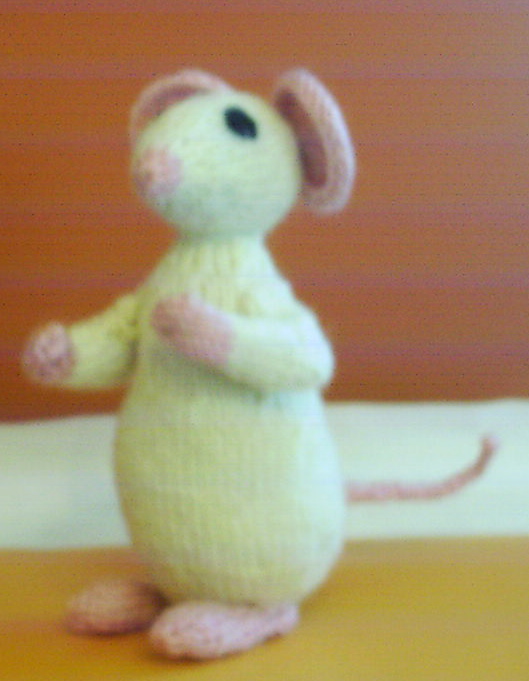
Melanie at tea reads has another blog, Knit the Classics, that makes me wish I could do more than just "knit, purl" in a straight line. They knit something that represents each novel they are reading, and my favorite is Count Fosco's Mouse.

This site is so much fun--a gallery of paper dolls! Here is Mr. Darcy (run the cursor over him and his clothes change) and Mr. Knightley and The Scarlet Pimpernel and Jane Eyre and Emily Dickinson.

A Little ...

More Flannery:

on religion: "The only force I believe in is prayer, and it is a force I apply with more doggedness than attention."

on Freud: "As to Sigmund, I am against him tooth and toenail but I am crafty: never deny, seldom confirm, always distinguish. Within his limitations I am ready to admit certain uses for him."

on reading her work aloud: "I do it whenever I go to Nashville or anytime anybody asks me, which is not often. Usually it works very well; however, the funnier the story, the straighter the face it should be read with and I am the kind who laughs heartily at my own jokes. This weekend I read the first story in the book and disgraced myself in this fashion."

Excerpts from The Habit of Being: Letters of Flannery O'Connor.

Your turn, Susan!

My disappointment in Avi's book may be related to the book that was, I think, a turning point in my reading career - The Secret Garden, which I read at about nine or ten, either the summer before or after the fourth grade. I was an avid reader early, but TSG whetted my appetite for more involved stories. From then on, I was not a hungry reader, but a voracious one. While not all books will capture our imaginations, it is important to have a book like TSG to turn young readers into lifetime readers.


The Book without Words


Avi. The Book without Words: A Medieval Fable. Even if I were ten, I don't believe this book would hold my attention for long. Which is a shame, because it has a lovely cover. :)

The book opens in 1046 in a small town in northern England. Thorston is an old man who has been practicing alchemy, but the false gold he creates is for purposes other than mere wealth. This is a story of greed, the greed for the "gold" and Thorston's greed for eternal life. His servant girl Sybil is thirteen and necessary to his plan. In a little twist on the mythic Sybil, this poor orphan yearns desperately to live, not just to exist in her hand-to-mouth situation.

Other characters include Odo, the talking raven; the monk Wilfred; Bashcroft, the local reeve; Alfric and Damian, two young boys. All of the characters seemed quite flat to me, and the story seemed to plod along. Despite so many elements that could have been charming, it was-- for me-- an empty experience that seemed too pedantic.

Fiction. Fable/fantasy. 2005. 200 pages.

Wednesday, March 28, 2007

Delirum

Last night, I had the pleasure of attending the Cirque de Soleil performance of Delirium. I posted about it here on my other blog with some links. Delightful, fantastic experience!

Started Avi's The Book with No Words: A Fable of Medieval Magic, but wasn't able to get much read. The book is for very young readers, and after the first page which I adored, slowed down a little. The names appear to have some mythological importance - Thorson, Odo (a talking raven), Sybil. I'll refrain from talking too much about it as I've not read enough.

I'm enjoying visiting other blogs taking part in Carl's Once Upon a Time Challenge; hoping to have more time to check on them in the days to come.

Tuesday, March 27, 2007

Philip Pullman and Neil Gaiman

Since the Once Upon a Time challenge is now in play, some of you may be interested in this interview with Philip Pulman, or this (conversation between Pullman and and his former teacher), or this. As usual, following one link over at Endicott Redux is impossible...

Today, Midori Snyder at Endicott Redux has links to Neil Gaiman's trailer for Stardust if you haven't been following Neil Gaiman's blog. I watched it again...just wonderful. (Claire Danes, Robert de Niro, Michelle Pfeiffer)

Monday, March 26, 2007

The Rossetti Letter

Phillips, Christi. The Rossetti Letter. Claire Donovan has the opportunity to attend a conference in Venice that will enable her to complete her Ph.D. dissertation on the Spanish Conspiracy. In order to afford the trip she must agree to chaperone a teenager. As you can imagine, this involves its own set of problems. Then at the first seminar, Andrew Kent, a well-known Cambridge historian announces his forthcoming book debunking the Spanish Conspiracy theory. Claire's approach has been based on a letter written by a famous courtesan of the time, and she must now find proof from primary sources or abandon her dissertation, losing all of the time and effort that she's put into it. Unfortunately, some of the information she needs is reserved for Kent's own research.

The chapters alternate between Claire's 21st century problems and the life of the early 17th century courtesan, Allesandra Rossetti. The reader follows both stories as Claire looks for evidence and Allesandra becomes entangled with the both Spanish and Venetian conspirators.

A light read, but some interesting historical information about life and politics in the Venice. of 1618. There was no Rossetti letter, but the Spanish Conspiracy was an actual event and several of the characters were real people caught up in the affair.

Fiction. Mystery. 2007. 383 pages.

Once Upon a Time...


Carl has posted his Challenge! I'm not sure which Quest (or Quests) I will pursue. The books I have in preparation are listed here, and I can't wait to dive in! Have one book to finish before starting (The Rossetti Letter) and will continue with Flannery O'Connor's The Habit of Being.

I'm combining the Once Upon a Time Challenge with Callapidder's
Spring Reading Thing.

How about a book truck?

I would love to see this truck rollin' down the highway. Of course, I'd be trying to read the titles, the post-it note, and the bulletin board!

In progress - The Rossetti Letter by Christi Phillips. Claire is working on her dissertation on the Spanish Conspiracy and manages to attend a conference in Venice where she can to research using primary sources. The first catch: She must act as chaperone to a fourteen-year-old girl. The second catch: A well-known historian, author, and Cambridge professor is also working on an aspect of the Spanish Conspiracy. O.K. so far. Alternating chapters move from Claire's difficulties in the present to Allesandra Rossetti in 1618.

Sunday, March 25, 2007

O'Connor's Influences

I was going to use O'Connor's reading influences in tomorrow's post. However, Susan beat me to it, so go right here, right now and read which authors Flannery O'Connor read. (I still can't believe I almost included it in this evening's post and then found the exact section at Susan's --great minds?)

Very tired as...

I have spent nearly 12 hours today in the yard: weeding, trimming, cleaning up, planting a few marigolds for their lively color. Kept books outside for reading during my breaks, which became more and more frequent as my neck began bothering me. Nevertheless, I've accomplished a great deal and have two wheelbarrows full of junk for the trash people tomorrow. Old plastic pots, old stakes, tree trimmings, weeds. Lots and lots of weeds.

Turned again to The Habit of Being and during my breaks indulged in more letters. O'Connor received many "fan" letters:

to a man who had not read her stories: "[he] doesn't really see how I can say a good man is hard to find. he is an industrial engineer, likes to play bridge, is the active type, 31 years old, single etc. etc. I wrote Mr. Semple that I didn't think I'd like him a bit but he would be crazy about me as I had seven gold teeth and weighed 250 pounds." ("A Good Man Is Hard to Find" is one of her short stories)


on religion:
"I believe that there are many rough beasts slouching toward Bethelem to be born and that I have reported the progress of a few of them, and when I see these stories described as horror stories I am always amused because the reviewer always has hold of the wrong horror."

and

"Dogma can in no way limit a limitless God.....For me a dogma is only a gateway to contemplation and is an intrument of freedom and not of restriction."

Her religion and the Catholic Church were paramount to O'Connor so reading some of her thoughts in the form of nonfiction is revealing.

Blind Submission


Ginsberg, Debra. Blind Submission. A mystery set in the publishing industry. I haven't seen The Devil Wears Prada, but there might be a similarity of characters from what I've heard. Angel Robinson is hired as an assistant to the head of the Luciana Fiamma Literary Agency. She is immediately caught up in the excitement (ignoring as best she can the ill treatment) and begins reading and recommending manuscripts. Angel is not only clever at recognizing a good manuscript, but she is also able capable of making suggestions for improvement. Then a partial manuscript arrives by an anonymous author; the setting of the narrative is a literary agency. As portions of the manuscript arrive (each new segment improved by Angel's judicious comments), the characters' resemblance to individuals at the Luciamma Fiamma office become more obvious. Lots of twists and turns; lots of tension. A fast read.

Neither bad, nor great, but very tense as the anonymous author knows more than anyone should about Angel and the agency.

Fiction. Mystery. Or chick lit? 2006. 328 pages.

Saturday, March 24, 2007

New Books

Went to the library yesterday and picked up several mysteries, most of which are related to books or manuscripts. Started Blind Submission last night, and it is speeding along. When I stop and rest (yard work), I pick the book up and give it 10 more minutes, and since I read over half of it last night, should finish it tonight. Not great, but very tense, especially as I approach the conclusion.

Fee and I had a good discussion about Nelle Harper Lee and Flannery O'Connor last night, and he is itching to read a little O'Connor (I always recommend Good Country People) and the letters as well. He may simply want me to quit reading aloud to him. Who knows?

My neck hurts from planting and weeding. Have not done anything strenuous, but something about the way I hold my head always gives me problems in the spring.

Received an ARC from Harcourt's Children's Books Division yesterday (Thanks, Anna); perfect timing as it should fit into the fantasy challenge. Evil Genius (has not been released, but review is on Amazon.com) by Catherine Jinks is a nearly 500 page YA novel and looks quite interesting. Jinks has won the Children's Book Council of Australia Book of the Year Award 3 times.

Flannery O'Connor...

was 23 in 1948 when she wrote the first letters in this book, and already in the process of writing Wise Blood. She won the Rhinehart-Iowa Fiction Award for a first novel, with the incomplete manuscript and was recommended for a place at Yaddo, where she worked for a few months with the likes of Robert Lowell. Pretty heady company!

The $750 prize from Rhinehart gave them the option to Wise Blood, but they weren't really pleased with it and suggested that O'Connor revise the parts of the novel that she felt were the strongest. She refused. That must have taken courage, don't you think? At 22-23 years old to stand up to a publishing company with that kind of confidence in her own work? She told John Selby that she would "listen to Rinehart criticism but that if it didn't suit me, I would disregard it."

In a letter to Paul Engle: "Selby and I came to the conclusion that I was 'prematurely arrogant.' I supplied the phrase."

That absolutely delighted me when I read it, and I highlighted and flagged it immediately because this book isn't going anywhere. This is one that will stay on the shelves all highlighted, flagged, and annotated. For me. (I know many of you don't mark your books, but I have a number of nonfiction books that I've marginalia'd to death.)

In 1951, she was reading "Dr. Johnson's Life of Dryden. Dryden 'embraced Popery' but Dr. Johnson is very lenient with him about it and says the measure of his sincerity was, he taught it (Popery) to his children..." That quote is to show Dorothy how well-rounded Miss Flannery was because I'm enjoying D.'s updates on Dr. Johnson.

When Wise Blood was published in 1952, O'Connor wrote Robert Giroux asking for extra copies (that she could get for 40% off) to be sent to several people because "My nine copies have to go to a set of relatives who are waiting anxiously to condemn the book until they get a free copy."

She tells Sally Fitzgerald that her mother is "composing you a fruitcake."

and "My mamma & I are on the way to the polls to cancel out each other's vote."

To Ben Griffith: " Merrill, Lynch, Pierce, Fenner, and Bean [ducks] are slated for the deep freeze in August but Clair Booth Loose Goose is going to live a natural life until she dies a natural death."

OK, OK...enough already! This is like having someone read the newspaper to you.

I know there is a copy of Wise Blood (or maybe of Three) boxed up in the garage somewhere, but it might be easier to buy another copy--

O'Connor was strongly influenced by Faulkner (no surprise there), and Bookfoolery and Babble
has several posts and pictures of Off-Square Books in Oxford, Mississippi and here.


Friday, March 23, 2007

A Scathing Review (or two)!

John Scalzi ran a Scathing Review contest on his blog...with some very clever results. John Scalzi is on my list of TBR (Thanks, Carl), but these reviews of his nonexistent book make me more curious than ever. You have to admit that inviting scathing reviews (even if there is no actual book) would be good aversion therapy.

O'Connor continues to charm in her letters. They are revealing a personality I wouldn't have expected from her work and from her illness-- cheerful, wry, whimsical!

Thursday, March 22, 2007

Flannery O'Connor's Letters

Yesterday, I had to go over Laddie's and wait for the locksmith to arrive, wait for him to re-key all of the locks, and pay him. He was a nice, shy, and efficient young man. During my enforced wait, I need something to read, so I grabbed Letters of Flannery O'Connor: The Habit of Being. I've hesitated to begin this because there are so many books in the various stacks, and this one is over 500 pages, but for some reason, I grabbed that particular book before starting out.

I've fallen in love with Flannery O'Connor! Will have to reread her works with a fresh, new outlook when I've finished. Sometimes I read the introductions before reading a work, sometimes, after. Usually, I glance at the first two paragraphs and make a decision, and this introduction seemed necessary as a review of O'Connor's life before getting into the letters themselves. Fitzgerald's introduction is a pleasure; a useful and necessary preface to the letters.

And the letters! Oh, I have so many little portions marked already...so funny, so dry, so Southern! O'Connor has absolutely charmed me with her wit, her view of life, and her relationship with her mother.

This will be my April biography, as I plan to enjoy this a little at a time and will not likely finish it this month. It is the perfect thing to read as counterpoint to all of the fantasy that I'll soon be delving into. Like short stories and essays, you can read a little, put it down and come back later without losing a narrative thread.

Mockingbird


Shields, Charles J. Mockingbird: A Portrait of Harper Lee. As I mentioned earlier, I liked the introduction very much and the first chapter not at all. The second chapter improved my attitude, and eventually I settled in and became quite absorbed. Nelle Harper Lee was a private person, who after 1964 avoided interviews, making this biography quite difficult--especially as she also had requested that close friends and family members not grant interviews. Although there was no direct contact with Lee, Shields' research appears to have gathered almost anything that was ever printed about her.

What Shields has accumulated does present a more unified version of Lee than can be found elsewhere; his attitude is respectful and his interest genuine...even if he adds nothing much new to the story Nelle Harper Lee.

I enjoyed the sketchy information on her childhood and friendship with Truman Capote. Her attitudes about writing and her efforts in taking the short stories she wrote and forcing them to coalesce into a novel with a central theme are very interesting, as are her friendships with the Browns and with Maurice Craine and his wife, who provided both emotional support and the opportunity for periods of uninterrupted writing. Without the support of these friends, To Kill a Mockingbird might never have existed.

The sections dealing with the research for In Cold Blood, and Lee's ability to get people to open up and talk show were particularly interesting to me. I read In Cold Blood when it was first published, and still have some vivid memories all these years later. It was Nelle's personality that won people over, and enabled Capote to develop friendships with people like Al Dewey and his wife. To Kill A Mockingbird won the Pulitzer before In Cold Blood was completed, andCapote was, not surprisingly, intensely jealous. In many ways, Capote's own success led to his downfall through drugs and alcohol, while Nelle's success led to a decline in their friendship because of Capote's jealousy.

Shields also had some interesting information on the making of the movie version of the book. Lee was not initially in favor of Gregory Peck in the role of Atticus; she not only came around, but was convinced that Peck "was" Atticus. The friendship between Nelle and Gregory Peck continued long after the film; he asked her to join him as a member of The National Council of the Arts where she spoke seldom, but what little she said gained the respect and attention of the other members.

There are no huge revelations in the book, no startling revelation about why the second novel never materialized, but it was an interesting and enjoyable read about the author of one of my favorite books and one of my favorite films. While there was nothing earthshaking, the gradual accumulation of details kept me interested.

Nonfiction. Biography. 2006. 285 pages + extensive bibliographic Notes.

Wednesday, March 21, 2007

New Challenge (links added)

Spring Reading List:

Summers at Castle Auburn - Sharon Shinn
The Silent Tower - Barbara hambly
The Amulet of Samarkand - Book One of The Bartimaeus Trilogy - by Jonathan Stroud
Godmother Night - Rachel Pollack
Coraline - Neil Gaiman
The Book Without Words - Avi
Spirit Gate - Kate Elliot

I'm combining this Challenge by Callapidder Days
with Carl's Challenge (will link when he posts the final info).

A New Stack


Here are my books for the upcoming Fantasy Challenge. Carl is going to post details this week, I think.


Some are young adult novels. All should of these should be fairly quick to read. One other one that I have is Inkheart, but it didn't make it onto the stack. A total of 8 possibilities!

Does anyone else know what they are reading?

I'm almost through with Mockingbird, and I'm relieved to say that after the first chapter, things get more interesting. After the 2nd chapter, I found myself on better terms with the work.

Tuesday, March 20, 2007

Fairy Tales and Folklore

The Spring Equinox is a time for celebrating new life. The earth has warmed and is in a dizzying array of green and bloom. In Jakob Grimm's Deutsche Mythologie, he asserts that Ostara "is the old high German name for the Easter festival." Think of the fertility symbols associated with Spring and Easter: rabbits, eggs, baby chicks...

And in the spirit of of the Vernal Equinox and Jakob Grimm, please visit this terrific link to National Geographic's From Folklore to Forever and the brothers Grimm, where they would like to tell you "12 unvarnished tales, based on a 1914 translation."

Tell me a story about...and then you have choices. A wicked stepmother who has.... Then more choices, each leading to a specific story from Grimm's Fairy Tales.

The Goose Girl, an annotated version, can be found here on the SurLaLune Fairy Tale Pages.

This video from Duirwaigh (pronounced doorway) is a lovely use of the illustrations by various artists on the topic of imagination. A beautiful site with original art and prints for sale, Duirwaigh Gallery is a pleasure to browse. My favorites include Larry MacDougal's Pumpkin Dealer and Terry Windling's work. I recently bought some of her prints, two of which will go to "our Mila" for her 4th birthday. Grandchildren can be a wonderful way to get back in touch with fairy tales.


Gerda and the Reindeer
illustration by Edmund Dulac
Fairy Tale and Golden Age Illustrators


And a blog I check daily is The Endicott Studio for Mythic Arts.
Here you can find illustrators and essays and much, much more.

Monday, March 19, 2007

Finn


Clinch, Jon. Finn. I don't think I was far off in the comments I made after reading only about 20 pages: "Clinch's writing is almost like reading a nightmare, beautiful and frightening. A study in wickedness. Evil under a microscope. Whitewashing. On page 11, Clinch introduces a morbid echo of the whitewashed fence in Tom Sawyer. The "whited sepulchre" -- a new approach to The Heart of Darkness."

Now that I've finished: Is this a novel about racism or about a psychopath? Both ideas are prominent. Huck's pap was a wicked fellow, and Clinch elaborates on the wickedness with great detail.

There are certainly hints about Finn's childhood, his cold parents whose cruelty followed different routes of emotional abuse. Finn's brother Will is also damaged, but relatively normal, yet Clinch doesn't adequately explain why Will manages to become a functioning human being, and Finn does not. Hints are provided, but not clearly delineated. Despite Clinch's eventual efforts to gain sympathy for Finn, his attempts to do so seem disjointed and don't appear to have his full attention.

The dialogue often repeats phrases that become echos or mantras. They are, perhaps, to illustrate the way uneducated and/or illiterate people are limited in their expressions of thought. It makes me wonder how it limits the thought itself, and not simply the expression.

The whitewashed room from the first few pages of the novel took on importance for me as I mentioned earlier. The covering up of corruption, physically and emotionally, is interesting. So, too, is the obsessive compulsion Finn has in marking over the newly cleaned space with new evidence of his crimes. The corruption seeps through the cover up, on the walls and in Finn's mind.

Apples appear in at least three scenes, almost like little vignettes, but the symbolism seem a bit more complicated. Did Clinch want them to be symbolic? Each episode seemed to stand out immediately and the repeated use of "apple" rather than another fruit would seem to indicate that Clinch used the apples deliberately, but that may not be the case. At any rate, apples have several symbolic meanings: temptation, health, harvest, fruitfulness, seduction, sexuality. Whatever their purpose, if Clinch intended one, the mixed message implied by the apples made me wonder about their purpose. The mixed symbolic message suits the novel.

Finn dominates. Huck, Mary, and the Widow Douglas are merely appendages to Finn's story, not even Mary seems to exist in her own right. The Judge, Finn's mother, and Will are also subjugated to Finn in the narrative, but influential in his thinking and behavior.

As repulsive as Finn is, both physically and spiritually, he seems to have a strange attraction for people. I had some difficulty believing this, but over and over-- in contrast to the fear he evoked-- he also evoked sympathy or pity from some of the least likely people.

Finn is doomed, but not even Twain would have imagined the sins that Clinch devises for Finn. In Huckleberry Finn, Huck rebels and escapes his father. Finn rebels, but never escapes.

After all of these wandering comments, what did I think of the book? I did not enjoy it. I will not soon forget it. The graphic images will remain with me, as will a kind of pondering similar to the worrying of a loose tooth. I've not covered half of the things that occurred to me as I read...

Fiction. 2007. 283 pages.

Busy Weekend

It has been a busy weekend. Lots of company, good food, and no let up of talk. The grandchildren are always a delight and keep every moment filled with activity.

I'm off to another appt. for Laddie this morning, but hope to catch up on emails and comments this afternoon. I also want to review Finn.

Saturday, March 17, 2007

catching up

Things have been very hectic around here lately. Spent Thursday seeking medical attention for my father at Quick Care (ha! quick?) for a stomach virus. Then Friday, spent the entire day over there. I'd hoped to have those two days for house cleaning as my daughter and her family came in last night, but hey, things don't always work out the way you plan and there are worse things than a dirty house.

Thursday, as we waited at Quick Care, I finished Finn. Hours of awaiting are only hours of reading, right? I'm not sure when I'll have a chance to review it because Thursday and Friday were spent over at Laddie's, then frantically cleaning house. Our Mila is watching Barny right now, so I've got a few minutes to catch up email and comments.

Finn is going to require a little more thought than some books. It is one that will, like it or not, remain with me for a long time, and I just don't have time now to review it.

Friday, March 16, 2007

Break No Bones

Reichs, Kathy. Break No Bones. Another Temperance Brennan mystery. One thing I enjoy about Reichs' novels is that she takes events from the news and crafts a forensic mystery around them. In Cross Bones , which I discussed here, Reichs mentions the discovery of bones in a tomb in Jerusalem which might contain members of Jesus and the unexplained bones found on Masada during a dig in the 60's. In the last couple of weeks, the story about a similar tomb had made the news (recent news article about the tomb--you've probably read or heard of this --and to the Discovery Channel special) .

I can't really say much about what Dr. Brennan discovers in this latest mystery without giving spoilers. Not that you don't have a clue fairly early on...

I wrote this review the other day, but was interrupted and didn't realize I never published it.

Another note: Hate the lurid cover on this one. Some books attract or repel readers by the cover alone. I read this one because of the author, but the cover would not have attracted me at all.

Fiction. Forensic mystery. 2006. 337 pages.

Wednesday, March 14, 2007

Mapping

Oh, you know, I've said it all before, but I'm fond of mysteries, maps, and lost manuscripts. I enjoy maps in fiction and fact, and those with literary roots like this one of Dickens' London. I like being able to click on something and see the associated information. (Not that I can necessarily follow a map--a friend of mine and I got off at the wrong underground station and walked for miles looking for the Doughty Street house/museum. By the time we got there, our main concern was how we were going to find a pub where we could recover our equilibrium and discuss Dickens with a half pint.) Sam at Book Chase has an interest in Dickens. :) Just look at those shelves!

Iliana posted about maps and mysteries today and then I happened on the Dickens' London map via Mindtracks.

Have you ever wondered about why some books stay with you and others don't? Sometimes I will remember great detail from a mediocre novel and almost nothing about a book that received great reviews and that I enjoyed. It is always curious about what manages to find a little niche in your brain, settle in, and make itself at home...and what drifts through without ever gaining a foot hold.

What trivia remains scattered in our brains while important facts fail to emerge when needed? There are certain things that, no matter how hard I try to remember, make no impression on me, and other information so esoteric that no one cares -- that makes it way to the forefront of the grey matter. It is as if certain synapses are gathered in isolation, the information may be there, but is irretrievable. My mapping skills are lacking here, too.

In my mind, I have (speaking of trivial information from a lifetime ago) a picture, from either Jo's Boys or Little Men, of the mind as a kind of huge post office filing system with thousands of little pigeon holes containing information.

Tuesday, March 13, 2007

Just Finished, Just Started

I've finished Break No Bones by Kathy Reichs and will review it later.

Right now, two books are in process, but I'm not sure if Charles J. Shields' Mockingbird: A Portrait of Harper Lee is going to make the cut. The introduction is terrific, but the first chapter gives me pause. This is an unauthorized biography, and Harper Lee refused to communicate with Shields. While I found the intro extremely promising, the first chapter is setting my teeth on edge, counteracting those positive feelings. Well, I've not really given it a chance, and will set it aside for a while to see if my attitude changes. This was going to be my monthly biography, but we shall see.

I've also begun Finn by Jon Clinch, a novel about Huck Finn's Pap. Whoa! Clinch's writing is almost like reading a nightmare, beautiful and frightening. A study in wickedness. Evil under a microscope. Whitewashing. On page 11, Clinch introduces a morbid echo of the whitewashed fence in Tom Sawyer. The "whited sepulchre" -- a new approach to The Heart of Darkness. This novel is going to be intense and will probably require many short sessions with lots of time to think in between. Lisa at Bluestalking Reader reviewed the novel with great enthusiasm a while back, and when I saw it on the New Book Shelf at the library, I whipped into my book bag without a second thought. Having read fewer than 20 pages, second and third thoughts (and more) are already whirling in a maelstrom.

My thanks to Sam at Book Chase for listing me in The Thinking Blogger Award meme. I particularly appreciate Sam's nomination as I enjoy his blog. As for participating (the rules are listed in the above link) and nominating 5 more blogs, well, check the side bar. Many of these blogs have already been nominated. I just can't choose. :) I've always had difficulty naming 5 or 10 (or whatever) of my favorite books, movies, etc. I'm too wish-washy! The internal debate goes on and on and my frustration with my inability to make up mind, to leave one out, to prioritize-- just grows and grows. I try to link any blog that has grabbed my attention, entertained me, intrigued me, made me curious, but I don't always remember to do so. I will try to be more conscientious about showing appreciation for blog posts in the future, but there are so many entertaining and informative blogs and blog posts...

Monday, March 12, 2007

one thing leads to another

On Friday, I mentioned that I'd found Amanda Craig's site in an odd way. O.K. -- here is the attempt to explain how I started out by searching for information about The Surrendered Wife (!?)...

My daughter was asked to take part in a book club discussion that was going to be filmed for a documentary. The book was The Surrendered Wife by Laura Doyle. (Have you heard of it? I had not, but after my conversation with Amelia, I immediately began Googling.)

Dear Daughter read the book and approached the meeting ready for a lively discussion, and please believe me, Dear Daughter is NOT a surrendered wife. Evidently, she first tried to be pleasant, but... she can get out of hand. When it became evident that even her friends who had laughed at the book, changed their tunes in front of the camera, Amelia became... well, more aggressive. At one point, they stopped the cameras, sat down beside her and asked her if she understood what the documentary was about. Obviously, she did not.

"You mean I'm not supposed to give my opinion?"

"Certainly, you can give your opinion, but do you understand what this is about?"

By the time the cameras were ready to roll again, Amelia was fuming. (Did I mention that she is NOT a surrendered wife.) She went from commenting that some of the book is common sense to a remark about Stepford Wives. At one point, she said, "Well, I would like to know who was 'servicing' Doyle's husband while she was on book tour." Uh oh. Maybe "servicing" is not the word she used. But you get the idea.

She suspects that they will either edit her out completely or even worse, edit her comments (while she was still trying to be tactful) to make her sound like a surrendered wife.

So...that's the background. I got online and began hunting for information about the book. Mind you, I'm a bit embarrassed that I'd never even heard of a book that made The New York Time's Best Seller list.

And I came across Amanda Craig's article in The Sunday Times (Sept. 2004). Craig's attempts to become "surrendered" confused her husband, then shocked him:

“Oh God,” he says. “You’re pregnant again, aren’t you? You’ve done a Cherie Blair.”

At this point, I confess all. The relief on his face makes him suddenly look ten years younger. He roars with laughter and says, “But I married you for being exactly who you are. I don’t want some stupid woman who agrees with me all the time. I’ll tell you what, though: you can be a surrendered wife today, but only if I can be a surrendered husband tomorrow.”

(had to Google Cherie Blair - who among other things became pregnant again at 45)

From that point, I began reading her other articles and found that I enjoyed them very much. She can criticize without appearing bitter or aggressive. Her book reviews are informative. Her articles interest me on a variety of levels.

There you go. One thing leads to another. From laughing 'til I cried listening to Amelia's version of the "book club" (by the way, this was arranged strictly for the "documentary"), to checking out the the book itself, to the intelligent, intriguing articles of Amanda Craig. I love this kind of journey!

The "documentary" is supposed to air on the BBC in May. Most likely without Amelia.

Oh, and one more thing, if you are interested in the book and can't read, audio programs and seminars are available.

Saturday, March 10, 2007

Silent in the Grave


Raybourn, Deanna. Silent in the Grave. Raybourn's first novel is a success in my book. I mentioned a few days ago that I was enjoying it--and so I did, right to the end. A fast-paced Victorian mystery with some interesting twists and turns. There are some flaws, some characters who could have used a bit more fleshing out and whose backstories appear interesting but too brief, but the novel is a wonderful bit of fun.

Always fond of the historical mystery, I enjoyed the details associated with Victorian mourning and other social conventions Raybourn, an English and history major, includes. While Lady Julia Grey is not the typical Victorian lady-- she repeatedly asserts that she wants to be conventional. It amusing to see the contrast between what Julia says and what Julia does.

The novel opens with the line: "To say that I met Nicholas Brisbane over my husband's dead body is not entirely accurate. Edward, it should be noted, was still twitching upon the floor." And we're off!

When Nicholas Brisbane first suggests that her husband was murdered, Lady Julia shrugs off the idea -- her husband had always suffered from a weak heart, the family physician accepted the heart disease as cause of death. A year later, Julia discovers a clue that sends her back to Brisbane . Determined to discover her husband's murderer, she decides to participate in the investigation.

Silent in the Grave is difficult to put down and a pleasure to pick up. To make things even better, Raybourne is working on her next novel, and I couldn't be more eager to find out what Julia, her eccentric family, her servants and friends (love Fleur) will get up to next.

Fiction. Mystery. 509 pages. 2007

Friday, March 09, 2007

The Uses of Enchantment

Amanda Craig (novelist, journalist, blogger) has a site (which I found in the oddest of ways, but that is worthy of a post in itself) where she has posts of her lectures, articles written for various publications, book reviews, and more. I loved her reviews of Beyond Black and Jonathan Strange & Mr. Norrell and was comforted that by abandoning these two celebrated works I didn't show a complete and total lack of taste.

Craig's lecture/post about The Uses of Enchantment is fascinating. "If you understand that Jane Eyre is a conscious variation on the fairy-tale of Bluebeard, Mansfield Park a version of Cinderella, and Pride & Prejudice a reworking of Beauty & the Beast, your understanding and appreciation of their author’s genius is deepened, not lessened." Novelists such as Margaret Atwood, Angela Carter, Helen Fielding, A. S. Byatt, Joan Aiken and others use "archetypes and structures of the fairy-tale to address not only our deepest fears and desires, but also to explore the act of story-telling itself."

"Fairy-tales don’t pretend to describe the world as it is. What they do is to free the dreaming part of your mind that helps you to find your own solution," says Craig. There is so much to think about in this post that I can't begin to cover it well, but take a few minutes and check it out.

miscellaneous

Have you seen the video that Susan at Pages Turned has posted? Oh, don't miss it!

Has a novel been written about the Shadow Wolves yet? Found this article (via Rebecca's Pocket) about Native American trackers in pursuit of smugglers in the Arizona Desert. Founded in 1972, the Shadow Wolves, "a federal law enforcement unit of Indian officers that has operated since the early 1970s on this vast Indian nation straddling the Mexican border," have seized "30,000 pounds of illegal drugs since October."