Search This Blog

Thursday, September 25, 2008

Pharmakon

Wittenborn, Dirk. Pharmakon. This ARC examines drug research and drug use, the American Dream transformed, ego and arrogance, and family dysfunction.

It is one of those novels with a particularly impressive first line: "I was born because a man came to kill my father."

The first paragraph draws you in and the first half of the book is quite interesting. Research psychologist William Friedrich has many good qualities, but is, overall, a damaged individual who perpetuates some of his own childhood misery. His ambition leads him on a destructive path that he never intended when he develops a new drug that attempts to relieve suffering, to increase happiness. Good characterization and tension in this portion of the novel.

The last half of the book, however, deals with the children and is less interesting. Much less so. While it is sad to see the effect of events and parental personalities on the children, they were strangely unappealing and unsympathetic.

The Greek word pharmakon means both poison and cure. An apt description of the pharmaceutical industry.

Fiction. 2008. 403 pages.

In Fury Born by David Weber

Weber, David. In Fury Born. Captain Alicia DeVries resigns from the Imperial Cadre because of a political decision to cover up a betrayal that cost the lives of all but 9 of Charlie Company, Third Battalion. She joins her family on the developing planet Mathison, and several years later, returns home to find her family dead or dying, massacred by space pirates. 

 With her Cadre training and enhancements, Alicia manages to kill all the pirates who have attacked their remote home, but in the process receives fatal wounds. And yet...

 When rescuers find her, they are amazed and bewildered and not a little frightened. Alicia becomes a medical mystery and a very dangerous patient. What she actually is would be even more unbelievable to her doctors -- because one of the Furies from early mythology has taken residence within Alicia and will help her take revenge on the murderers of her family and her planet -- for of the forty-one thousand inhabitants of Mathison, there were only 306 survivors. 

 The Fury Tisiphone has made sure that Alicia will live and be able to take her revenge; the two of them eventually are able to escape and steal an AI starship... And then there were three. I liked it. Another fast-paced novel with lots of action by David Weber, there are a few flaws and the book is long, but it was interesting and exciting. 

 Fiction. Science Fiction/Space Opera. 2006. 828 pages.

Friday, September 19, 2008

A Clubbable Woman

Hill, Reginald. A Clubbable Woman. This is the first in the Dalziel & Pascoe series and the characters are pretty rudimentary. Dalziel is simply crude in this first novel in the series (published in 1970), and Pascoe is almost cardboard. Not a bad mystery, I suppose, but mostly interesting to see the first novel in which Fat Andy Dalziel (pronounced [diːˈɛl]) and Peter Pascoe appear. Hill had a better grasp on them within a year when he published An Advancement of Learning (# 2 in the series; reviewed a few weeks ago, here and here).

I was unable to find copies of #'s 3-7 -Ruling Passion, An April Shroud, A Pinch of Snuff, A Killing Kindness, and Deadheads (1973-1983) - when I ordered from Alibris, but was able to get Exit Lines (1984), and will look for the #'s 3-7 in the series, maybe at Amazon.com.

I've read 9 of the last 10 of Hill's Dalziel & Pascoe novels and find it great fun to see the evolution from the early to the late novels. A nearly 40 year span!

Fiction. Mystery/crime. 1970. 255 pages.

Tuesday, September 16, 2008

The Blood of Caesar

Bell, Albert A. The Blood of Caesar. Set in ancient Rome, this mystery has Pliny the Younger and Tacitus investigating the missing memoir of Nero's mother, the death of a Jewish slave, and the possibility of a previously unknown descendant of Nero who might provide a rallying point for those who would challenge Emperor Domitian.

An interesting look at Rome and some of its well-known figures and some of its social and political intricacies, but the characters just didn't come off the page for me. Does include a chronological timeline and a list of terms and people at the back.

My favorite Roman mysteries are those of Lindsey Davis and the irrepressible Marcus Didius Falco. Lindsey Davis and Stephen Saylor (Gordianus the Finder) are perhaps the most familiar authors who use ancient Rome, but there are quite a few others as I discovered at The Detctive and the Toga. Here is a list of recently published Ancient Roman Mysteries.

Fiction. Historical mystery. 2008. 252 pages.

Sunday, August 31, 2008

Fathers and Sins

Bannister, Jo. Fathers and Sins. Although I liked the main character, Agnes was just a bit too good to be true and in the final few pages, I felt her behavior seemed contradictory, as if she'd done an about face.

General impression: Not up to Bannister's best. Characterization weak, tempo off, plot untidy, motivation confused. Quite short.

Fiction. Mystery. 2008. 201 pages.

Friday, August 29, 2008

By Schism Rent Asunder

Weber, David. By Schism Rent Asunder. I'm a big Weber fan. Love the Honor Harrington space opera series and loved Off Armageddon Reef which I reviewed here.

I liked this one a lot, too. How in the world Weber keeps up with all of the characters and details in his many long and complicated books is beyond me. How he manages to turn so many characters into real personalities is another difficult task that leaves me marveling at such a phenomenal memory.

His novels are full of political, social, and military discussions. I like them (who'd a thunk that military tactics & politics would hold such fascination for me?) --but some of Weber's fan have begun to get restless as his novels increase in length and expository material. I know whereof they speak, as I've noticed it, too, even in the later Honor Harrington novels, but I enjoy it. I enjoy the hints Merlin (Nimue Alban) gives as he tries to encourage this society to advance its technological abilities but not give them the answers and the religious discussions that result as a corrupt few in the church seek to impose their will on others.

I enjoy the political aspect because Weber tries to put himself into the logical thinking of both the good guys and the bad guys. Although the "Group of Four" in the Church of God Awaiting are corrupt individuals, Weber develops them into real men, flawed and corrupt, and in one case, certainly wicked, but they are not cardboard monsters.

Hate having to wait for the next one.

Fiction. Science fiction/fantasy. 494 pages.

Thursday, August 28, 2008

The Primrose Convention

Bannister, Jo. The Primrose Convention. A cozy mystery featuring a pathologist who turns "agony aunt" (or advice columnist) in a second career. I liked Rosie - a brash, middle-aged, woman, hefty in weight and personality - whose responses to those seeking advice are certainly out of the norm. In fact, a young woman who sought Rosie's advice turns up at the office to chastise Rosie for her flippant reply to what the woman considers quite serious.

Add a gardener with psychic abilities, a rather finicky retired schoolmaster named Arthur Prufrock (well, I couldn't help but love him, now could I? ...and I've no doubt but that the mermaids do sing to him), a lovely assistant, and the owner of the paper who is missing a foot from his time in the service... and eclectic mix even before adding in the missing person and the villain.

It was a bit slow in the beginning, but rather a fun read. Not as good as Bannister's Brodie Farrell series, but quite entertaining.

Fiction. Mystery. 1997. 267 pages.

Abandoned

I finally abandoned When the White House Was Ours after reading a little more than half. The characters made me want to knock heads. I'd hoped to enjoy a book about opening an alternative school, but dear Lord, the adults needed more supervision than any students.

I've finished a couple more books that need to be reviewed, fiction, of course. The nonfiction moves as slowly as ever, shunted aside like a stepchild. We all know about reading moods, and I'm definitely into fiction right now, though it shames me to neglect some of the books that await my return.

Received an ARC copy of The Map Thief by Heather Terrell which I hope to enjoy. Not too long ago, I saw a special on The Discovery Channel (?) about Admiral Zheng He and his remarkable naval exploits during the Ming Dynasty. I'm always interested in missing maps and manuscripts, so the combination of good historical facts with the present day search for a missing map sounds appealing.

Dalziel & Pascoe Expanded

A little more on Reginald Hill and the Dalziel & Pascoe novels --

Hill's first novel in the series is A Clubbable Woman, which I've recently ordered. The second in the series is An Advancement of Learning, the book I reviewed in the previous post. In 2002, I found Dialogues of the Dead and went back to find any other novels in the series that the library had to offer. I had read a D & P novel earlier and recognized the characters, but Dialogues of the Dead was much longer and much more involved; it provided the deep hook.

I checked out all of the series that the library had ( Pictures of Perfection, Recalled to Life, The Wood Beyond, On Beulah Height, Arms and the Women) and read and enjoyed them all, but now I'd like to fill in the gaps among the older novels. Some are being re-published, but others I can get through Alibris.

Even as I made my way through the above novels, I awaited Hill's new novels and kept up with all of them - Death's Jest-Book, Good Morning Midnight, and Death Comes for the Fat Man. Have not yet read the most recent, A Cure for All Diseases, but look forward to it. The only ones I've read since beginning this blog are Death Comes for the Fat Man and An Advancement of Learning, so they are the only 2 I've reviewed.

Hill's inclusion of allusions, and there are plenty of them in the later works, range from historic to literary to contemporary topics and works. I especially love these allusions, many I recognize at a glance (which is always fun), but sometimes I only know that it is an echo of something I've read or heard and must do some research to pin it down (also fun).

The combination of humor and the horrific is also well done. The relationship between Andy Dalziel and Peter Pascoe is often testy, full of irony and tongue in cheek satire that makes me smile, and occasionally, laugh out loud. Pascoe is a strong character in his own right, but is an excellent foil for the often crude and always curmudgeonly Dalziel. The minor characters are also well-developed and interesting in their own right, never cardboard totems - and in some novels, Hill gives them the lead. Edgar Wield the gay sergeant whose appearance is always commented on (unattractive, to put it mildly) is by far the most lovable and interesting.

Hill is one of the best crime/mystery/detective fiction authors around. If you haven't given him a try, now might be the time.

Monday, August 25, 2008

An Advancement of Learning by Reginald Hill

Hill, Reginald. An Advancement of Learning. I have no idea how many of the Dalziel & Pascoe novels I've read. I'd read everything the library had to offer, but some of them have escaped me. I found this 2008 edition of the 2nd Dalziel & Pascoe on the new book shelf the other day. Originally published in 1971, this novel has the fat man and a young Sergeant Pascoe still uneasy in their relationship.

A first-rate mystery, although not as full of literary references as some of the later books, An Advancement of Learning introduces Ellie Soper and Franny Roote. If you are a fan of the series, you know that Ellie and Pascoe are married in later novels and that Franny, that strange (sociopath?) young man, features in several of Hill's best novels.

In this second novel of the series, the characters of Andy Dalziel, Peter Pascoe, Ellie Soper, and Franny Roote are in their incipient stages of characterization, and that alone makes the novel worth reading. Hill has created the basics of each one, but knows they will be worth the trouble he takes to develop them in succeeding novels - they are clay (interesting clay) waiting for the breath of life at this point.

A good mystery this, but especially interesting in seeing the way Hill's characters and style originated. Although chapters all have epigraphs from Sir Frances Bacon, the multi-layered allusions that are such fun in later novels are not yet present.

I did miss Sergeant Wield, whose lovable personality transcends his appearance, but I thoroughly enjoyed meeting some of Hill's characters in their infancy.

Fiction. Mystery/detective fiction. 2008 re-edition (UK original, 1971). 288 pages.

Saturday, August 23, 2008

Hand of Evil

Jance, J.A. Hand of Evil. This is the third novel in this series featuring Ali Reynolds, but the first in the series that I've read. I've read quite a few of the Joanna Brady series and enjoyed them.

The novel's plot was all over the place and the characters weren't all that appealing either. I can recommend Jance's Joanna Brady mysteries, I don't feel strongly enough about this one to say much of anything.

Any fans of J.A. Jance out there? If so, how do you feel about this series?

Fiction. Mystery/thriller. 2007. 384 pages.

Thursday, August 21, 2008

This and That

Skip To My Lou has been posting some terrific ideas to encouraging reading- the series is Bloggy Book and Craft-a-thon, and I especially love the Day 6 (book marks specific to the book) and Day 4 (torn paper collage) . What creative ways to encourage kids to read!

Vanilla Joy also has some excellent ideas about reading with children.

I think The Invention of Hugo Cabret (reviewed in yesterday's post) would offer a ton of creative activities - and that would be such fun.

Still have a couple of reviews left -- the J.A. Jance and a Reginald Hill (you know I love the Pascoe & Dalziel seried) that I had not read. Hill is tops in the genre, and one of my favorite writers period.

A couple of new ARC's: One More Year: Stories by Sana Krasikov and When the White House Was Ours by Porter Shreve (a novel loosely based on his own family and the alternative school they founded in Washington, D.C.)

I've started the one by Porter Shreve (have to wonder about his family background since Shreveport, named after Henry Miller Shreve, is where I grew up and is still just across the river). I'm not quite half-way through, but do want to share one quote from the mother whose son says he didn't lie, he just didn't tell what he knew: "Secrets and lies are two sides of the same coin. Only, one is hidden and the other is face up."

Wednesday, August 20, 2008

The Invention of Hugo Cabret (with post script)

Sleznick, Brian. The Invention of Hugo Cabret.

Hugo Cabret is an orphan living in a train station in Paris. That information alone has its own fascination. Written for children, the book includes page after page of beautiful drawings -- an interesting combination of narrative and picture book.

My favorite parts have to do with Selznick's symbolic emphasis on eyes and the way he connects those elements in his drawings to plot elements in a subtle manner. The story is a mixture of fact and fiction, and I liked that as well. I liked the play on words in the title. Automatons , early movies, and clocks all fascinate me....

I was not, however, as captivated as many readers have been and thought the narrative much less artistic than the drawings. All the elements of mystery are here, but the textual characterization and the plot never have the effect of other great children's novels. The writing and dialogue seem stilted.

This does not mean that I didn't enjoy this book. I did. Actually, quite a lot. There were many elements that I appreciated, but for several reasons, it did not quite live up to what I hoped for when I first heard about it on NPR a year or so ago.

Last summer, I read The Chess Machine which I reviewed here, another mixture of fact and fiction that dealt with magicians and automata. A nice companion book, but written for adults.

A peek at an automaton:

-----------Post Script----------
Other reviews: Becky's review ; Maggie's review; Carl's review;

Fiction. Juvenile/Children's Lit. 2007. 533 pages.

Tuesday, August 19, 2008

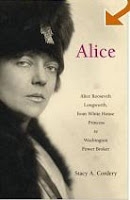
Alice: Alice Roosevelt Longworth biography


Cordery, Stacy A. Alice: Alice Roosevelt Longworth, from White House Princess to Washington Power Broker.

Alice Roosevelt Longworth, often referred to as Princess Alice, was a fascinating Washington icon for decades, but was not a totally likable individual. Cordery certainly admires her, but even she leaves several episodes open, unable to comment in a genuinely positive manner.

What is obviously true about Alice is that she had an intellect to contend with and a sly wit with a tendency toward malevolence. This biography reads in many ways like the biography of Eudora Welty I read a couple of years ago - much of the book is a list of who Alice saw, where she went, what she did in that "date book" manner. Cordery was privy to much private correspondence that had not previously been published, and yet much of this resource material gives little insight into the woman Alice became and of her personal relations.

The facts are all there, her mother's death a few days after her birth, her father's distance until she was a political asset, her friends, her marriage to an older man, her political views and associates. In many ways, the biography is an excellent, if somewhat biased view, of the Republican Party and the political events of the early 20th century. I found it a bit patchwork, however. Situations remarked upon, abandoned, mentioned again and again abandoned, and eventually expanded upon. Especially in the early chapters, there is a patchwork quality.

Writing a biography must be among the most difficult tasks of any writer. Using the abundant source material in a cohesive way (if such is available), filling in gaps without too much speculation (if source material is unavailable); creating a real human being of a legend; controlling one's personal sentiments; interviewing and evaluating the accounts of friends and enemies; avoiding mere lists of names, dates, and activities while still giving a reliable examination of the individual's friends and significantly influential events-- must be a tremendously complex job.

One of the first national (& international) celebrities, Alice received as much or more attention than even her father during his White House years, and she worked at keeping her name at the front of events her entire life. She was not bound by tradition, and dismissed (to the joy of many women) many of the social traditions of the time. She was not afraid of voicing her opinion or using her political clout, and she cultivated politicians and famous people who often adored her even into her 90's. She made many fast friends, charmed almost everyone she met, made devastatingly cutting remarks that were often personally hurtful as well as politically influential.

Her husband, Nick Longworth, was a womanizer and a drinker. When he died, one of his mistresses, Laura Curtis, was present (Laura was later a close friend of Alice's). Alice herself had a child by Senator William Borah, and it is not clear whether Nick knew and chose not to acknowledge it - after all, he had for decades carried on widely with his women friends - or simply didn't realize that Paulina was not his child. At any rate, Nick adored "his daughter," and Alice seems to have managed quite easily with the arrangement.

Interesting that all of her romantic interests were with much older men, especially given her desire for her father's attention and affection.

Alice Roosevelt Longworth was a force to be reckoned with for over 80 years and despite some of the less pleasant public aspects of her personality, she was both powerful and popular, admired for her courage and commitment and feared for her waspish tongue. She was intelligent and extremely well-read, sometimes jealous, sometimes petty, yet stylish and charming, and had most people eating out of her hand at will.

Earlier, I mentioned the difficulty of writing biography and just want to add that two of the best biographies I've read in the last couple of years are Eden's Outcasts: The Story of Louisa May Alcott and Her Father and Voltaire Almighty . I also enjoyed Mockingbird: A Portrait of Harper Lee . All of these have been reviewed here on my blog, along with other biographies and memoirs that I've enjoyed, but weren't quite as good.

Nonfiction. Biography. 2007. 483 pages + extensive bibliography & notes with additional detail.

Monday, August 18, 2008

The Calling

Wolfe, Inger Ash. The Calling.

Kate Atkinson, Peter Robinson, and Gillian Flynn all contributed to the jacket blurbs. (See Sam's post Blurbs and Back Scratching.) Inger Ash Wolfe is a pseudonym for Russell Smith, a Canadian author, according to one source.

I liked the idea of the 61-year-old female detective inspector and her 87-year-old mother, but Hazel is no Miss Marple. In a small Canadian village, Detective Inspector Hazel Micallef is confronted with the gruesome murder of a terminally ill woman, and apparently, the killer was expected and invited into the home.

Then, within a few days and a short distance away, another murder -- very different appearance -- but with many commonalities for those who, like Hazel and her staff, have looked a little deeper. Now this small town police force that has never dealt with anything close to this kind of horror finds itself on the trail of a serial killer whose victims are terminally ill and...eager.

The characters are well-drawn, flawed, and dealing with difficulties in their personal lives as well as with the pursuit of the killer; the plot is intriguing, and while it did not hang together as logically as I would have liked, kept me involved and puzzling over the strange character of Simon, the mercy-killer with a bizarre agenda.

One thing that bothered me was the dialogue-- the speaker was not always clear, especially at the police station, where the conversation shifted frequently.

My favorite characters were minor: Hazel's mother Emily was a joy; Detective Constable James Wingate and Detective Sergeant Adjutor Sevigny (recent additions to the Port Dundas force) have great possibilities for development and the author managed a great deal with their smaller parts.

Fiction. Mystery/Crime. 2008. 371 pages.

Tattoos...

Here is something of interest: Literary Tattoos. What would you have tattooed -- if you were going to get a literary tattoo? My favorite of the examples is "Harriet, the Spy" which is so nicely done.

Hmmph. I know I've failed in my attempt to get through all of my "in progress" nonfiction before getting back to fiction. "And so it goes..."

I have, however, finished one more in the nonfiction category: Alice Roosevelt Longworth: From White House Princess to Washington Power Broker by Stacy A. Cordery.

And several more fiction: The Invention of Hugo Cabret by Brian Selznick, Hand of Evil by J.A. Jance, and The Calling by Inger Ash Wolfe.

Reviews on these soon.

Sunday, August 17, 2008

We Work Hard

While visiting Musings of a Bookish Kitty, that literary feline, I found the link to Amy's Book Blogger's Appreciation Week.
Here's what Amy says about it:


Book Bloggers: You work hard. You read books, you write reviews, you maintain relationships with your readers, publicists, and authors. You are constantly running to the post office to mail your giveaways and participating in carnivals to help boost traffic. You sometimes want to faint when you see the size of your TBR pile, but faithfully you read. And you do it because you love it. Book blogging is for most a hobby. But it’s a hobby that takes a lot of work and time. It’s a labor of love.

The Readers: We love you! You don’t have a blog, but you read our reviews and share your thoughts with us. You enter our giveaways and click on our Amazon associates link. We do this for you and appreciate your readership. We hope you’ll join in the fun and festivities of BBAW! (we’ll have a special contest just for you!)

Book Blogger Appreciation Week: Acknowledging the hard work of book bloggers and their growing impact on book marketing and their essential contribution to book buzz in general, I am excited to announce the first Book Blogger Appreciation Week. Think of it as a retreat for book bloggers and a chance for us to totally nerd out over books together. And of course, shower each other with love and appreciation.

Register: In order to experience the maximum impact of the week, register your participation (just like a retreat)! To register, just send an email to bookbloggerappreciationweekATgmailDOTcom with your blog URL and what you consider your niche…i.e, general book blog, classics blog, personal blog with a healthy dose of books, YA books blog, etc. Then, add one of the two buttons at the bottom of this post to your sidebar. If you are a reader (no blog) just send an email announcing your plans to follow along.

Why bother? If you register, you will be added to a book blog directory which will exist long after this week is over. Additionally, you will receive one raffle entry into the daily giveaways during BBAW at My Friend Amy.

Thursday, August 14, 2008

The Guernsey Literary and Potato Peel Pie Society

Shaffer, Mary Ann, and Annie Barrows. The Guernsey Literary and Potato Peel Pie Society.

Perhaps my favorite book this year. Dear Reader, I loved this book. I loved the characters, I loved the epistolary style, I loved the history, I loved the plot. I loved the literary references and the importance of books. The only thing that I didn't love was finishing this delightful novel.

Don't let the title fool you. Whimsical as it is (and I don't believe I mentioned that I loved the title AND the cover), the novel is not all whimsy and good humor. The subject matter - the occupation of the Channel Islands during WWII - is serious, well-researched, and detailed.

Did I mention the influence of Charles Lamb? Charles Lamb, my favorite essayist, is influential in establishing the initial contact between Juliet Ashton and the Guernsey Literary Society, and Mr. Lamb makes his presence felt throughout if only in a minor way.

I don't want to tell too much. This is a book that should be personally discovered by every lover of books and literature; the wit, the charm, and the literary delight are ever present, and ever balanced by the serious consequences of German Occupation.

Lesley's review first caught my interest, so when I saw it at the library, I couldn't resist. This, however, is a book that I'd like to own and return to whenever the need for it might arise.

Other reviews: Marg, Kay, and Katherine

Fiction. Historical novel and much more. 2008. 274 pages.

Moving Forward: Taking the Lead in Your Life

Pelzer, Dave. Moving Forward: Taking the Lead in Your Life.

Oh, I don't know. I agree with the statement, "...the lives we live are the lives we make" (the bold and italics are part of the original quote).

The book, however, seems another example of a self-help book that can be capsulized in one sentence and the rest becomes a bit monotonous. Pelzer was subjected to horrible abuse as a child and has evidently overcome many of the obstacles in his path, and yet ...

How strange that I don't quibble with the premise, and yet I quibble with the book itself. There was a reason that it took me so long to finish.

Pelzer has written at least 9 books, has a radio show, and is a popular public speaker.

This one is an ARC.

Nonfiction. Self-help. 2008. 192 pages.

Sunday, August 10, 2008

There were only two people who commented on The Fatal Waltz give-away post, and Teabird was the winner. Send me your address, and I will get the book in the mail!

Give-Away (sticky post)

Time for a give-away. This one is A Fatal Waltz (uncorrected proof) by Tasha Alexander. I reviewed it here.

Hmmm. The drawing will be on Sunday, August 10. If you are interested leave a comment on this post.

Thursday, August 07, 2008

In Progress, if only slowly

While I'm still not in the mood for much reading, but I've decided to finish a few books that have been put aside in various stages of progress.

Moving Forward: Taking the Lead in Your Life by Dave Pelzer. Pelzer is the author of the memoir A Child Called "It" - which was on the NY Times best-seller list for 6 years. He opens the book with the statement, "I believe the lives we live are the lives we make." I was almost exactly half way through this one before putting it down. I agree that it is easy to blame others or circumstances for the bad stuff in our lives and that ultimately we are responsible for our own choices. Have a few questions about the way Pelzer has parlayed his experiences into a profitable business, but can't disagree with the basic premise.Old Friend from Far Away: The Practice of Writing Memoir by Natalie Goldberg. I loved Goldberg's Writing Down the Bones and used many of her practices with great success in the classroom. This book is a series of associative and meditative exercises to help you "discover and open forgotten doors of memory." Most of the exercises are 1-2 pages, so the book is easy to pick up and put down. Goldberg studied with Allen Ginsberg, and Ginsberg remain a figure of great importance to her long after his death.The Intention Experiment by Lynne McTaggart. McTaggert is "an award-winning science journalist and leading figure in the human consciousness studies commmunity."
The opening chapters are largely concerned with physics and quantum physics (a bit beyond my grasp) and some interesting stories about the scientists engaging in the various experiments. However, when I have a lot of nonfiction - and I'm a slow reader of nonfiction - I tend to seek other activities more frequently, and thus, though I'm really quite interested in this one, it has settled in the "on hold" stacks. Must get back to it.Alice: Alice Roosevelt Longworth, from White House Princess to Washington Power Broker by Stacy A. Cordery. I do love biographies and Alice Roosevelt was certainly an iconic (flamboyant, witty, vibrant) figure. I'm enjoying this one.We will see how this goes... Can I stick with nonfiction long enough to get through all of them before going back to fiction? The biography won't be a problem because it is the one I've been picking up on the rare occasions I've been reading lately.

Wednesday, August 06, 2008

A Little Poetry

I just read "The Domestic Arrangement," a poem by Maxine Kumin, over at Letters from a Hill Farm. It is a lovely poem and sent me to find "The Absent Ones" - a favorite of mine.

The Absent Ones

The two foals sleep back to back
in the sun like one butterfly.
Their mothers, the mares, have weaned them,
have bitten them loose like button thread.


The beavers have forced their kit

out of the stick house; he waddles
like a hairy beetle across the bottom land
in search of other arrangements.

My mother has begun to grow down,

tucking her head like a turtle.
She is pasting everyone's name
on the undersides of her silver tea service.

Our daughters and sons have burst
from the marionette show
leaving a tangle of strings
and gone into the unlit audience.

Alone I water the puffball patch.

I exhort the mushrooms to put up.
Alone I visit the hayfield.
I fork up last summer's horse-apples
to let the seeds back in the furrow.

Someone comes toward me--a shadow.
Two parts of a butterfly flicker

in false sun and knit together.

A thigh brushes my thigh.

The stones are talking in code.

I will braid up the absent ones like onions.
The missing I will wrap like green tomatoes.
I will split seventy logs for winter,
seven times seven times seven.

This is the life I came with.

Maxine Kumin

It is a poem of loss, immediate and impending. Of change. Of memory. Of acceptance. Children grow up and leave. Parents grow old and die. Some things, however, remain the same: we go on living our lives, doing the practical, the every day chores.

Don't you love the lines:

Our daughters and sons have burst

from the marionette show

leaving a tangle of strings
and gone into the unlit audience.

We did; we moved from the parental sphere out into the world, and our children have done or will do exactly the same. And while we may want that independence for them, there remains the physical absence, the loss of their presence. So Kumin wraps her memories in every day activities and, in a way, keeps the absent ones close to her ...and goes on about her life.

Tuesday, August 05, 2008

A Slice of Organic Life

Goldsmith, Sheherazade, ed. A Slice of Organic Life.

6 words: Plenty of ideas for organic living.

Beautiful pictures and lots of 'em. An overview of ways in which one can tread more softly on this planet. I enjoyed it, learned a few things, and appreciate the extensive directory of web sites for saving energy, gardening, cooking organically, recycling, etc.

A place to get started, with lots of resources. Very few of us will ever do all of these things, but the book gives good ideas for different areas of living that anyone can try. I'm not going to raise chickens, but I do grow culinary herbs. No cows for me, but I've looked at rain barrels as a means of providing water for my garden.

The library appears to be anxious that I return this one. It has missed its overdue date because I've been so slow to review.

Nonfiction. Ecology. 2007. 347 pages.

Monday, August 04, 2008

Touchstone

King, Laurie R. Touchstone.

6 words: Different from King's usual, but good.

This novel is quite different from her Mary Russell/Sherlock Holmes series. It is weightier in both content and style, but I liked it. Set in England shortly before the General Strike of 1926, the plot involves an American Bureau of Investigation agent Harris Stuyvesant who, working on his own, is in pursuit of a terrorist bomber who has struck several times in the U.S. and then retreated to England.

Harris is turned away from most avenues of aid until he meets the unpleasant Alduous Carstairs. Carstairs suggests using Bennet Grey, an unusual casualty of WWI, as a method of getting close to the man Harris suspects of the bombings. In spite of his instinctive dislike of Carstairs, Harris agrees to meet and work with Bennet Grey.

Politics, love, and suspense mix well in this novel. The beginning of the book is a little slow, but the characters have depth-- and for me, the strength of the characters overcame any other problems (length) the novel might have.

Fiction. Historical, Suspense, Mystery. 2008. 548 pages.

Saturday, August 02, 2008

I'm Back

Oh, without notice I am "unlocked"!! -- of course, it was without notice that I was "locked." Never-the-less, I'm no longer considered a spammer. Hope everyone else is back in production.


Here is a book that I've put on my wish list: A Summer of Hummingbirds: Love, Art, and Scandal in the Intersecting Worlds of Emily Dickinson, Mark Twain, Harriet Beecher Stowe, & Martin Johnson Head. Sounds Delicious!


I'm still not reading, however, things are pretty stalled on that front. Well, except for this sort of thing... This week I have been busy with all sorts of activities with granddaughter Mila and my niece and nephew, Maggie and Matthew.
I've heard an awful lot of "Jenny Claire! Jenny Claire" and "Excuse me, Jenny Claire, but can I...." We've been having a wonderful time with art and craft and books and Sci Port and fountains. Jenny Claire will need a few days to recover by the time Miss Mila goes home! I'm not used to so much activity and so much fun!

Thursday, July 31, 2008

Book Chase's Sam Locked Out

I just received an email from Sam Houston at Book Chase asking me to help spread the word about his silence. Blogger has somehow mistaken him for a spammer (the result of some software program) and has locked him out of his blog.

Sam has posted comments on many blogs -- he wants the book community to know about what has happened so people will realize that he has not simply disappeared. He is trying to get an interview with a real person, but doesn't know how long it will take to get it straightened out.

He has no access to his blog at present, and they have threatened to delete Book Chase in 20 days!

Tuesday, July 29, 2008

A Magic of Twilight

Farrell, S. L. A Magic of Twilight.

6 words: Neither awful nor awesome. Over-complicated names/titles.

Characters never really come off the page. Some interesting elements, but I didn't really care for this world... I mean, this world and its characters never really captured me or made me truly concerned for the individuals or about the events. Not sure exactly why it missed...

Fiction. Fantasy. 2008. 526 pages.

Sunday, July 27, 2008

Excuses, Excuses

I'm not sure what is going on with me.

I was reading, but not blogging.

Now, I'm not reading, but blogging.

But not reviewing.

I don't feel so bad about that, however, after reading Bookfool's list of books to be reviewed. :)

Reviewing aside, my books in progress list is pretty chilling. Let's go through the drill:

1) Oh, this looks interesting. Worth a try. This one, too.

2) Hmmm, just found this one under a stack of 7; let's see, I think I started it 2 months ago. Forgot about it. Move to "in progress" stack.

3) Just arrived from Amazon - a book that I had looked forward to. Five pages in...maybe later. Maybe never.

4) ARC books...what did I do or say to indicate that all I wanted to read was self-help? I may need an occasional positive thinking book, but not 15. Nor do I really want to read about someone's suicide, so put it in the stack titled "What do I do with these books? Who could I give them to?" Would they take it as an insult?

5) I like this one, but only for a chapter at a time...then let's have a little mystery or fantasy time.

6) Oh, I've finished all the mystery and fantasy. Schedule library trip.

7) This biography of Alice Roosevelt Longworth is terrific. I love reading about smart, witty women. Background on Teddy is interesting, too.

8) A little Pratchett. Smile.

9) Two more unsolicited ARC's from different publicists yesterday. Goody, goody! Oh, one is another self-help! Still, the other is a good possibility.

10) Hold it! What about the long list of those that I've already started? The "in progress" stack? Discipline. Must. Practice. Some. Discipline.

Do not begin another book until having finished some of the "in progress" stack OR AT LEAST until I've written reviews of those that are already overdue at the library. The ones I didn't return with the others because I had not reviewed them.

11) Learn to admit that I have abandoned some books. Move from "in progress" to "abandoned" stack.

I think I'll sew instead.


I know I've been absent here, but I've been busy over at Bayou Quilts, playing with fabric and thread.

Thursday, July 17, 2008

Light of the Moon

Rice, Luanne. Light of the Moon. I wasn't familiar with the author and was interested because the novel deals with the white horses of the Carmarque. Susannah Connolly, the main character, is also an anthropologist...another point of interest. Turned out to be more Chic Lit. Sappy.

However, watch this video if you want to see why the white horses and their riders fascinate me.


Fiction. Chic Lit. 2008. 386 pages.

The Crows

Soule, Maris. The Crows.

When P.J. is shot at in the woods, she manages to get home only to find a dying man in her house. From deadly Ladybugs to counterfeiting. And a dead father. This one never really made me believe, but it was short. Which was a good thing. Nice cover, though.

Fiction. Mystery. 2007. 262 pages.

Sunday, July 13, 2008

The Poisoner of Ptah

Doherty, P.C. The Poisoner of Ptah.


6 words: Has the Rekhet returned? Prisoner escaped.

Set during the reign of Hatshepsut (or Hatusu, as Doherty uses the shortened version of her name), the female pharaoh who ruled Egypt for 22 years, this mystery requires Judge Amerotke to discover who poisoned 3 scribes during an important ceremony to confirm a peace treaty between the Egyptians and the Libyans. Is it the Rekhet, the poisoner of Ptah, who poisoned so many people several years earlier?

And there are other issues, political and national, at stake. Will the peace treaty be sidetracked? What do the gangs of the Egyptian underworld have to with events? What about the deaths of a wealthy merchant and his wife?

I like Doherty's Egyptian mystery series. They read quickly and have a way of re-creating ancient Egypt --from the palace, to the temple, to the streets --that I enjoy.

Fiction. Historical Mystery. 2007. 378 pages.

Saturday, July 12, 2008

Shadow Gate: Book Two of the Crossroads

Elliott, Kate. Shadow Gate.

6 words: What has happened to the Guardians?

I read many series out of order and don't usually have any trouble, but I would highly recommend reading this series in order as Elliott makes few concessions to back story. I read Spirit Gate: Book One of the Crossroads last year (and loved it) so the characters and various plot lines were still fresh. However, without having read Book One, the sequel would be most confusing.

The world of the Hundred is a turbulent one; the religions and politics are diverse; the races, customs, and traditions often antithetical. The Reeves and their eagles struggle to preserve some sense of order in the midst of the violence. Aiding the people of the Hundred are the Qin, soldiers in exile who are following their leader Anji and his wife Mai, ahead of threats from their own country.

But what has happened, is happening to the Guardians -- theNine who are supposed to provide protection and justice? How many are corrupt? Will Marit discover her role in the confusion she awakes to find herself in?

Many, many characters and threads in this fantasy. I eagerly await the next in the series.

Fiction. Fantasy. 2008. 475 pages.

The Pajama Girls of Lambert Square

Lippi, Rosina. The Pajama Girls of Lambert Square.

6 words: Chic Lit. Predictable. A beach read?

O.K. So I liked the title, the idea of a small Southern town with quirky characters, the idea of a shop named Cocoon that sells antique and luxury linens and where the owner and her employees wore pajamas to work, and the idea of a Scrivener's, "an odd little shop that specializes in collectible pens."

A light little time-waster that has you making many critical remarks in your head while you continue to read.

Fiction. Chic Lit. 2008. 351 pages.

Friday, July 11, 2008

Older Characters in Contemporary Fiction

DesLily brought up an important point in her comment on my review of The Sorcerers' Plague. Two of the most important characters are old. Unfortunately, the author doesn't give as much time to them as they deserve. Licaldi, the antagonist, is talked about, but rarely appears and when she does appear it is always in the same role...until the very end of this volume. Besh, the village elder who feels required to put an end to Licaldi's deadly activities, is better developed, but still has only about 10% of novel time.

I find DesLily's point about old protagonists an interesting one, especially given the "graying of America." The protagonists in literature are predominantly young, but there are authors who have created some fascinating elderly leading characters. I'm thinking of two in particular. So a couple of questions for you:

Which authors or titles feature dynamic older protagonists?

How do you feel about older main characters?

----
Because I'd rather begin a new book than write a review, I've 5 more reviews to write. Received an Amazon delivery and made a library run yesterday, and so have added to the already huge stack of TBR.

Thursday, July 10, 2008

The Sorcerers' Plague

Coe, David B. The Sorcerers' Plague.

6 words: A plague spreads. Revenge at work.

As a child, Licaldi witnesses the deaths of her family and village; 64 years later, she begins her revenge against the race she holds responsible.

Besh, a village elder, is concerned when Licaldi disappears from his village -- without fully knowing why. When he reads the journal of the woman who took Licaldi in and raised her all those years ago, his fear increases, and when he suspects Licaldi of spreading a plague to avenge herself against the people she blames for the deaths of her family, Besh decides he must, even at his own advanced age, be the one who prevents Licaldi's terrible vengeance from continuing.

I wasn't all that taken with this fantasy, perhaps because so many of the characters introduced quickly fell victim to the plague. I didn't like being introduced to characters who appear to have a role to play only to discover that their roles are solely as victims.

Fiction. Fantasy. 2007. 393 pages.

A Pale Horse

Todd, Charles. A Pale Horse.

6 words: Didn't live up to previous works.

I'm usually a big fan of Inspector Rutledge, but this one felt slow and a bit awkward. Even the conversations with Hamish have palled a bit. Several things - the many trips back and forth to London (it would have taken an awful long time in 1920 to make those many trips), a lack of connection to the characters (admittedly, with Rutledge's own problems this is not an unusual aspect of this series), the pattern of the interviews...I don't know, I was just not as involved with Rutledge as I was in the first several novels. And Jean? Sometimes, I just want to shake the man and say that, with his past, Jean was just a hiccup.

Fiction. Historical mystery. 2008. 360 pages.

Dark Summit


Heil, Nick. Dark Summit: The True Story of Everest's Most Controversial Season. An ARC that has been sitting around here for a while.

6 words: 2006: 11 deaths attempting Everest's summit.

Heil attempts to determine exactly what siren call lures so many climbers to Everest and to discover what went wrong in 2006, when 11 people lost their lives attempting the climb. Almost 12 people, for Lincoln Hall was reported dead, but by some miracle survived a night alone and without shelter at 8700 meters. (Hall has written his own book about his experience - Dead Lucky).

Heil admits that he didn't entirely succeed in either attempt for an explanation, yet he is able to give an interesting and detailed account of that particular season. He also gives some interesting historical background about Everest.

There were so many groups on the mountain and so many climbers in each group that it was sometimes difficult to keep track, but Russel Brice's Himex (Himalayan Experience) group included "a double amputee; a ...mechanic whose back, knee, and ankle were bolted together with metal screws; and an asthmatic who intended to summit without using oxygen."

I'll never understand the desire to risk one's life for such a miserable experience (temperatures often 30-40 degrees below zero, months on the mountain at various camps with little comfort, frostbite and loss of fingers and toes, cerebral edema - a frequently fatal form of high altitude sickness, and on and on), but climbers flock to Everest.

While I found the book interesting, I did not find it enthralling and felt it lacked a sense of continuity as Heil followed all of the threads and groups and climbers of that season as well as "flashbacks" to previous seasons.

Nonfiction. Adventure. 2008. 251 pages.

Friday, July 04, 2008

Happy July 4th!

Bookfool is giving away an autographed copy of The Questory of Root Karbunkulus. Check it out here. I'm hoping to continue my winning streak.

Just placed an order with Amazon. I'm so weak. There are stacks of ARCs around here that I've not yet read and a brand new stack from Wednesday's trip to the library, but...

I just had to have this one - Resurrecting Virgil by Dorie LaRue. Why? Well, there are several reasons including some excellent reviews:

"Winner of the Omaha Prize for Novel for the year 2000, selected by Mark Spencer. A modern comic-romance with a generous dollop of Southern Gothic, Resurrecting Virgil will keep readers turning the pages long into the night."
I love good Southern Gothic, and the setting and characters are loosely based on Shreveport and the surrounding areas.

And, of course, I know Dorie. Or knew her...way back when. We worked at the Tech Theater together when we were students at Louisiana Tech in Ruston. She always made me smile, and the last time I saw her, years ago on the LSU-S campus, she was exactly the same: friendly, down-to-earth, vital.

When I had lunch with my friend Thomas the other day, he asked if I knew a Shreveport author named Dorie LaRue. All I could do was grin. I knew Dorie, but didn't know she had written a novel (she has two published works of poetry), and immediately thought of an incident involving a washateria back in Ruston all those years ago.

Oh, yeah. I can't wait to get hold of Resurrecting Virgil.

Thursday, July 03, 2008

Wonderful Mail!

I was lucky enough to win one of Iliana's handmade journals, and the little beauty arrived yesterday!Now, just look at the detail. Isn't it lovely? Thanks so much, Iliana! I adore it and now must go through the waiting period.

You know, that time after you have a new, blank journal, and you just can't bear to write in it? When you turn the pristine pages and fear marking on them because you might mess them up? Maybe this is not a problem for everyone, but I always go through this transition period while I gather the courage to actually WRITE in a new journal.

Here is the postcard that arrived with it - our old friend Nancy Drew! Just perfect.

Monday, June 30, 2008

A Charmed Life: Growing Up in Macbeth's Castle

Campbell, Liza. A Charmed Life: Growing Up in Macbeth's Castle.

6 words: Charmed or cursed? Fairytale turns nightmare.

Well, of course, when I saw this autobiographical work about growing up in Cawdor Castle, I was unable to resist.

Liza Campbell recounts her family history, dwelling on the problems experienced by her father Hugh, the 25th Thane of Cawdor, and the impact of his behavior on immediate family members. Witty, dry, and exceptionally unsentimental, Campbell tells of Hugh's descent into alcohol, drugs, and sexual adventures that coincide with greater and greater instability, verbal abuse, and domestic violence at home.

Although a sorry tale of privilege abused, Campbell tells a compellingly readable and strangely entertaining tale of Hugh's decline and his family's attempts to survive his many betrayals.

Nonfiction. Autobiography/ Memoir. 2007. 321 pages.